










LIC non-agency share reaches 8.19% as agency force shrinks
Key highlights
- LIC’s non-agency share of individual NBP rose to 8.19% in H1 FY27 from 7.87% in H1 FY26.
- LIC’s bancassurance and alternate channels generated Rs 2,458 crore of individual NBP in H1 FY27, up 21.44% year on year.
- LIC’s agency force fell to 14.57 lakh in FY26 from 14.87 lakh in FY25.
- Bima Sakhis had sold 21.94 lakh policies and procured Rs 2,848.36 crore of NBP by March 31, 2026.
powered by IRIS
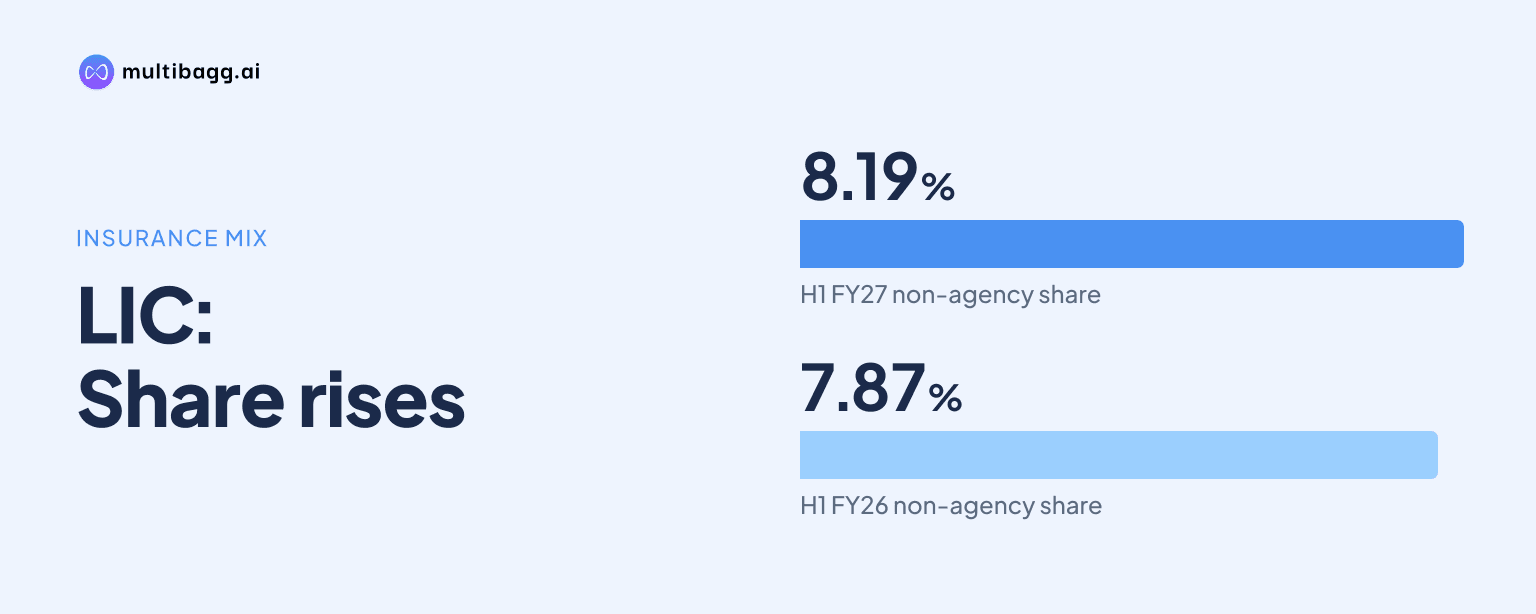
Life Insurance Corporation of India raised non-agency channels to 8.19% of individual new business premium (NBP) in H1 FY27 from 7.87% a year earlier, while its exclusive agency force fell to 14.57 lakh at March 31, 2026 from 14.87 lakh a year earlier. LIC still sourced 91.81% of individual NBP through agents.
Know Life Insurance Corporation of India inside out
Results, valuation, peers and who's buying, in one view.
How much of LIC’s individual NBP comes from non-agency channels?
LIC sourced 8.19% of individual NBP through non-agency channels in H1 FY27, leaving the agency channel with 91.81%. The non-agency share increased by 0.32 percentage points from 7.87% in H1 FY26, while agency declined by the same amount from 92.13%. Thus, agents continued to account for more than nine-tenths of LIC’s individual NBP in the latest half-year period.
LIC’s H1 FY27 mix was also slightly below the full-year FY26 position, when other channels contributed 8.25% and agency contributed 91.75%. Non-agency distribution was therefore 0.06 percentage points lower than in FY26, despite improving from H1 FY26. The change reflected a higher alternate-channel contribution, partly offset by lower bank and digital-marketing shares.
Which channels are driving LIC’s non-agency distribution growth?
Alternates drove the year-on-year rise in LIC’s non-agency mix, increasing to 3.44% of individual NBP in H1 FY27 from 2.67% in H1 FY26. This 0.77 percentage-point gain exceeded the 0.36 percentage-point decline in banks and the 0.09 percentage-point decline in digital marketing. Banks nevertheless remained LIC’s largest individual non-agency component at 4.09% in H1 FY27.
Bancassurance and alternate channels together generated Rs 2,458 crore of individual NBP in H1 FY27, compared with Rs 2,024 crore in H1 FY26, a reported increase of 21.44%. On a full-year basis, the same combined channels generated Rs 5,076 crore in FY26, against Rs 3,496 crore in FY25, a reported increase of 45.19%. These figures show premium growth through bank and alternate channels while their combined share of total individual NBP remained below 10%.
LIC has said it is enhancing its focus on an omni-channel distribution network alongside its field force. At March 31, 2026, the network included 92 bancassurance partnerships, 176 corporate agents including banks, 308 brokers and 167 insurance marketing firms. LIC also reported 39,131 premium points, including 2,487 micro-insurance premium points.
Has LIC’s agency force contracted?
LIC’s exclusive agent count declined by 0.30 lakh in FY26 to 14.57 lakh at March 31, 2026, from 14.87 lakh at March 31, 2025. The FY26 decline followed increases from 12.09 lakh in FY20 to 13.47 lakh in FY23 and 14.15 lakh in FY24. The presentation does not identify a reason for the FY26 reduction.
In contrast, the count for other life insurers rose to 18.36 lakh in FY26 from 16.36 lakh in FY25. LIC reported a 44.25% market share by number of agents at March 31, 2026. Its presentation describes agency as the bedrock of life-insurance distribution globally, a position consistent with the 91.81% agency share of its H1 FY27 individual NBP.
Got a follow-up? Ask IRIS
How is LIC supporting its agency network?
LIC trained 7.81 lakh agents in FY26 through 716 training facilities, comprising eight zonal training centres, 35 sales training centres, 113 divisional training centres and 560 agent training centres. Of the total trained, 1.99 lakh were newly recruited agents and 4,667 met Million Dollar Round Table (MDRT) criteria. The training disclosure covers the period from December 31, 2025 to March 31, 2026.
LIC’s agency base included 52.63% of agents with more than five years of tenure and 47.37% with up to five years. By age, 18% were aged 18 to 30, while 13% each were in the 31-to-35 and 36-to-40 groups. Separately, LIC reported that 76.53% of agents recruited during the disclosed period were aged 18 to 40.
LIC’s employee deployment remained branch-led at March 31, 2026. Branch offices accounted for 80.66% of employees and divisional offices for 13.88%, meaning 94.54% were deployed across those two levels. The organisation had 2,130 branch offices, 113 divisional offices and 1,584 satellite offices under the stated structure.
Where are LIC’s agents and Bima Sakhis expanding reach?
LIC’s agent base became more rural in composition, with rural agents accounting for 53.89% in H1 FY27, compared with 52.85% in FY26 and 48.22% in FY23. Urban agents represented 46.11% in H1 FY27, down from 47.15% in FY26. LIC reported coverage across 36 states and Union Territories and 92% of districts, compared with 82% for the combined sector excluding LIC in the cited industry comparison.
LIC’s Bima Sakhi Yojana, launched on December 9, 2024, is a Mahila Career Agent scheme designed to provide employment opportunities to women. By March 31, 2026, LIC had appointed 3.45 lakh Mahila Career Agents, who had sold 21.94 lakh policies and procured Rs 2,848.36 crore of NBP. Rural areas accounted for 61.16% of policies and 57.72% of premium procured by Bima Sakhis.
The scheme provides a stipend for three years, subject to achievement of specified norms. Its rural policy and premium mix coincides with the increase in LIC’s rural agent proportion between FY23 and H1 FY27. However, the presentation does not disclose the number of active Bima Sakhis at March 31, 2026 or their contribution to H1 FY27 individual NBP.
Conclusion
LIC’s distribution figures show a gradual diversification beyond its agency channel. Non-agency channels rose to 8.19% of individual NBP in H1 FY27, aided by a 21.44% increase in bancassurance and alternate-channel premium, but agency still generated 91.81% of individual NBP. At the same time, LIC’s agency count fell to 14.57 lakh in FY26 while the count reported for other insurers increased to 18.36 lakh.
The next disclosures should indicate whether LIC’s stated omni-channel focus can increase the non-agency contribution beyond the 8.19% recorded in H1 FY27. They should also clarify whether the agency base stabilises after the FY26 decline, particularly as LIC continues agent training, recruitment and the three-year Bima Sakhi stipend scheme subject to specified norms.