










LIC says non-par mix can grow before final RBC rules arrive
Key highlights
- LIC made two pro-forma risk-based capital submissions to the regulator.
- LIC said surplus from its existing non-par book supports continued non-par growth.
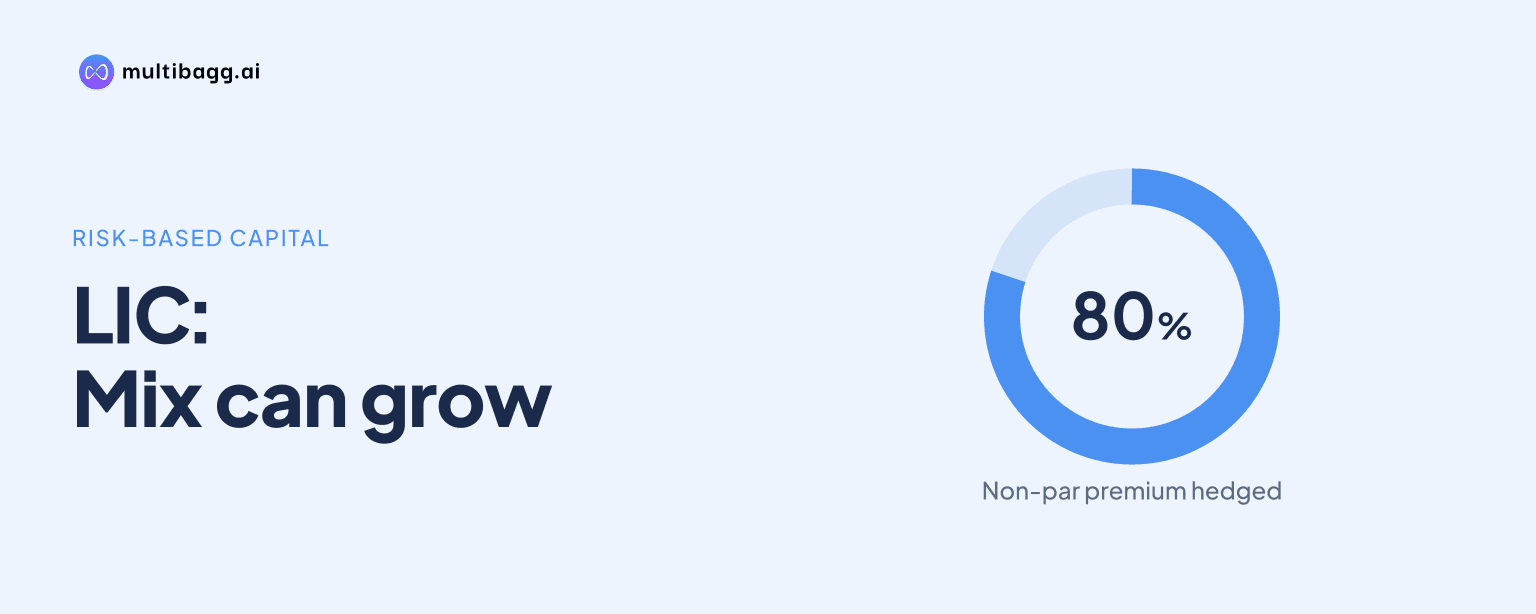
- LIC said it usually hedges around 80% of non-par premium and has hedged maturities up to eight years.
- LIC said VNB margin rose from around 11%-12% at the time of its IPO to almost the industry level.
powered by IRIS
Life Insurance Corporation of India (LIC) said in its first-half FY27 earnings call that surplus from its existing non-par book can support further non-participating product growth, after two pro-forma submissions under risk-based solvency capital (RBC), although the final rules will determine its eventual solvency position and any additional capital requirement.
Know Life Insurance Corporation of India inside out
Results, valuation, peers and who's buying, in one view.
What has LIC submitted under risk-based capital rules?
LIC has made two pro-forma submissions to the regulator under the proposed RBC framework. Management said the purpose of the two exercises was to identify pain points in the proposed approach, with feedback taken from the insurance industry and discussions continuing on those issues. LIC did not describe the submissions as final capital filings or as confirmation of its eventual capital requirement.
LIC said the final outcome will depend on how the RBC guidelines are issued. Management specifically said it cannot yet determine where its solvency position will stand under the final system, or whether there will be an additional capital requirement. The company’s ability to support non-par growth is based on surplus from its existing book, while the final regulatory capital calculation remains unresolved.
The first-half FY27 call placed RBC in a forward-looking context without giving a formal implementation date. An analyst referred to a possible 12-to-18-month timeframe based on prior studies, but LIC did not confirm that timetable. LIC said it is retaining solvency capital while considering how the final RBC guidelines could affect its position.
Can LIC continue increasing its non-par product mix?
LIC said it can continue optimising its product mix towards more margin-accretive lines, including a higher non-par mix. In response to an analyst’s question on incremental growth, management cited a strong existing non-par book and said surplus generated from that book has supported the growth already written. LIC did not provide a numerical target for the future non-par share.
LIC’s stated product plan includes non-par savings products and term insurance, which management identified as higher-margin lines. Management also linked the mix plan to operational efficiency and expense optimisation rather than a single market variable. For FY 2027-28, LIC said its route to margin improvement combines product selection and lower operating costs, while the RBC effect on capital requirements remains uncertain.
LIC described the approach as product optimisation rather than a commitment to stop selling a particular category. Management said it would focus on more margin-accretive product lines while maintaining a positive margin outlook for FY 2027-28. This was not guidance for a specific value of new business, or VNB, margin, and LIC did not say that all product lines would have equal capital efficiency under final RBC rules.
Got a follow-up? Ask IRIS
What could support LIC’s margin outlook through FY 2027-28?
LIC said business mix and operational efficiency are its main controllable margin levers through FY 2027-28. Management said VNB margin had risen from around 11% to 12% at the time of the initial public offering to almost the industry level, attributing the change to its continuing focus on profitability drivers. It also said the risk-free rate, or RFR, is outside LIC’s control.
In group business, LIC said the majority of current sales are fund-based products, while it is also focusing on group annuity and group term assurance. Management said margins are higher in group annuity and group term assurance than in fund-based business. It said group-business margins could improve if those two product lines grow faster than fund-based sales, though no premium, sales or margin split was disclosed.
LIC’s FY 2027-28 outlook therefore relies on mix changes rather than an assumption that interest-rate effects will remain favourable. Management said the availability of an RFR advantage would be known only over time. Its stated plan is to pursue non-par savings, term business, group annuity, group term assurance and expense optimisation even if the RFR contribution changes.
How do hedging and interest rates affect LIC’s non-par business?
LIC said it usually hedges around 80% of non-par premium and had already hedged maturities up to eight years. Management said the hedging programme continued as usual and that LIC was able to hedge at good rates as interest rates hardened. This is a product-management mechanism for non-par business, separate from the unresolved calculation of capital under final RBC rules.
LIC also said a yield-curve movement does not have a uniform effect across products. Management said some points on the curve rose between 30 June and 30 September while other points declined, and the result depends on where the liability profile sits. It cited annuity business as long-term business more affected by the right-hand side of the curve, while shorter-term business uses rates from different maturity points.
That explanation limits a simple comparison between an overall change in market yields and LIC’s margins. Annuity liabilities, shorter-duration products and non-par products can respond to different points of the yield curve. LIC did not quantify the RFR impact by product segment in the first-half FY27 call, but said its margin actions would continue to centre on mix and expenses.
Conclusion
LIC’s disclosed position is that surplus from its existing non-par book can support further non-par growth while final RBC rules are pending. The evidence cited was two pro-forma submissions, continuing emphasis on non-par savings and term products, and a hedging programme covering around 80% of non-par premium with maturities hedged up to eight years.
The next issue to watch is the final RBC guideline and the resulting solvency-capital calculation, which management said cannot yet be determined. LIC has also said it plans to improve margins in FY 2027-28 through product-mix optimisation, faster growth in group annuity and group term assurance than fund-based business, and expense optimisation.