










LIC ANANDA share reaches 17.48% of all individual policies
Key highlights
- LIC completed 12.41 lakh policies under ANANDA in H1 FY27, up from 8.78 lakh in H1 FY26.
- LIC ANANDA’s share of total individual policies increased to 17.48% from 12.10%.
- Activated ANANDA agents rose to 3.20 lakh in H1 FY27 from 2.42 lakh a year earlier.
- LIC says its offices cover 92% of Indian districts, compared with 82% for the combined private sector.
powered by IRIS
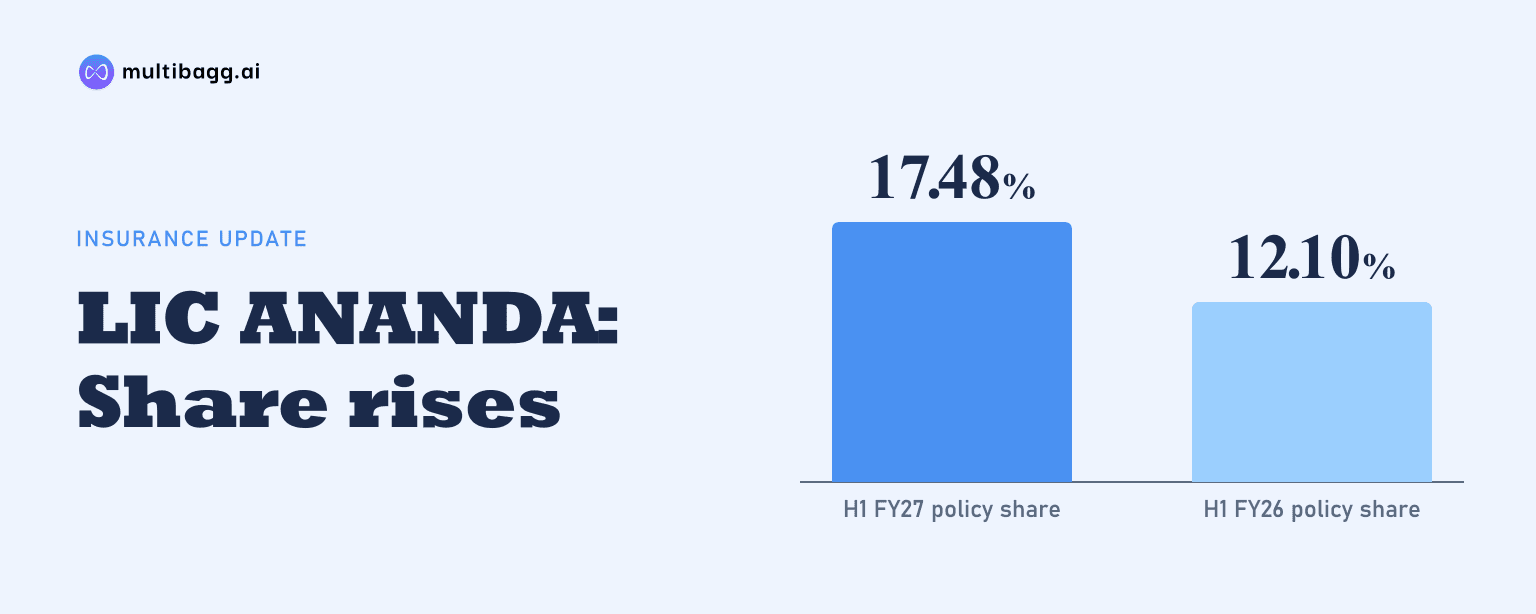
Life Insurance Corporation of India increased ANANDA’s share of total individual policies to 17.48% in H1 FY27 from 12.10% in H1 FY26, while policies completed through the agent digital app rose 41% to 12.41 lakh from 8.78 lakh. Activated ANANDA agents also increased to 3.20 lakh from 2.42 lakh.
Know Life Insurance Corporation of India inside out
Results, valuation, peers and who's buying, in one view.
How did LIC ANANDA usage increase in H1 FY27?
LIC completed 12.41 lakh policies under ANANDA in H1 FY27, compared with 8.78 lakh in H1 FY26, an increase of 3.63 lakh policies or about 41%. ANANDA, expanded by LIC as Atma Nirbhar Agent’s Business Digital App, was launched during COVID to enable agents to conduct business without meeting customers face to face. LIC describes it as a digital app for processing new business digitally.
ANANDA’s share of total individual policies rose by 5.38 percentage points to 17.48% in H1 FY27 from 12.10% a year earlier. Based on LIC’s stated definition, this means ANANDA accounted for about 17.5 of every 100 individual policies in H1 FY27. The measure is a share of total individual policies, not a share of new-business premium or total business value.
LIC presents the policy and agent counts in thousands and notes that figures may not add up because of rounding. Policy completions increased by about 41%, compared with an increase of about 32% in activated agents. The comparison shows that the H1 FY27 expansion combined a larger activated-agent base with faster growth in policies completed through ANANDA.
How many LIC agents were activated on ANANDA?
LIC had 3.20 lakh agents activated on ANANDA in H1 FY27, up from 2.42 lakh in H1 FY26. The increase of 0.78 lakh agents was about 32% across the comparable half-year periods. LIC identifies ANANDA 2.0 as a modern application for agents, brokers, intermediaries, employees and advisors to connect with customers faster while on the go.
LIC says ANANDA 2.0 is intended to acquire, engage and retain customers and is integrated with WhatsApp. Its stated design is to make customer onboarding easier for LIC’s agency force. The 3.20 lakh figure is therefore LIC’s disclosed measure of activated agency-side participation, while 12.41 lakh is the disclosed count of policies completed under the app.
LIC’s agency technology also includes Super Sales Saathi, a separate application with customer and policy lists, views of new and renewal business, commission tracking, and renewal and revival management. Its agency functions include an agent-organisation view and agent-level business insights. LIC does not disclose a Super Sales Saathi user count, so its scale cannot be compared directly with ANANDA’s 3.20 lakh activated agents.
Got a follow-up? Ask IRIS
What does LIC ANANDA do for agents and customers?
LIC says ANANDA enables agents to process new business digitally, while the original app allowed business to be conducted without face-to-face customer meetings during COVID. ANANDA 2.0 broadens the stated user group to brokers, intermediaries, employees and advisors. The application is designed to help these users connect with customers while mobile and is integrated with WhatsApp.
The customer mechanism described for ANANDA is digital onboarding through an app used by the agency force. This differs from LIC DIVE, which LIC describes as a one-stop shop for insurance and policy-servicing needs. LIC says its New Datalake platform is operational, and its lakehouse infrastructure will support development of artificial intelligence and machine learning use cases for business objectives and growth.
LIC DIVE displays functions including customer login, address updates, National Electronic Fund Transfer, or NEFT, updates, premium renewals, and maturity or survival-claim workflows. LIC says these functions are designed to accelerate digital engagement and self-service adoption while improving convenience, operational efficiency and service accessibility. The presentation does not disclose transaction volumes, registered-user totals or service-completion rates for LIC DIVE.
How does LIC ANANDA fit into LIC’s digital process?
ANANDA is one of several LIC tools serving different stages of the insurance relationship, and it is the tool for which LIC reports 12.41 lakh completed policies and a 17.48% individual-policy share in H1 FY27. For individual pension policyholders and LIC staff pensioners, Jeevan Saakshya is a mobile application that facilitates submission of a digital existence certificate.
LIC Mitra, also displayed as LIC MITRA, is an artificial intelligence chatbot with listed functions including policy-status queries, first unpaid-premium dates, last paid-premium dates, form downloads and product information. LIC docK enables online document submission, while Pay Direct supports online premium payment through the customer portal or without login. LIC provides no common usage measure for these tools, so ANANDA’s policy-completion data cannot rank their adoption.
LIC’s wider distribution system remains physical as well as digital. LIC says it is present in 36 states and Union Territories, and its offices cover 92% of Indian districts, compared with 82% for the combined private sector, based on data as of March 31, 2025. In H1 FY27, Uttar Pradesh accounted for 11.92% of LIC’s new-business premium in India and Maharashtra accounted for 11.45%.
Conclusion
LIC’s H1 FY27 data show that ANANDA became a larger part of its individual-policy process: its share rose to 17.48% from 12.10%, policy completions increased by 3.63 lakh to 12.41 lakh, and activated agents increased by 0.78 lakh to 3.20 lakh. The faster increase in completed policies than in activated agents indicates that app-based policy processing expanded alongside agency activation.
The next development to watch is LIC’s planned use of its operational New Datalake platform and lakehouse infrastructure to develop artificial intelligence and machine learning use cases. LIC has not disclosed implementation dates, adoption targets or financial effects for those use cases, and it has not provided comparable usage measures for LIC DIVE, Jeevan Saakshya, LIC Mitra, LIC docK or Pay Direct.