










LIC bancassurance and alternate premium rose 21% in H1 FY27
Key highlights
- LIC’s bancassurance and alternate-channel individual NBP rose 21.44% to Rs 2,458 crore in H1 FY27.
- LIC’s non-agency “Others” category reached 8.19% of individual NBP in H1 FY27, versus 7.87% in H1 FY26.
- Alternate channels increased their individual-NBP share to 3.44% from 2.67%, while banks declined to 4.09% from 4.45%.
- LIC reported 88 bancassurance partnerships and 14.52 lakh exclusive agents as at September 30, 2026.
powered by IRIS
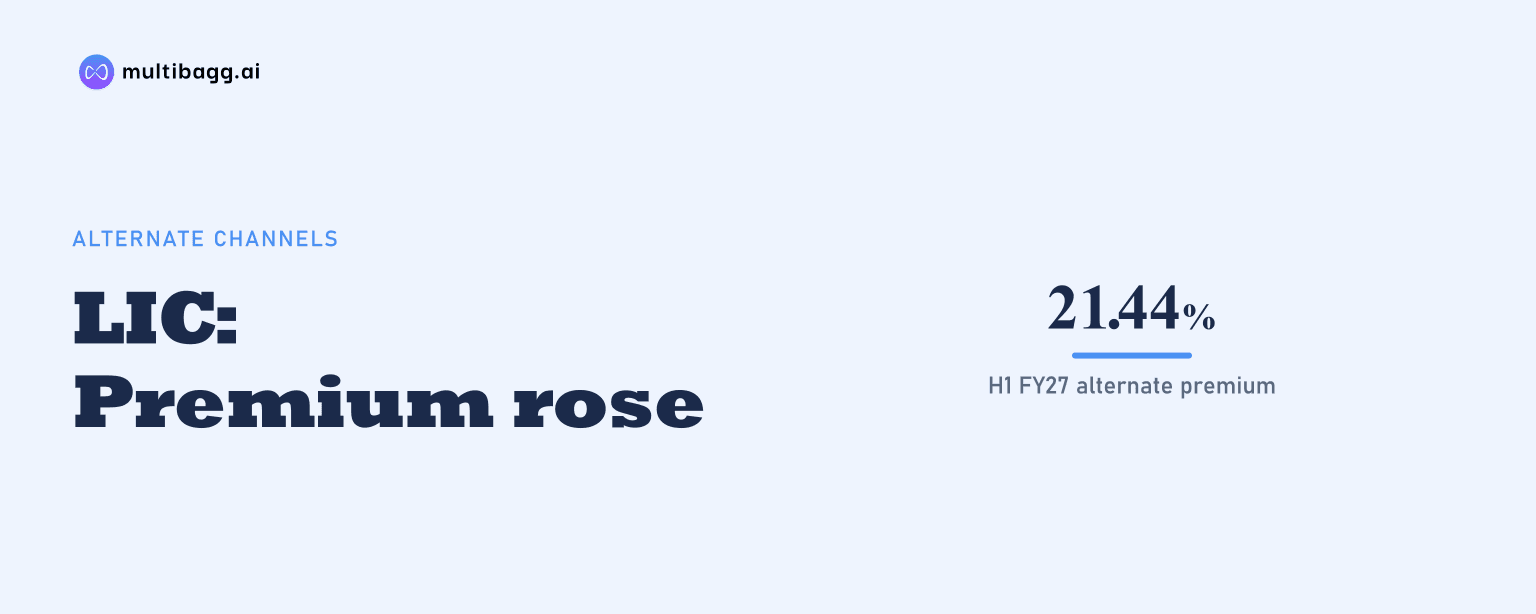
Life Insurance Corporation of India reported Rs 2,458 crore of individual new-business premium (NBP) from bancassurance and alternate channels in H1 FY27, up 21.44% from Rs 2,024 crore a year earlier, while LIC’s full non-agency “Others” category accounted for only 8.19% of individual NBP against agency’s 91.81%.
Know Life Insurance Corporation of India inside out
Results, valuation, peers and who's buying, in one view.
How fast did LIC’s bancassurance and alternate channels grow?
LIC’s bancassurance and alternate-channel individual NBP rose by Rs 434 crore, or 21.44%, to Rs 2,458 crore in H1 FY27 from Rs 2,024 crore in H1 FY26. The presentation reports this combined premium measure separately from its distribution-mix chart, which includes banks, alternates and digital marketing within the “Others” category.
The source does not provide separate individual-NBP values for banks and alternates in either period. It therefore does not show how much of the Rs 434 crore increase came from each route, and digital marketing is not included in the Rs 2,458 crore combined bancassurance and alternate-channel chart.
The reported growth rate applies to premium generated by the two combined routes, rather than to the entire “Others” category. LIC’s H1 FY27 mix data shows that banks, alternates and digital marketing together represented 8.19% of individual NBP, compared with 7.87% in H1 FY26.
What share of individual NBP comes from non-agency channels?
LIC’s non-agency “Others” category accounted for 8.19% of individual NBP in H1 FY27, up 0.32 percentage points from 7.87% in H1 FY26. Agency’s share moved in the opposite direction, declining by 0.32 percentage points to 91.81% from 92.13% over the same periods.
The comparison shows a modest shift toward non-agency distribution, while the sales mix remained agency-led. LIC describes agency as the bedrock of distribution for most life insurers globally, and its 91.81% H1 FY27 contribution was more than 11 times the 8.19% contribution from all other channels combined.
Which non-agency routes changed within LIC’s mix?
LIC’s alternate-channel share rose to 3.44% of individual NBP in H1 FY27 from 2.67% in H1 FY26, an increase of 0.77 percentage points. This was the largest movement within “Others” and offset declines in the shares reported for banks and digital marketing.
Banks accounted for 4.09% of individual NBP in H1 FY27, compared with 4.45% in H1 FY26, while digital marketing declined to 0.66% from 0.75%. The increase in the overall non-agency share to 8.19% was therefore associated with the rise in alternates rather than gains in bank or digital shares.
LIC does not define the products, partners or sales processes included in the “Alternates” label on this page. It does disclose 88 bancassurance partnerships, 176 corporate agents, 304 brokers and 169 insurance marketing firms as at September 30, 2026, but does not assign individual-NBP contributions or growth rates to those outlets.
Got a follow-up? Ask IRIS
How large is LIC’s agency distribution base?
LIC had 14.52 lakh agents exclusive to it as at September 30, 2026, alongside 3,636 branch and satellite offices. The agency network’s 91.81% share of H1 FY27 individual NBP aligns with this physical distribution base of agents, branches and satellite offices.
The source reports that 53.89% of individual agents were in rural areas in H1 FY27, up from 52.85% in FY26 and 48.22% in FY23. Urban agents represented 46.11% in H1 FY27, down from 47.15% in FY26, indicating that the reported agent footprint became more rural over the period.
LIC said 94.30% of employees were deployed at divisional and branch offices as at September 30, 2026, including 80.25% at branch offices and 14.05% at divisional offices. It also trained 2.86 lakh agents in H1 FY27 through 8 zonal, 35 sales, 113 divisional and 560 agent training centres.
What omni-channel network is LIC building?
LIC says it is enhancing its focus on an omni-channel distribution network combining agents with 88 bancassurance partnerships, 176 corporate agents, 304 brokers and 169 insurance marketing firms. As at September 30, 2026, it also reported 1,501 micro-insurance agents and 39,542 premium points, including 504 micro-insurance premium points.
LIC said its network covered 92% of districts across 36 states and Union Territories, compared with 82% for the combined sector excluding LIC as of March 31, 2025. This comparison measures geographic reach rather than premium productivity, so it does not establish the individual-NBP output of bancassurance partnerships or other non-agency outlets.
A further distribution initiative is the Bima Sakhi Yojana, launched on December 9, 2024 as a Mahila Career Agent scheme. Up to September 30, 2026, LIC reported 3.04 lakh Mahila Career Agents in force, 10.64 lakh policies sold and Rs 1,548.80 crore of NBP procured, with rural areas contributing 57.80% of that premium.
Conclusion
LIC’s H1 FY27 data shows that bancassurance and alternate-channel individual NBP increased 21.44% to Rs 2,458 crore and the total non-agency mix rose by 0.32 percentage points to 8.19%. Agency nevertheless supplied 91.81% of individual NBP, while alternates at 3.44% remained smaller than banks at 4.09% despite recording the largest within-category gain.
The next disclosure to watch is whether LIC’s stated omni-channel focus changes the mix beyond the H1 FY27 movement. Management has disclosed 88 bancassurance partnerships and 39,542 premium points, but has not stated a target non-agency share of individual NBP or a timetable for reaching one; future channel-level premium disclosures would clarify the outcome.