










LIC Bima Sakhi reaches Rs 1,548.80 crore by September 2026
Key highlights
- LIC Bima Sakhi had 3.04 lakh Mahila Career Agents in force as of September 30, 2026.
- LIC Bima Sakhi sold 10.64 lakh policies and procured Rs 1,548.80 crore of new business premium.
- Rural areas generated 58.26% of LIC Bima Sakhi policies and 57.80% of its premium.
- LIC’s rural share of individual agents rose from 48.22% in FY23 to 53.89% in H1 FY27.
powered by IRIS
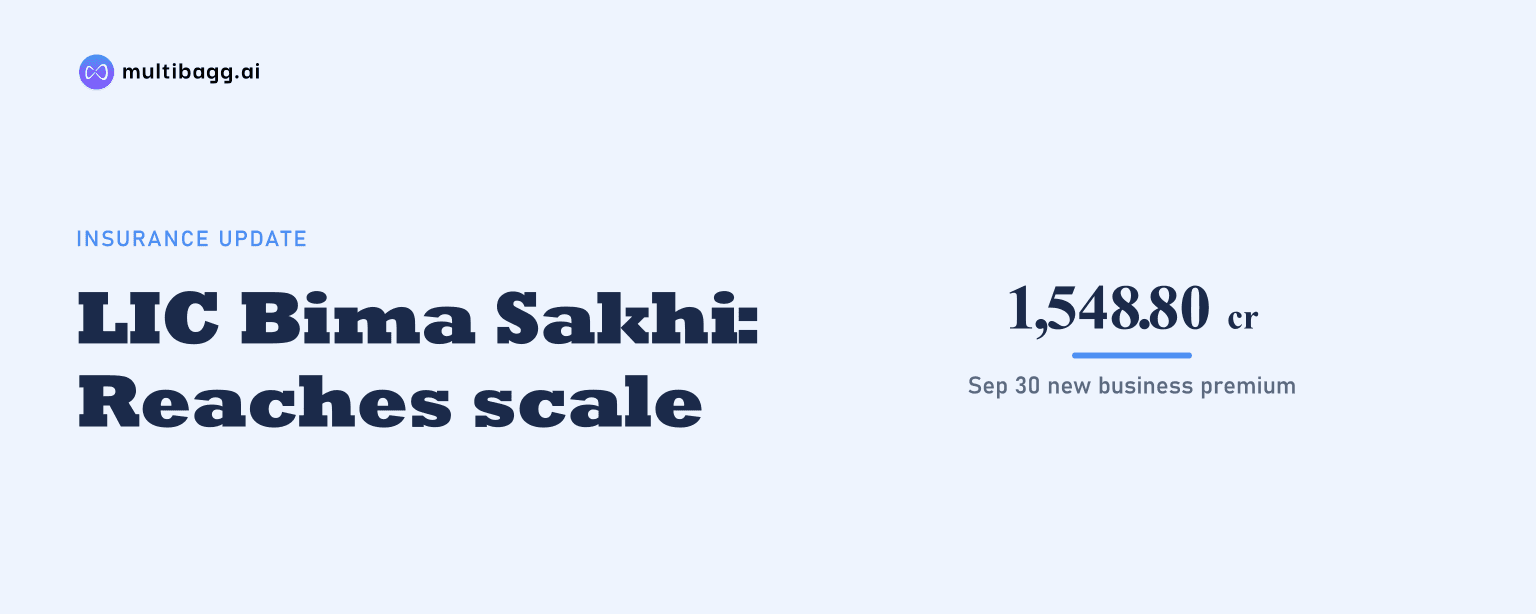
Life Insurance Corporation of India’s LIC Bima Sakhi scheme had 3.04 lakh Mahila Career Agents in force by September 30, 2026, selling 10.64 lakh policies and procuring Rs 1,548.80 crore in new business premium. Rural areas contributed 58.26% of policies and 57.80% of premium procured through the scheme.
Know Life Insurance Corporation of India inside out
Results, valuation, peers and who's buying, in one view.
What has LIC Bima Sakhi delivered since launch?
LIC Bima Sakhi built a 3.04 lakh Mahila Career Agent, or MCA, force from its launch on December 9, 2024 through September 30, 2026. The scheme sold 10.64 lakh policies and procured Rs 1,548.80 crore of new business premium, or NBP, during the disclosed period. LIC describes the programme as an MCA scheme aimed at providing employment opportunities to women.
LIC Bima Sakhi is a three-year stipendiary scheme, with stipend eligibility based on achievement of specified norms. LIC does not disclose the stipend amount, the applicable norms, policy-level premium or persistency data for the scheme. The reported 3.04 lakh MCAs in force therefore show the programme’s operating scale at September 30, 2026, but not its recruitment or retention trend.
How rural is LIC Bima Sakhi’s business?
LIC Bima Sakhi sourced most of its business from rural areas, which accounted for 58.26% of its 10.64 lakh policies and 57.80% of its Rs 1,548.80 crore NBP through September 30, 2026. The rural policy share was 0.46 percentage points higher than the rural premium share, indicating that rural business represented a slightly larger share of policy volume than premium.
LIC does not separately disclose urban policy numbers or urban NBP for LIC Bima Sakhi. It also does not provide a state-level or district-level split of the rural business. The rural percentages measure business sourced through the scheme rather than the geographic location of its 3.04 lakh MCAs.
How does LIC Bima Sakhi fit into LIC’s agency network?
LIC Bima Sakhi operates within LIC’s agency network of 14.52 lakh agents as of September 30, 2026. LIC reported that its agency force represented 43.70% of the life insurance industry’s agents, while 55.90% of LIC agents had more than five years of tenure. LIC also described its agents as exclusive to LIC in its distribution snapshot.
LIC’s total agent count declined from 14.87 lakh in FY25 to 14.57 lakh in FY26 and 14.52 lakh in H1 FY27. Over the same periods, the agent count reported for other insurers rose from 16.36 lakh to 18.36 lakh and then 18.71 lakh. LIC’s presentation nevertheless characterises its network as the largest agency force.
LIC’s agent population included 44.10% with up to five years of tenure and 55.90% with more than five years as of September 30, 2026. The largest age group was 41 to 50 years at 24%, followed by 51 to 60 years at 21%; agents aged 18 to 30 represented 16%. LIC does not disclose the age or tenure mix specifically for LIC Bima Sakhi MCAs.
Got a follow-up? Ask IRIS
Where are LIC’s field resources and training deployed?
LIC deployed 94.30% of employees at its 113 divisional offices and 2,130 branch offices as of September 30, 2026. Divisional offices accounted for 14.05% of employees and branch offices for 80.25%, compared with 2.57% at the central office and 3.13% at eight zonal offices. The field footprint also included 1,584 satellite offices.
LIC’s training network comprised eight zonal training centres, 35 sales training centres, 113 divisional training centres and 560 agent training centres. It trained 2.86 lakh agents in H1 FY27, including 43,483 newly recruited agents, while 2.39 lakh received training in sales and zonal training centres. LIC does not state how many of the trained agents were LIC Bima Sakhi MCAs.
How has LIC’s broader rural agent presence changed?
LIC’s rural share of individual agents rose to 53.89% in H1 FY27 from 48.22% in FY23, while the urban share fell to 46.11% from 51.78%. The network moved from an urban-majority mix in FY23 to a rural-majority mix from FY25, when rural agents represented 51.02% and urban agents 48.98%.
The rural agent proportion increased by 5.67 percentage points between FY23 and H1 FY27. LIC Bima Sakhi’s 58.26% rural policy share is directionally consistent with this broader field-network shift, but the measures are different: one tracks business sourced and the other tracks individual-agent location.
How is LIC changing its distribution-channel mix?
LIC remained agency-led in H1 FY27, with agency accounting for 91.81% of individual NBP, down from 92.13% in H1 FY26. Other channels increased to 8.19% from 7.87%, with banks contributing 4.09%, alternate channels 3.44% and digital marketing 0.66% in H1 FY27.
LIC said it was enhancing its focus on an omni-channel distribution network. Individual NBP through bancassurance and alternate channels increased 21.44% to Rs 2,458 crore in H1 FY27 from Rs 2,024 crore in H1 FY26. As of September 30, 2026, LIC reported 176 corporate agents, 304 brokers, 169 insurance marketing firms and 88 bancassurance partnerships alongside its 14.52 lakh agents.
Conclusion
LIC Bima Sakhi has established a sizeable women-agent programme, with 3.04 lakh MCAs, 10.64 lakh policies and Rs 1,548.80 crore of NBP by September 30, 2026. Its rural business majority, alongside LIC’s increase in rural individual-agent share to 53.89% in H1 FY27, shows that the scheme operates within a distribution network with an increasingly rural field presence.
The next disclosure to watch is whether LIC’s stated omni-channel focus alters a distribution mix in which agency still supplied 91.81% of individual NBP in H1 FY27. LIC has not disclosed a future recruitment, policy-sales or premium target for LIC Bima Sakhi, leaving later operating updates necessary to assess its pace beyond September 2026.