










LIC VNB margin rose 470 basis points on product mix shift
Key highlights
- LIC's VNB margin rose 470 basis points year on year to 22.3% in the six months ended September 30, 2026.
- Business mix added 3.3 percentage points to LIC's VNB margin, while assumptions added 2.8 points and expense realignment reduced it by 1.4 points.
- LIC's non-par savings APE grew 35%, lifting its share to 9.9% from 7.7% of total business.
- LIC's overall expense ratio declined 87 basis points to 10.41% in the first half.
powered by IRIS
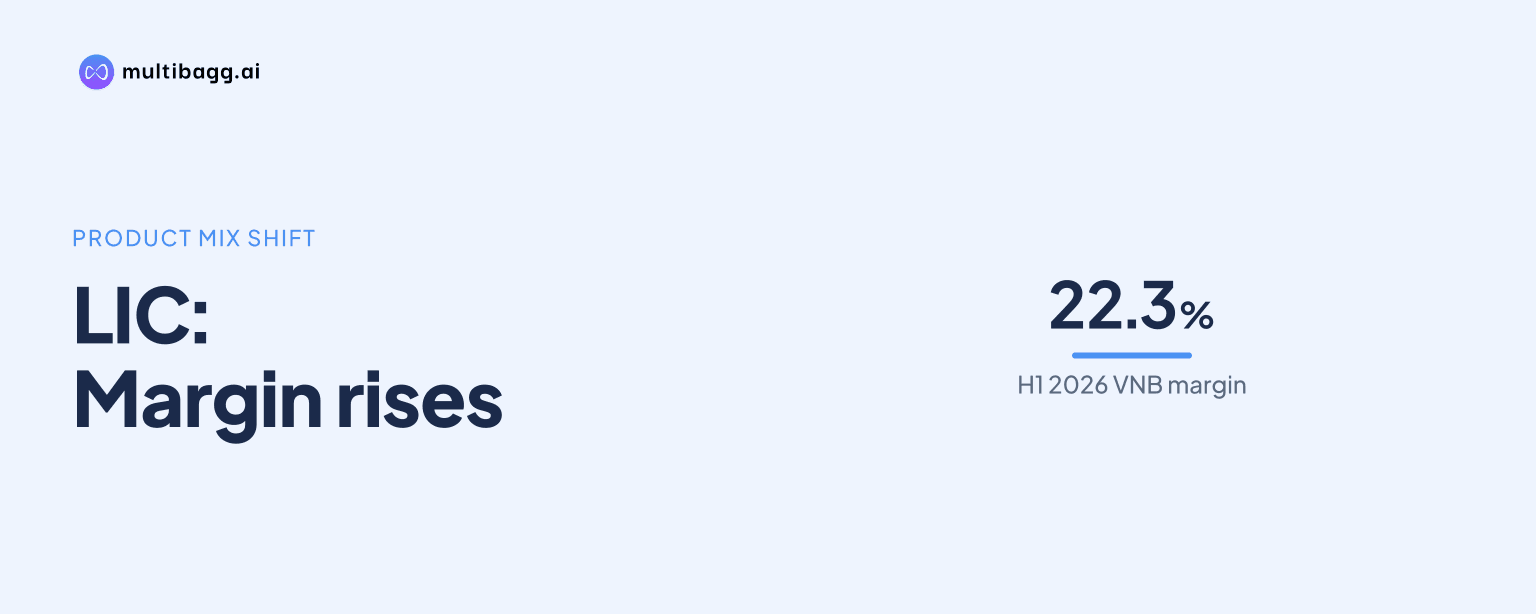
Life Insurance Corporation of India reported a 22.3% value of new business margin for the six months ended September 30, 2026, up 470 basis points from 17.6% a year earlier. LIC said business mix added 3.3 percentage points and assumptions added 2.8 points, more than offsetting a 1.4-point expense realignment impact.
Know Life Insurance Corporation of India inside out
Results, valuation, peers and who's buying, in one view.
What drove LIC's VNB margin expansion?
LIC's VNB margin expansion came from product mix and assumption changes, partly offset by expenses. The margin rose from 17.6% for the six months ended September 30, 2025 to 22.3% for the comparable 2026 period, with business mix contributing 3.3 percentage points, assumptions contributing 2.8 points and expense realignment subtracting 1.4 points.
Value of new business, or VNB, rose 33.95% year on year to Rs 6,846 crore in the six months ended September 30, 2026, while total annualised premium equivalent, or APE, rose 5.72% to Rs 30,696 crore. The faster VNB growth than APE growth coincided with management's stated focus on a more favourable new-business mix and higher policy ticket sizes.
How did LIC's product mix change?
LIC said faster non-par savings growth, term-business growth and higher-ticket policies produced the 3.3-percentage-point business-mix contribution. Non-par savings APE increased 35%, taking non-par business to about 13% of total business from 10.7%, according to the appointed actuary. Non-par savings represented 9.9% of total business, compared with 7.7% a year earlier.
Management said non-par savings and pure protection can improve margins, and it is seeking larger policy tickets across cohorts. Individual business protection APE grew 58.59% to Rs 157 crore in the first half. LIC also linked larger tickets to persistency, stating that higher-sum-assured and higher-premium policies have historically shown better retention than lower cohorts.
The same strategy affected unit-linked insurance plans, or ULIPs. LIC said it encouraged agents to sell larger-ticket ULIPs through monthly electronic National Automated Clearing House, or eNACH, mandates; the monthly eNACH share in ULIPs fell to 14% from almost 24% a year earlier. Management said fewer lower-ticket policies and market conditions contributed to ULIP APE declining by more than 40%.
Why did LIC's margin decline quarter on quarter?
LIC's VNB margin fell to 22.3% in the second quarter of 2026-27 from 22.9% in the first quarter because lower risk-free rates outweighed a positive business-mix effect. Management said business mix added 0.5 percentage points quarter on quarter, while an approximately 40-basis-point decline in the risk-free rate, or RFR, reduced margin by 1.2 points.
The quarter-on-quarter decline differs from the first-half year-on-year increase because the assumptions comparison was still favourable against the prior year. Management said the RFR variation between the first quarter of the prior year and the first quarter of 2026-27 was about 100 basis points higher, while the second-quarter year-on-year variation was positive by 40 to 50 basis points.
LIC said smaller changes to CRNHR and friction-cost assumptions, together with RFR movements, generated the 2.8-percentage-point first-half assumptions contribution. Management did not provide a full-year VNB margin target, but said it expects product mix, higher tickets, digital adoption, centralisation and operating-process changes to support further improvement. It also said RFR movements are outside its control.
Got a follow-up? Ask IRIS
What was the expense impact on LIC's margin?
LIC said expense realignment reduced first-half VNB margin by 1.4 percentage points because expenses in certain business lines were adjusted in March to reflect current experience. This actuarial effect occurred alongside an improvement in the reported overall expense ratio, which fell 87 basis points year on year to 10.41% from 11.28%.
The reported expense ratio and the VNB expense adjustment measure different items. The 10.41% ratio reflects reported first-half expenses relative to business volume, whereas the 1.4-point VNB impact followed the March realignment of expense assumptions for particular lines of business. LIC described the margin effect as an alignment with current experience.
Management said it plans to improve operating efficiency through digital adoption, centralisation and redesigned processes. The agent-assisted ANANDA app completed 12,40,676 policies in the first half, up 41.23% from 8,78,470 a year earlier, while the number of active agents using the app increased 32.49%.
How do persistency and distribution support LIC's plan?
LIC's persistency data were mixed, and management said the quality of retained policies remains relevant to its higher-ticket strategy. On a premium basis, 13th-month persistency was 74.69%, down from 75.29% a year earlier, and 25th-month persistency was 69.62%, down from 71.37%. The 49th-month measure improved to 64.31% from 63.70%.
On a policy-count basis, LIC improved persistency at the 13th, 37th and 49th months. Management said this did not translate into better premium-cohort retention because policies remaining in force were concentrated in lower-sum-assured and lower-premium cohorts. It said it is working to increase new-business sum assured and premium per policy to improve longer-term retention.
Bancassurance and alternate channels accounted for 7.53% of individual new-business premium in the first half, compared with 7.12% a year earlier. Premium collection through these channels grew 21.44% to Rs 2,458 crore. LIC said it plans to raise agent productivity through training, tools and products that meet customer needs, while also seeking greater traction from existing bancassurance partners.
Conclusion
LIC's first-half margin increase combined a more favourable product mix with beneficial actuarial assumptions, lifting VNB margin by 470 basis points to 22.3%. The company reported that non-par savings, term business and larger-ticket policies supported the business-mix contribution, while the March expense realignment partly offset those gains despite the reported expense-ratio decline.
Next, LIC's disclosed plan points to the non-par savings share, protection growth, higher-ticket policy execution and premium-based persistency as key operating measures. Management also expects digital adoption, centralisation and process redesign to improve efficiency, while future RFR movements remain an unresolved factor affecting quarterly VNB margin.