










LIC agency sold 98.4% of policies as alternate premium rose
Key highlights
- LIC agents sold 69.84 lakh policies, or 98.4% of 70.97 lakh new policies, in the six months ended September 30, 2026.
- LIC’s alternate-channel new-business premium rose 48.01% year on year to Rs 1,122 crore.
- Bancassurance and alternate channels accounted for 7.53% of LIC’s individual new-business premium, up from 7.12%.
- LIC’s ANANDA agent-assisted application completed 12.41 lakh policies, up 41.23% year on year.
powered by IRIS
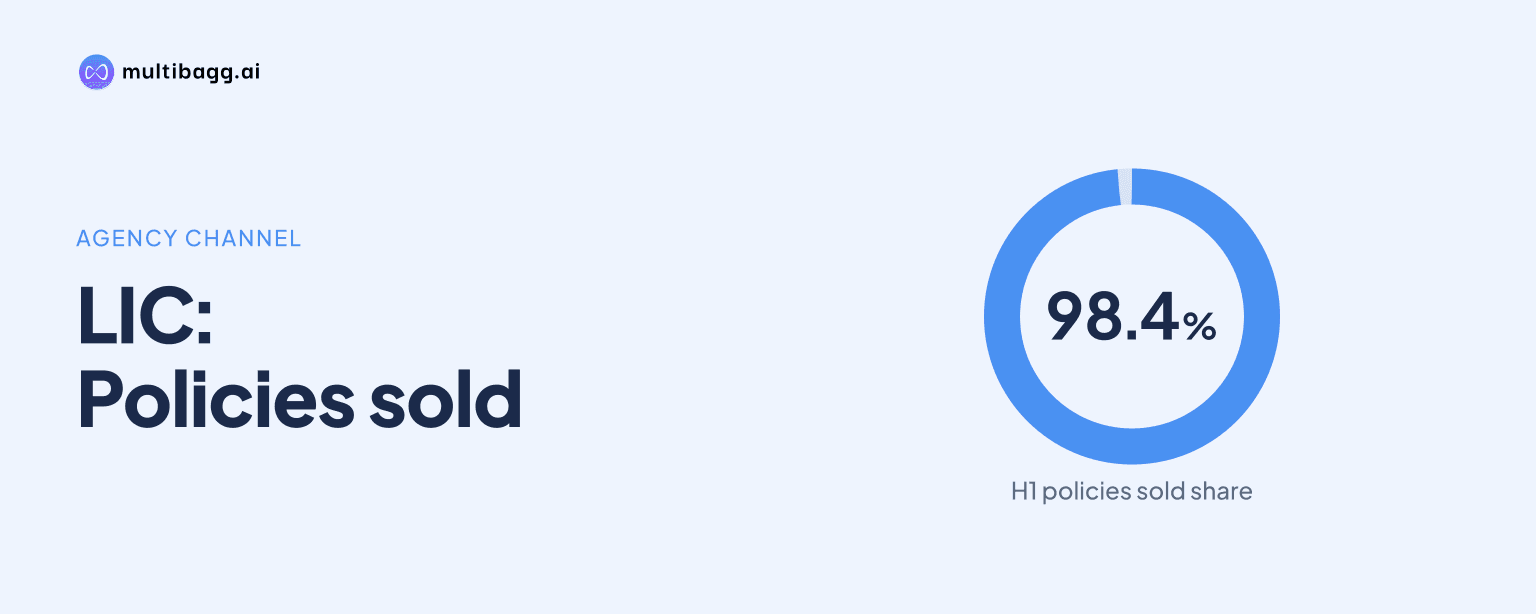
Life Insurance Corporation of India’s agency force sold 98.4% of its 70.97 lakh new policies in the six months ended September 30, 2026, even as alternate-channel new-business premium rose 48.01% year on year to Rs 1,122 crore. LIC’s data show that agents remained the principal source of policies while non-agency premium channels expanded from a smaller base.
Know Life Insurance Corporation of India inside out
Results, valuation, peers and who's buying, in one view.
How dependent is LIC on its agency channel?
LIC remained highly dependent on its agency channel in the six months ended September 30, 2026, with agents selling 69.84 lakh of its 70.97 lakh new policies. The agency share was 98.4%, compared with 71.44 lakh agent-sold policies out of 72.61 lakh total new policies in the corresponding six months ended September 30, 2025.
Total new-policy sales fell by 1.63 lakh year on year, while policies sold by agents declined by 1.60 lakh. The similar movement indicates that the reduction in total policy volume was concentrated in the agency-led distribution base, which continued to account for nearly all new policies in the September 2026 half year.
On a premium basis, LIC said 91.81% of new-business premium came from the agency channel during the period. LIC had 14.52 lakh agents as of September 30, 2026, compared with 14.85 lakh a year earlier, while its share of industry agents declined to 43.70% from 45.86%.
LIC had 60 products available for new business as of September 30, 2026, excluding Pradhan Mantri Jeevan Jyoti Bima Yojana. The range included 38 exclusive individual products, 13 exclusive group products, one common individual and group product, seven individual riders and one group rider.
How fast are LIC’s bancassurance and alternate channels growing?
LIC’s bancassurance and alternate channels collected Rs 2,458 crore in new-business premium in the six months ended September 30, 2026, up 21.44% from Rs 2,024 crore a year earlier. Alternate-channel premium grew faster than bank-sourced premium, rising 48.01% to Rs 1,122 crore from Rs 758 crore.
Bancassurance premium increased 5.56% to Rs 1,336 crore from Rs 1,266 crore. The difference in growth rates shows that the alternate channel was the main contributor to the combined channels’ increase, although bank distribution remained the larger source of premium during the six-month period.
Bancassurance and alternate channels represented 7.53% of individual new-business premium in the six months ended September 30, 2026, up from 7.12% in the previous year’s comparable period. That was a 0.41-percentage-point increase, alongside individual new-business premium growth of 14.86% to Rs 32,725 crore.
Group new-business premium rose 20.63% to Rs 1,11,685 crore during the September 2026 half year, faster than the 14.86% increase in individual new-business premium. LIC’s total premium income increased 11.64% to Rs 2,74,269 crore, compared with Rs 2,45,680 crore in the prior-year period.
Is LIC using digital tools to support agent distribution?
LIC is using digital tools to support agent-assisted customer onboarding, with its ANANDA application completing 12.41 lakh policies in the six months ended September 30, 2026. That was 41.23% higher than 8.78 lakh policies completed through the application in the corresponding period a year earlier.
The number of active agents using ANANDA to onboard customers digitally increased 32.49% during the period. LIC describes ANANDA as an agent-assisted application, so its disclosed 12.41 lakh policy completions indicate digitisation within its existing agent distribution process rather than a separately reported direct-sales channel.
LIC also reported more than 98.44 lakh unique logins for its MyLIC application, which had a 4.7 rating. Its Super Sales Saathi application had a 4.8 Google Play Store rating and was used by 5.38 lakh agents and 16,175 development officers as of the earnings call.
The MyLIC and Super Sales Saathi applications were launched under LIC’s DIVE project, according to management. The reported use of Super Sales Saathi by 5.38 lakh agents compares with LIC’s total agency force of 14.52 lakh as of September 30, 2026, indicating that the application was being used by a portion of the network.
Got a follow-up? Ask IRIS
What role do Bima Sakhis have in LIC’s distribution plan?
LIC had designated 3.04 lakh women as Bima Sakhis as of September 30, 2026, and they sold 10.64 lakh policies in the six months ended on that date. The Bima Sakhi network generated Rs 1,548.80 crore in new-business premium during the six-month period.
Management’s stated objective is to appoint at least one Bima Sakhi in every gram panchayat. LIC reported recruitment in 1.61 lakh of the 2.45 lakh gram panchayats it cited, equal to 66% coverage as of September 30, 2026.
The disclosed Bima Sakhi policy volume was material relative to LIC’s 70.97 lakh total new policies, but the company did not state whether Bima Sakhi sales were included in agency-channel figures or reported in another channel category. It also did not provide productivity data by product, geography, policy tenure or retention cohort.
LIC launched five new non-participating individual products in the six months ended September 30, 2026, including New Jeevan Sathi Single Premium and New Jeevan Sathi Limited Premium on June 1. It launched Jeevan Raksha and Bima Platinum on September 7, with management describing Jeevan Raksha as an initiative to build term-insurance business.
What could change LIC’s distribution economics?
LIC said the proposed distribution-sector regulation consultation paper announced by the Insurance Regulatory and Development Authority of India in September 2026 could affect the sector, but management said the final regulatory outcome remained unresolved. Management said it had gathered views from intermediaries, including agent associations, and submitted its feedback to the regulator.
LIC’s overall expense ratio fell by 87 basis points to 10.41% in the six months ended September 30, 2026, from 11.28% a year earlier. In response to an analyst’s question, management said product pricing depends on total expenses built into a product rather than distribution expenses alone.
Management said it planned to improve agent productivity through training, handholding and tools, while considering product premium-paying terms, policy terms and sums assured suited to customer needs. It also linked potential efficiency gains to higher digital adoption, centralisation and redesigned operating processes.
Management did not announce changes to agent commission structures or product pricing during the call. It said it would seek to protect agent interests within the regulatory framework and expected feedback from LIC and intermediary groups to be considered before final regulations are released.
Conclusion
LIC’s September 2026 half-year data show that distribution diversification is occurring primarily through premium growth rather than a shift away from agents in policy acquisition. Alternate-channel new-business premium rose 48.01% to Rs 1,122 crore, but agents still sold 69.84 lakh policies and accounted for 98.4% of LIC’s 70.97 lakh new policies.
The next disclosed markers are progress toward LIC’s target of at least one Bima Sakhi in each of 2.45 lakh gram panchayats, continued adoption of agent-assisted digital tools, and the final version of the distribution regulations following the September 2026 consultation paper. Management also said its operational plans include further digital adoption, centralisation and measures intended to raise agent productivity.