










LIC cuts monthly ULIP mix to 14% for larger policies
Key highlights
- LIC said monthly eNACH ULIP share fell to 14% from almost 24% one year earlier.
- LIC said ULIP APE declined by more than 40% amid market conditions and lower monthly-mode sales.
- Almost 30% of LIC agents are strongly interested in selling ULIP policies, management said.
- LIC said protection business, though small, is growing by more than 50%.
powered by IRIS
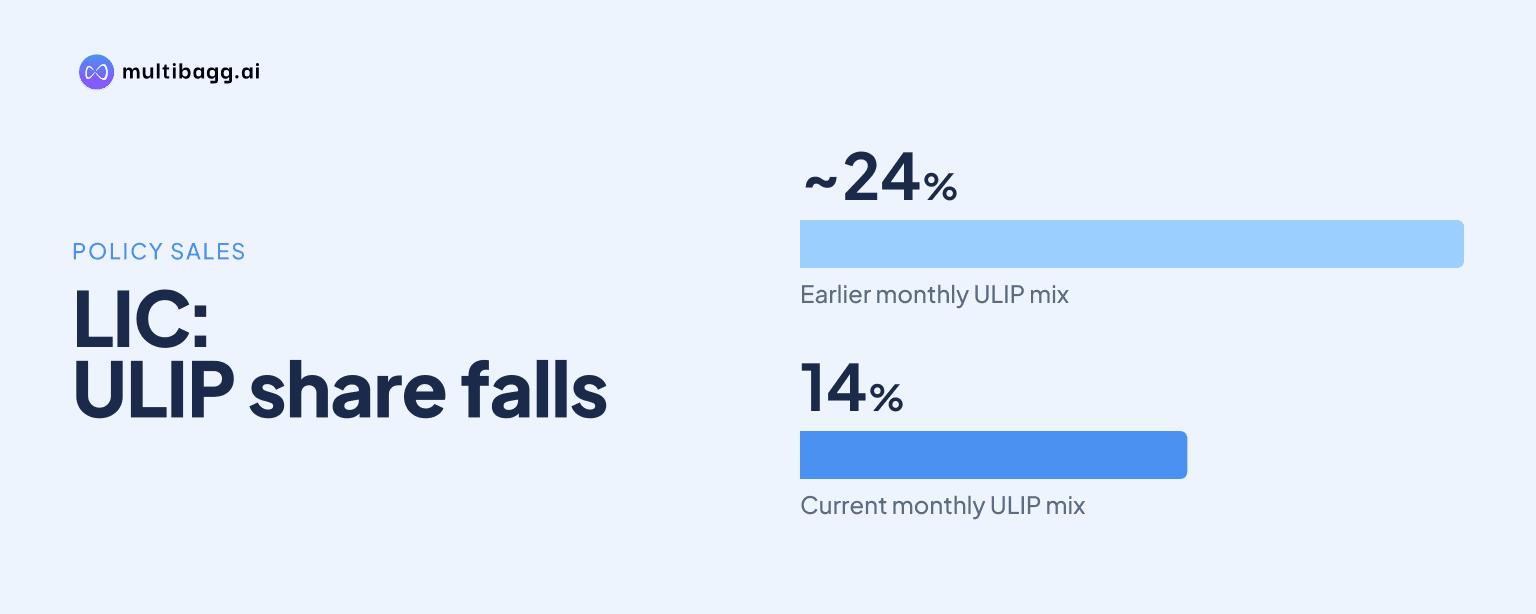
Life Insurance Corporation of India reduced the monthly electronic National Automated Clearing House (eNACH) share of its unit-linked insurance plan (ULIP) business to 14% from almost 24% one year earlier, directing agents toward larger policies. LIC said the move weighed on annualised premium equivalent (APE) growth but was intended to improve persistency and margins.
Know Life Insurance Corporation of India inside out
Results, valuation, peers and who's buying, in one view.
Why did LIC reduce monthly eNACH ULIP sales?
LIC reduced lower-ticket monthly eNACH ULIP sales because management wants agents to write policies with higher premium tickets. Management said it had consciously nudged agents to sell monthly eNACH ULIPs at a higher ticket size, meaning many lower-ticket policies were no longer coming in. It said this effort would continue especially in the second half.
The insurer described the change as a business-quality decision rather than a retreat from ULIPs. Management said higher-premium policies generally have better persistency than lower-premium cohorts and that it was pursuing a higher ticket price in the interests of persistency and margins. The monthly eNACH share fell by about 10 percentage points, from almost 24% to 14%.
How did the ULIP mix shift affect LIC's APE growth?
LIC said the lower monthly ULIP mix contributed to muted APE growth because monthly premiums receive differential treatment in that measure. Management said APE uses 12 times the monthly premium, making the reduced flow of monthly-mode ULIPs more visible in APE than in premium measures based on received collections.
Management said ULIP APE declined by more than 40% amid market conditions and the change in monthly-mode sales. Savings and protection growth was not enough to offset that ULIP APE decline, it said. However, LIC said weighted received premium and individual rated premium were growing comfortably even in the ULIP business.
The current period also followed a high base. Management said ULIP growth in the first half of the previous year was almost 68%, after LIC had repositioned a product it had not sold for a long period. It described current-year ULIP growth as muted across the industry because of market conditions, while saying competitors' growth was not significant.
Can LIC restore ULIP growth in the second half?
LIC expects APE growth to recover in the second half if markets improve, while retaining its focus on higher ticket sizes. Management said it was confident of a comeback in APE growth if markets catch up, but it gave no numerical target for ULIP sales, APE growth or the monthly eNACH mix.
LIC said almost 30% of its agents are strongly interested in selling ULIPs and are already positioned to do so. Management plans to nudge these agents back towards ULIP sales, train more agents and lift productivity in both policy numbers and ticket sizes over the next two to three years, subject to market and regulatory developments.
Management also expects APE and weighted received premium (WRP) growth to converge nearer year-end. It attributed the current gap to ULIP market conditions and the more-than-40% APE decline, while saying savings and protection were showing good growth. That expectation remains dependent on market movement and agent execution.
Got a follow-up? Ask IRIS
Which products support LIC's wider growth plan?
LIC is relying on protection, health and deferred-annuity products alongside a selective ULIP recovery for second-half growth. Management said protection, though small, was growing by more than 50% in the current year and had been a priority, placing ULIPs on the second line. It also said it had collected more than 100,000 assurance-product policies.
Products introduced in October include two health products and New Jeevan Dhara-II, a deferred annuity product. Management said health products were unavailable in the previous year, so their sales can add growth from a lower base. It plans agent training and customer awareness efforts for health cover and pension-oriented deferred annuity sales.
LIC said it had not changed the internal rate of return or made another rate revision on annuity products over the preceding three to six months. Instead, management plans to train more agents in retirement-planning calculations to reach customers seeking a guaranteed lifetime pension. Distribution capability, rather than a revision in annuity terms, is its stated growth lever.
What could influence LIC's margins beyond ULIPs?
LIC said its business-mix interventions contributed positively to value of new business (VNB) margin quarter on quarter, but a 40-basis-point decline in the risk-free rate reduced VNB margin by 1.2 percentage points. Management said the risk-free rate was the only cause of the quarter-on-quarter margin decline and was outside its control.
Management identified non-participating savings, term protection, group annuity and group term assurance as product areas with higher margins than some other categories. Group business is currently led by fund-based products, but management said faster growth in group term insurance and group annuity could improve group margins. It is also progressing office rationalisation, digital adoption and process re-engineering for rollout over the next few quarters.
Conclusion
LIC's reduction in monthly eNACH ULIP mix to 14% from almost 24% represents a stated trade-off between near-term APE growth and higher ticket sizes, persistency and margins. The more-than-40% ULIP APE decline shows the immediate impact of market conditions and lower monthly-mode sales, while management said received-premium measures in ULIPs remained comfortable and protection was growing by more than 50%.
The next developments to watch are second-half ULIP sales as LIC continues its higher-ticket agent push, market conditions affecting ULIP demand, and traction for the two health products and New Jeevan Dhara-II introduced in October. Management also expects office rationalisation, digital adoption and process re-engineering to roll out over the next few quarters.