










LIC new-business margin reaches 22.3% as individual APE is flat
Key highlights
- LIC’s H1 FY27 net VNB margin increased to 22.3% from 17.6% in H1 FY26.
- LIC’s net VNB rose 33.95% to Rs 6.846 thousand crore in H1 FY27.
- LIC’s individual APE increased 0.31% to Rs 17.224 thousand crore in H1 FY27.
- LIC’s group APE grew 13.55% to Rs 13.472 thousand crore in H1 FY27.
powered by IRIS
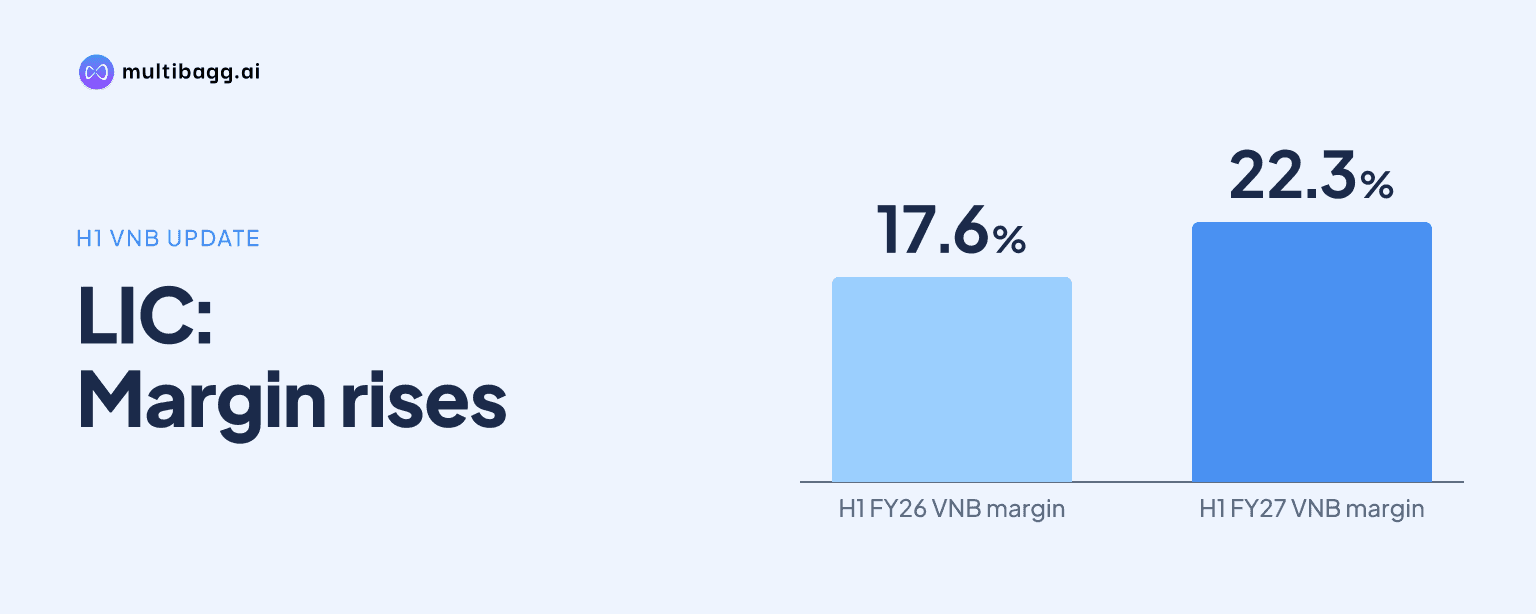
Life Insurance Corporation of India reported a 22.3% net value of new business (VNB) margin in the first half (H1) of FY27, up 4.7 percentage points from H1 FY26, while individual annualized premium equivalent (APE) rose just 0.31% to Rs 17.224 thousand crore. LIC attributed 3.3 percentage points of the margin increase to business mix and 2.8 points to assumptions, partly offset by expenses.
Know Life Insurance Corporation of India inside out
Results, valuation, peers and who's buying, in one view.
How did LIC’s new-business margin reach 22.3%?
LIC reached a 22.3% net VNB margin in H1 FY27, compared with 17.6% in H1 FY26. Net VNB increased 33.95% year on year to Rs 6.846 thousand crore, while total APE, the premium measure used as the margin denominator, increased 5.72% to Rs 30.696 thousand crore. VNB therefore grew faster than the APE base during the period.
LIC’s H1 FY27 VNB walk assigns 3.3 percentage points of the increase to business mix and 2.8 percentage points to assumptions. Expenses reduced the margin by 1.4 percentage points. These movements bridge the 17.6% opening margin at 30 September 2025 and the 22.3% margin at 30 September 2026.
The full-year comparison shows a different composition of margin movement. LIC reported a 21.2% net VNB margin for FY26, compared with 17.6% for FY25, with business mix contributing 3.0 percentage points and economic assumptions contributing 3.4 points. Operating assumptions reduced the FY26 margin by 2.8 percentage points, unlike the single assumptions line reported in the H1 FY27 walk.
What happened to LIC’s individual and group APE in H1 FY27?
LIC’s individual APE was broadly unchanged in H1 FY27, increasing by Rs 54 crore to Rs 17.224 thousand crore from Rs 17.170 thousand crore in H1 FY26. Individual participating, or Par, APE rose 3.91% to Rs 11.364 thousand crore. That increase was largely offset by a 5.98% decline in individual non-participating, or Non-Par, APE to Rs 5.861 thousand crore.
Group APE accounted for most of total APE growth, rising Rs 1.608 thousand crore, or 13.55%, to Rs 13.472 thousand crore in H1 FY27. Total APE increased by Rs 1.662 thousand crore to Rs 30.696 thousand crore. In comparison, full-year FY26 individual APE grew 13.39% to Rs 43.335 thousand crore and group APE rose 26.95% to Rs 23.626 thousand crore.
Within individual Non-Par business, savings APE increased 35.02% to Rs 3.034 thousand crore and protection APE grew 58.59% to Rs 157 crore in H1 FY27. Annuity APE rose 5.33% to Rs 791 crore. However, unit-linked insurance plan (ULIP) APE declined 40.07% to Rs 1.88 thousand crore from Rs 3.137 thousand crore, resulting in lower aggregate individual Non-Par APE despite growth in the other disclosed subsegments.
Got a follow-up? Ask IRIS
Did LIC’s Non-Par share increase in H1 FY27?
LIC’s Non-Par share of India individual APE declined to 34.02% in H1 FY27 from 36.31% in H1 FY26. The Par share correspondingly increased to 65.98% from 63.69%. This shift matched the 5.98% fall in individual Non-Par APE and the 3.91% rise in individual Par APE.
The H1 FY27 Non-Par share nevertheless remained above the 27.69% reported for FY25. In FY26, Non-Par products represented 35.11% of individual APE and Par products accounted for 64.89%. LIC’s presentation states that it is focused on consolidating its increased Non-Par product share, although the H1 FY27 share was 1.09 percentage points below the FY26 level.
The VNB walk records a 3.3-percentage-point contribution from business mix in H1 FY27. LIC does not allocate that contribution among individual Par, individual Non-Par, group, savings, protection, annuity or ULIP business. The presentation therefore identifies an overall mix benefit without specifying which product or segment produced it.
What assumptions and risks affect LIC’s margin outlook?
LIC reported that assumptions added 2.8 percentage points to the H1 FY27 margin and expenses deducted 1.4 percentage points. For FY26, economic assumptions added 3.4 percentage points, while operating assumptions reduced margin by 2.8 points. The disclosed walks show that changes in assumptions were material to both the H1 FY27 and FY26 margin outcomes.
LIC’s sensitivity analysis as at 30 September 2026 shows that a 100-basis-point increase in reference rates would increase the 22.3% base VNB margin by 3.0 percentage points. A 100-basis-point decrease would reduce the margin by 4.4 percentage points. A 10% increase in acquisition expenses would lower margin by 0.6 percentage points, while a 10% increase in policy or premium discontinuance and partial-withdrawal rates would reduce it by 1.2 percentage points.
Persistency measures, which track policy continuation, were mixed in H1 FY27. On a policy-count basis, the 13th-month persistency ratio improved to 67.58% from 63.36% in H1 FY26, while the 25th-month ratio declined to 57.29% from 60.23%. On a premium basis, the 13th-month ratio fell to 74.69% from 75.29% and the 61st-month ratio declined to 61.03% from 63.81%.
Conclusion
LIC’s H1 FY27 results show that the increase in new-business profitability occurred alongside almost unchanged individual APE. Group APE grew 13.55% to Rs 13.472 thousand crore, while business mix and assumptions added a combined 6.1 percentage points to the VNB margin. Those movements helped lift net VNB 33.95% to Rs 6.846 thousand crore despite the 1.4-percentage-point expense effect.
The next disclosed measures to watch are whether LIC consolidates its Non-Par share after it declined to 34.02% in H1 FY27, and how APE develops across savings, protection, annuity and ULIP products. LIC’s 30 September 2026 sensitivity analysis also identifies reference rates, acquisition expenses and discontinuance rates as variables that can alter reported VNB margin.