










NALCO explains ₹317 crore first-half power cost increase
Key highlights
- NALCO reported a ₹317 crore year-on-year increase in H1 2026-27 power and fuel costs.
- Refinery fuel oil contributed ₹256 crore of the H1 cost increase, according to management.
- Grid-power purchases rose to ₹123 crore from ₹50 crore in H1 2025-26.
- Refinery coal stock recovered to around four to five days from one to two days.
powered by IRIS
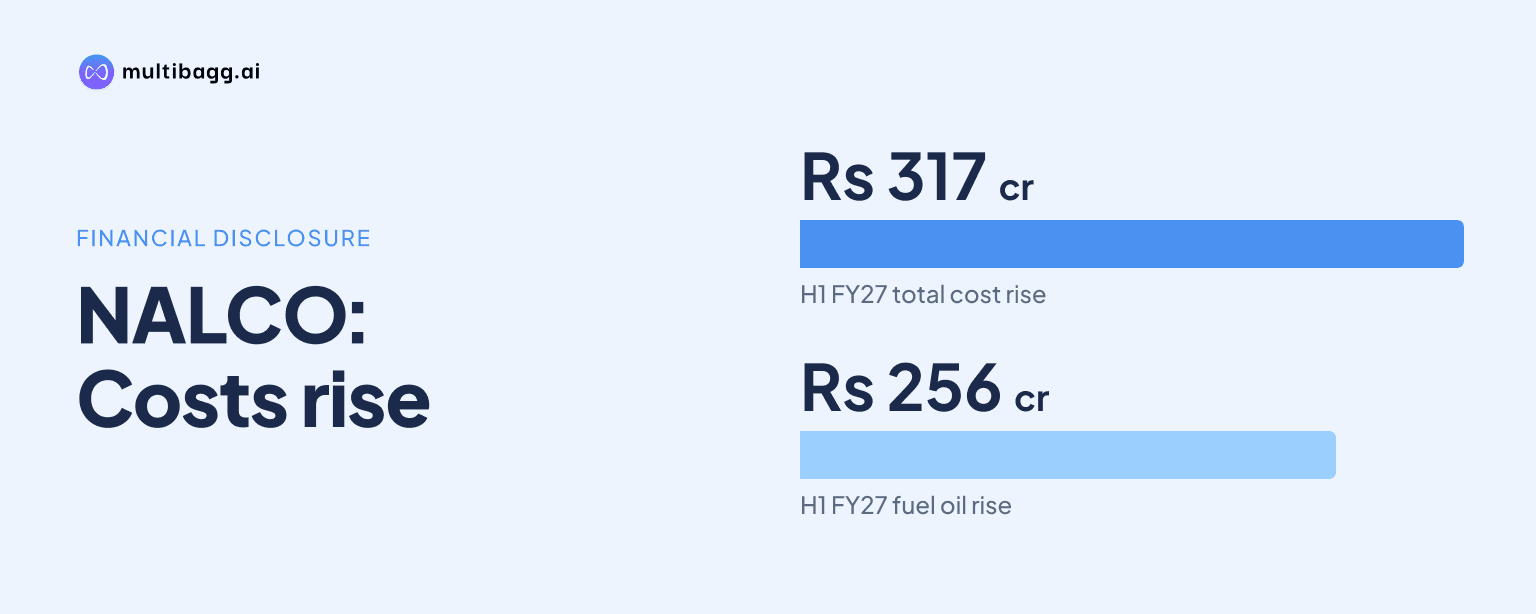
National Aluminium Company Limited said its ₹317 crore increase in H1 2026-27 power and fuel costs was principally caused by ₹256 crore of additional refinery fuel oil and ₹73 crore of extra grid purchases, following coal shortages, rain-related moisture and captive-plant disruptions. Management expects these operating pressures to ease in H2.
Know National Aluminium Company inside out
Results, valuation, peers and who's buying, in one view.
What caused NALCO's ₹317 crore first-half cost increase?
NALCO attributed the ₹317 crore year-on-year rise in H1 power and fuel costs to disruptions in coal availability and higher electricity and boiler-fuel use. Management said rail wagons had been diverted towards integrated power plants because of coal shortages at thermal plants across India, leaving the refinery with inadequate coal deliveries. The comparison was between H1 2026-27 and H1 2025-26, rather than a single monsoon quarter.
The immediate operational effect was lower coal inventory at the refinery, where management said normal stock should be about 15 days but fell to only one or two days. Heavy rains increased coal moisture, requiring additional fuel injection into boilers. Management described this as the main explanation for higher refinery fuel consumption, rather than a permanent change in the refinery's fuel requirement.
How much came from fuel oil and purchased power?
NALCO said refinery fuel oil accounted for ₹256 crore of the first-half increase, making it the largest disclosed contributor to the ₹317 crore rise. Management linked that cost directly to low coal availability and wet coal during the rainy period. It said fuel oil is not required at that level when adequate quantities of suitable coal are available for refinery boilers.
Purchased power was the second major disclosed factor, rising to ₹123 crore in H1 2026-27 from ₹50 crore in H1 2025-26, an increase of ₹73 crore. Management said this power was bought from the grid because of breakdowns at the captive power plant, or CPP, as well as constrained coal availability and coal moisture. The two stated contributors, ₹256 crore and ₹73 crore, are major cost drivers rather than a line-by-line reconciliation of the reported ₹317 crore total.
Why did coal shortages raise NALCO's refinery fuel bill?
NALCO said rail restrictions limited coal supply to its power plant while wagons were directed to integrated power plants. With refinery coal stocks falling from a required average of about 15 days to as low as one or two days, the company had to use more fuel in its boilers. Rainfall worsened the situation because moisture in coal reduced its effective operating quality.
Management said it had appointed consultants and taken other measures to improve wagon management and coal supplies. By the November 3, 2026 call, refinery coal stock had recovered to around four to five days from one to two days. That improvement remains below the 15-day average stock management said it seeks to maintain, but it represents a change from the most constrained point in H1.
Got a follow-up? Ask IRIS
Will NALCO's power and fuel costs fall in H2?
NALCO management said the extra ₹317 crore cost should be addressed in H2 because coal stocks were improving and the exceptional heavy fuel oil use was not expected to recur. It did not give a quantified H2 power-and-fuel-cost target. Its expectation depends on sustaining better coal availability, reducing the impact of wet coal and avoiding further CPP breakdowns that would require purchases from the grid.
Management also said the company had identified technical operating areas for corrective action in H2. One stated target is to reduce caustic soda consumption by at least 7 kilograms over the next six months, alongside reduction plans covering calcined petroleum coke and coal-tar pitch. These measures are separate from the ₹256 crore refinery fuel-oil impact, but management presented them as part of its plan to keep second-half production costs at or below H1 levels.
What does NALCO's coal-production plan mean for costs?
NALCO said captive coal output was about 21 lakh tonnes in H1 2026-27 and that it was operating at the rate needed to meet its full-year plan of 48 lakh tonnes. The planned output is higher than the roughly 40 lakh tonnes reported for the prior year. Management said remaining environmental clearances were at an advanced stage, with state-level clearance obtained and an application made to the Ministry of Environment, Forest and Climate Change.
Management expects those clearances within two months and said it intends to end the year at 48 lakh tonnes of captive coal production. The transcript does not quantify a rupee saving from that volume, but the operational rationale is clear: more available coal would reduce dependence on short-supply conditions that drove fuel-oil consumption and grid purchases in H1. The plan remains contingent on receipt of the pending central clearances.
Did accounting reclassification cause the reported increase?
NALCO said a coal-cost reclassification did not change its overall earnings before interest, tax, depreciation and amortisation, or EBITDA. Previously, the company recorded captive-coal costs in manufacturing or other expenses; it now records them under power and fuel because management considers coal a manufacturing input for aluminium. The corresponding prior period was also reclassified.
Management said it had disclosed this treatment in the FY 2025-26 annual results and is now presenting it in the main profit-and-loss account. As a result, the classification can make the power-and-fuel line appear higher while other manufacturing expenses decline by the same amount. Investors assessing the ₹317 crore H1 increase therefore need to distinguish the disclosed operating pressures, including fuel oil and purchased power, from the accounting presentation change.
Conclusion
NALCO's explanation identifies a specific H1 2026-27 operating chain: restricted rail-borne coal supply and rain-affected coal lowered refinery inventories to one or two days, increasing heavy fuel oil use by ₹256 crore, while CPP breakdowns and coal constraints lifted grid-power purchases by ₹73 crore. The reported ₹317 crore increase was therefore tied chiefly to refinery fuel and external electricity rather than to the captive-coal accounting reclassification.
The next point to watch is whether NALCO can lift refinery coal inventory beyond the four-to-five-day level reported on November 3, 2026 and progress towards its 15-day norm. Management also plans 48 lakh tonnes of captive coal production for the year, subject to central environmental clearance, and has targeted at least a 7-kilogram reduction in caustic soda consumption over the next six months.