










NALCO Sees Stable H2 Alumina Margins Despite Higher Costs
Key highlights
- NALCO expects second-half alumina margins to remain stable at the second-quarter level.
- Management expects Rs 300 crore to Rs 350 crore of additional second-half profitability.
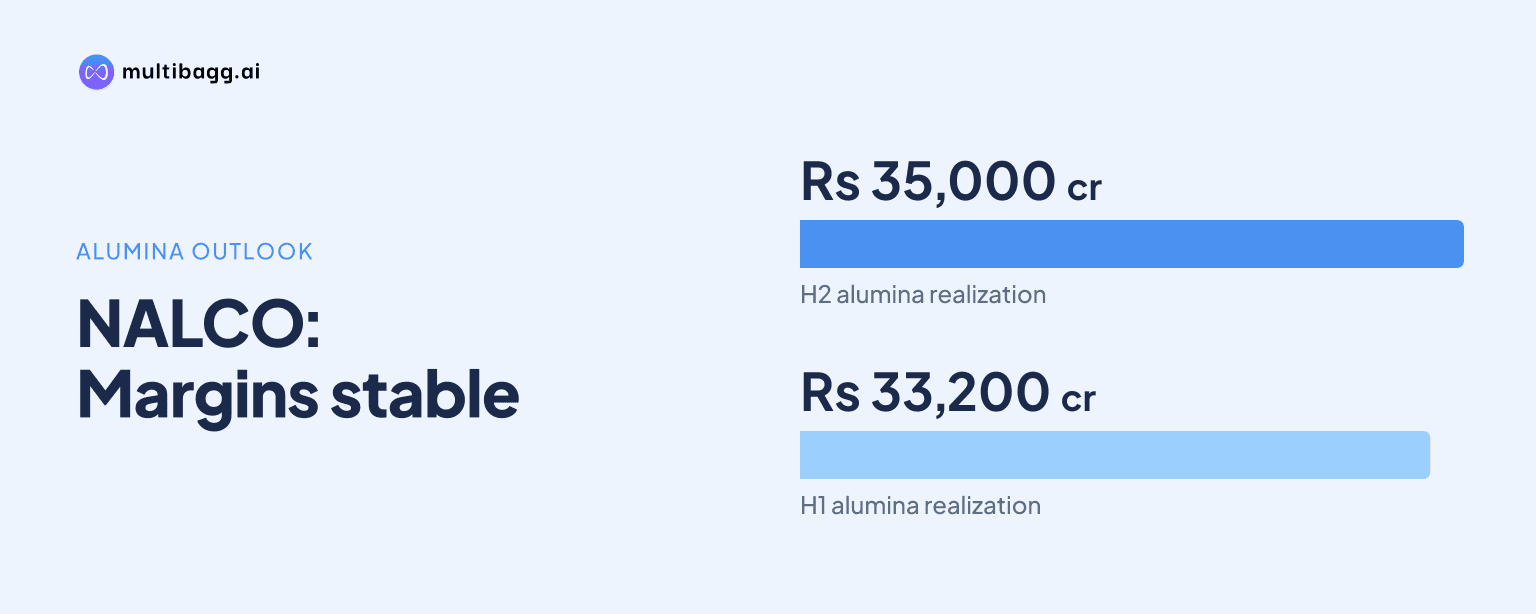
- NALCO expects H2 alumina realization of about Rs 35,000 versus Rs 33,200 in H1.
- Caustic soda is projected at about Rs 49,000 in Q3 versus Rs 46,900 in H1.
powered by IRIS
National Aluminium Company Limited expects alumina margins in the second half of the current fiscal year to remain stable at the second-quarter level, with management citing Rs 300 crore to Rs 350 crore of additional profitability from fifth-stream output, operating improvements and a first-half royalty impact that it does not expect to recur.
Know National Aluminium Company inside out
Results, valuation, peers and who's buying, in one view.
Will NALCO's alumina margins stay stable in the second half?
Yes. NALCO said it expects second-half alumina margins to remain stable at the second-quarter level despite higher costs for caustic soda, calcined petroleum coke and fuel oil. Management based this assessment on a planned combination of new refinery output, a recovery in operating performance and the non-recurrence of an additional royalty impact recorded in the first half.
Management identified the fifth refinery stream as the first contributor. It said the new stream would add 2 lakh tonnes of alumina output and could contribute Rs 150 crore to profit before tax, or PBT, on a financial-year basis. The estimate is tied to the planned start of production in late December or early January, after integrated trials are completed.
The second contributor is an improvement in techno-economic performance after an adverse first half. Management said actions to improve operating efficiency could add at least Rs 100 crore to profit margin in the remaining half. It also said the additional royalty impact associated with an Odisha government claim in the first half would not be repeated in the second half.
NALCO combined these factors into an expected Rs 300 crore to Rs 350 crore of additional profitability in the second half. This is management's operating outlook rather than a fixed earnings forecast, because alumina pricing remains dependent on demand from new smelters and on shipping conditions affecting deliveries to the Middle East.
Which costs are rising for NALCO's alumina business?
NALCO said caustic soda, calcined petroleum coke, or CP coke, and fuel oils were the main sources of higher raw-material costs compared with the 2025-26 average. Caustic soda averaged about Rs 42,000 in 2025-26, increased to Rs 46,900 in the first half of the current year and was projected at about Rs 49,000 in the third quarter.
CP coke rose more sharply across the same periods. Its average price was about Rs 44,600 in 2025-26, moved to Rs 63,700 in the first half and was projected at Rs 70,600 for the third quarter. Management also cited increases in high fuel oil and light diesel oil prices, which it said were up by around 15%.
The third-quarter caustic-soda projection is Rs 2,100 above the first-half average, while the CP coke projection is Rs 6,900 higher. An analyst said production cost had risen by roughly US$75 to US$100 at the earnings-before-interest-and-tax level, but NALCO did not provide its own cost-per-tonne figure in this exchange.
How does NALCO plan to contain higher caustic-soda costs?
NALCO plans to offset higher caustic-soda prices by recovering more caustic soda and improving refinery efficiency during the dry season. Management said rainfall in the first half limited caustic-soda recovery from the slag pond, described in the call as a rainwater pond, and prevented some corrective operating actions during the rainy period.
Management targets a reduction of 6 kilograms to 7 kilograms in caustic-soda consumption in the refining process. It said dry-season production should be higher and that corrective action in the caustic-soda area would improve techno-economic performance that was not maintained in the first half.
The company indicated that these actions could lower alumina cost by about Rs 500 to Rs 1,000, while management elsewhere referred to a cost-reduction target of Rs 400 to Rs 500. The range reflects comments from different speakers during the call, but both indicate that NALCO is relying on lower consumption and operating improvements rather than a decline in caustic-soda prices.
The operating programme matters because management projected caustic soda at Rs 49,000 in the third quarter, compared with Rs 46,900 in the first half. NALCO therefore expects its margin stabilisation measures to work alongside continued raw-material inflation, rather than after input costs have eased.
Got a follow-up? Ask IRIS
What alumina realization does NALCO expect in the second half?
NALCO expects average alumina realization of around Rs 35,000 in the second half, compared with Rs 33,200 in the first half. The implied increase is Rs 1,800, which management described as an increase of about Rs 2,000, while it also targeted lower alumina production cost through efficiency measures.
Management said first-quarter alumina spot prices averaged about US$324 per tonne and that second-quarter conditions improved. It attributed higher alumina pricing to refinery issues in China, Rusal and Australia, while saying the second-half average should be broadly similar to the situation in the second quarter.
The pricing outlook is qualified by shipping constraints. Management said Middle East smelters need alumina, but vessel restrictions through the Strait of Hormuz have increased insurance and freight costs, leading spot buyers to quote lower prices. It said alumina prices could increase further if shipping conditions improve.
NALCO also noted that projections had pointed to a global alumina surplus of 1.6 million tonnes in the 2026-27 financial year. Management expects smelter starts in the Middle East and Indonesia to absorb some supply, but said the pace of demand recovery depends on the ability of Middle East smelters to secure alumina and increase production.
What does the fifth stream mean for NALCO's output plan?
NALCO indicated a full-year alumina production expectation of 2.45 million tonnes, after discussion during the call of a 2.4 million-tonne level. Management said the existing four-stream refinery was operating at a rate of 2.3 million tonnes, with the fifth stream expected to provide a partial-year contribution after its planned January start.
The fifth stream was in advanced mechanical completion, with 34 to 35 of about 50 packages completed. Management said three to four packages on the critical path were about 90% to 92% physically complete, and that it had begun no-load trials for completed packages before the planned integrated trial.
Management said the stream may take three to five months after production begins to reach 100% of rated capacity. It therefore expects production of about 0.75 million tonnes to 0.8 million tonnes from the new stream in the following year, rather than 1 million tonnes, before moving toward full capacity from the next year onward.
The timing is central to the Rs 150 crore PBT contribution cited in the margin outlook. A later start than late December or early January, or a longer ramp-up than three to five months, would delay the additional alumina volume management expects to support second-half profitability.
Conclusion
NALCO's second-half margin outlook combines higher expected alumina realization of about Rs 35,000, lower targeted caustic-soda consumption and a partial contribution from the fifth refinery stream. Management expects these operating factors, together with the absence of the first-half royalty impact, to generate Rs 300 crore to Rs 350 crore of additional profitability while margins remain around the second-quarter level.
The next disclosures to watch are the planned late-December or early-January start of the fifth stream, its three-to-five-month ramp to rated capacity, and progress toward reducing caustic-soda consumption by 6 kilograms to 7 kilograms. Management also identified Strait of Hormuz shipping restrictions as an unresolved factor for alumina demand, freight costs and spot-market pricing in the second half.