










PDS French mandate covers Rs 5,500 crore annual sourcing volume
Key highlights
- PDS said its French retailer mandate is a five-year contract covering about Rs 5,500 crore of annual sourcing volume.
- Management expects nearly Rs 2,000 crore of French retailer sourcing volume in the contract's first year.
- PDS reported H1 FY27 revenue of Rs 7,876 crore, up 23% year-on-year.
- PDS moved from net debt of Rs 105 crore in March 2026 to net cash of Rs 154 crore in September 2026.
powered by IRIS
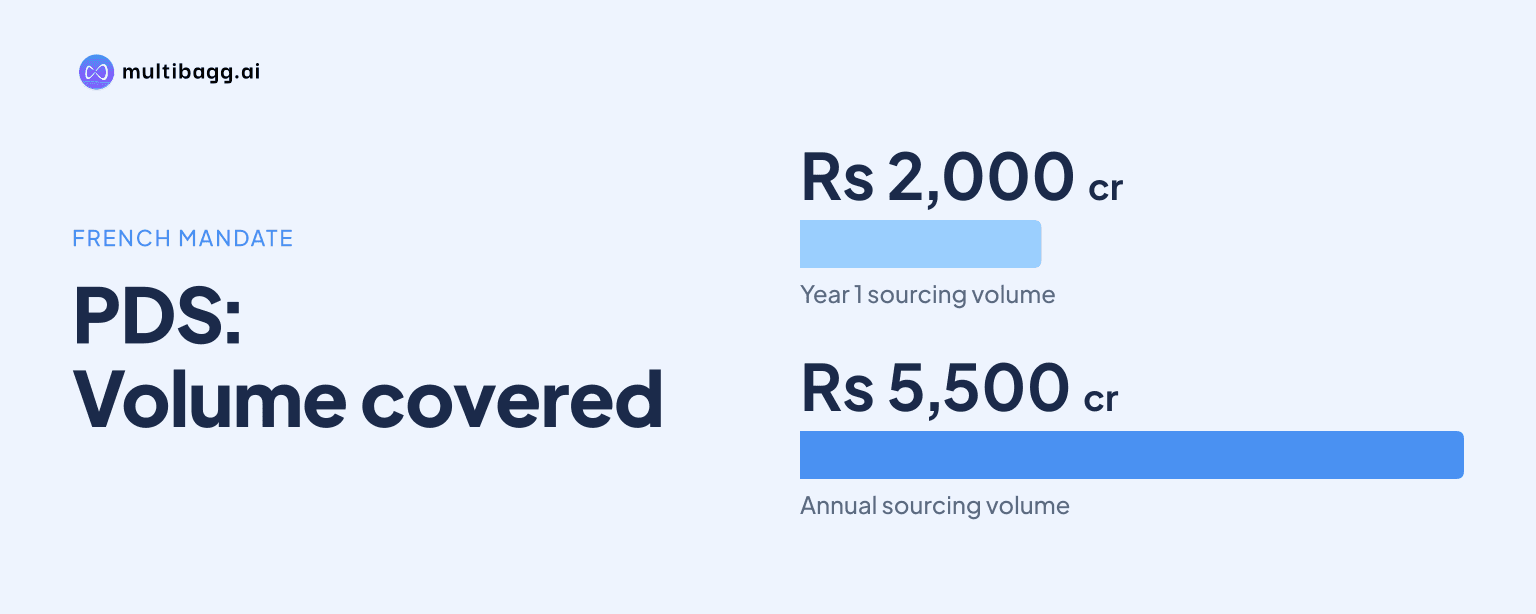
PDS said its five-year French retailer Sourcing as a Service mandate covers about Rs 5,500 crore of annual sourcing volume, with nearly Rs 2,000 crore expected in its first year. Management said the contract was entering execution and had made no meaningful contribution to H1 ended September 2026 gross merchandise value.
Know PDS inside out
Results, valuation, peers and who's buying, in one view.
What does PDS's French retailer mandate cover?
The mandate covers management of about Rs 5,500 crore of annual sourcing volume under a five-year contract. PDS described the arrangement as Sourcing as a Service, under which it runs a retailer's sourcing operation rather than acting only as a manufacturer or trading company. The retailer was not named during the call, but management described it as France's second-largest retailer.
The Rs 5,500 crore figure is managed sourcing volume, not annual revenue that PDS will necessarily recognise. In its discussion of gross merchandise value, or GMV, management said the French retailer order would represent nearly Rs 2,000 crore in the first year. That indicates that the programme is expected to enter execution progressively rather than add its full annual managed volume immediately.
How does the French retailer contract fit PDS's growth plan?
PDS said the contract supports its shift from product-led activity to service-led relationships with large retailers. Management said it offers both Sourcing as a Service and Buying as a Service, seeking to run retailers' sourcing or buying functions. The five-year French arrangement is the disclosed example of this approach, which management said can create more predictable revenue streams.
Management linked the mandate to entry into a country where PDS had “hardly any business” previously. It said winning the sourcing operation of France's second-largest retailer had started conversations with other retailers, but did not disclose further signed mandates, customer names or volumes. The Rs 5,500 crore annual figure therefore applies to one disclosed contract rather than a broader French order pipeline.
PDS also placed the contract alongside its vertical-growth strategy. Pallak Seth said the top 20 existing verticals were growing organically at about 5% to 7%, while businesses started in the last three to four years were growing faster after passing funding, customer-engagement and factory-approval stages. Management said this mix could help sustain momentum over the next couple of years, while acknowledging difficult market conditions.
How much of the French contract is in PDS's current numbers?
The French retailer mandate did not make a meaningful contribution to Rs 11,366 crore of GMV that PDS executed in H1 ended September 2026, according to management. H1 GMV rose 12.5% from Rs 10,100 crore in the corresponding prior-year period. Management said both the French order and a separate newly contracted US customer order were largely outside the reported H1 GMV.
PDS reported H1 FY27 revenue of Rs 7,876 crore, up 23% year-on-year. Q2 FY27 revenue was Rs 4,432 crore, up 29% quarter-on-quarter and 30% year-on-year. The sourcing segment generated Rs 7,542 crore of H1 revenue, up 25% year-on-year, while manufacturing reported Rs 452 crore of revenue and Rs 26 crore of earnings before interest and tax, or EBIT, at a 5.8% margin.
The first-year French estimate of nearly Rs 2,000 crore should also be assessed against current order visibility. Sanjay Jain said the order book was 13% higher and offered visibility for roughly nine months, following H1 revenue growth of 23%. He said PDS aimed to remain near maintainable mid-teens growth, while cautioning that order-book levels can fluctuate with seasonality in Q4 and the following Q1.
Got a follow-up? Ask IRIS
What financial progress did PDS report as execution starts?
PDS reported Q2 FY27 earnings before interest, tax, depreciation and amortisation, or EBITDA, of Rs 153 crore, up 49% year-on-year, at a 3.5% margin. The margin was 44 basis points above the prior-year quarter and 66 basis points above Q1 FY27. For H1 FY27, EBITDA was Rs 249 crore, up 62%, while margin expanded 77 basis points to 3.2%.
Profit after tax, or PAT, was Rs 70 crore in Q2 FY27, up 144% quarter-on-quarter and 44% year-on-year, at a 1.6% margin. H1 PAT was Rs 98 crore, up 44%, with a 1.3% margin. Gross margin held at 20% in Q2, while H1 gross margin was 20%, up 37 basis points year-on-year, and gross profit grew 25%.
The balance sheet also changed during H1 FY27. Net working capital moved to negative five days in September 2026 from positive four days in March 2026, while PDS moved from net debt of Rs 105 crore at March-end to net cash of Rs 154 crore at September-end. The board considered an interim FY27 dividend of Rs 2.2 per share, 33% higher than the previous year.
What does PDS expect to watch as execution starts?
Management said it aims to improve EBITDA margin by at least 50 to 70 basis points annually and PAT margin by 50 to 75 basis points a year. Sanjay Jain identified a PAT margin closer to 3% as an intermediate objective over two to three years. These are management objectives rather than formal revenue or earnings guidance for the French retailer mandate.
Cost control remains part of that plan. Employee expense was Rs 396 crore in Q2 FY27, up 17% quarter-on-quarter, partly because annual increments and incentive payouts were moved from October to July. Sadik Sunasara said management did not expect overall employee-cost growth above 5% to 7% in FY27 and was seeking savings as Q3 and Q4 progress.
Other expenses were Rs 340 crore in Q2, up 33% quarter-on-quarter, reflecting freight, licence and marketing fees, and costs associated with onboarding new software-as-a-service businesses. Management said some other expenses were semi-variable and could decline gradually as operating leverage develops. That outcome matters to the stated annual margin-improvement objectives as the French mandate moves into execution.
PDS also identified an unresolved business issue outside the French contract. Ted Baker's H1 income from operations rose to Rs 268 crore from Rs 205 crore, while its loss narrowed to about Rs 11 crore from Rs 30 crore. Management said it was evaluating options with Authentic Brands Group, including a third-party tie-up, cost rationalisation or relocation, to bring the operation to breakeven during the financial year.
Conclusion
The French retailer mandate gives PDS a disclosed five-year Sourcing as a Service contract covering about Rs 5,500 crore of annual managed volume, with nearly Rs 2,000 crore of first-year volume expected. Its significance is both its scale and its structure: the mandate advances PDS's effort to operate sourcing and buying functions for retailers while H1 FY27 results showed 23% revenue growth, a 3.2% EBITDA margin and Rs 154 crore of net cash.
The next measure to watch is execution, because management said the French order had no meaningful contribution to H1 GMV of Rs 11,366 crore. Investors can also track whether the 13% higher order book supports PDS's mid-teens growth objective, whether annual margin-improvement plans progress, and whether management reaches a solution for the loss-making Ted Baker operation during FY27.