










PDS Limited targets manufacturing margin recovery through mix
Key highlights
- An analyst cited PDS manufacturing margin declining from about 8% to 2.8% in the quarter.
- PDS said manufacturing revenue was almost flat in H1 compared with the same period last year.
- PDS signed its Busana Group partnership in July to pursue higher earning-per-minute Bangladesh orders and worker skill upgrades.
- PDS said Knit Gallery was growing while Bangladesh manufacturing was flat across its three-factory portfolio.
powered by IRIS
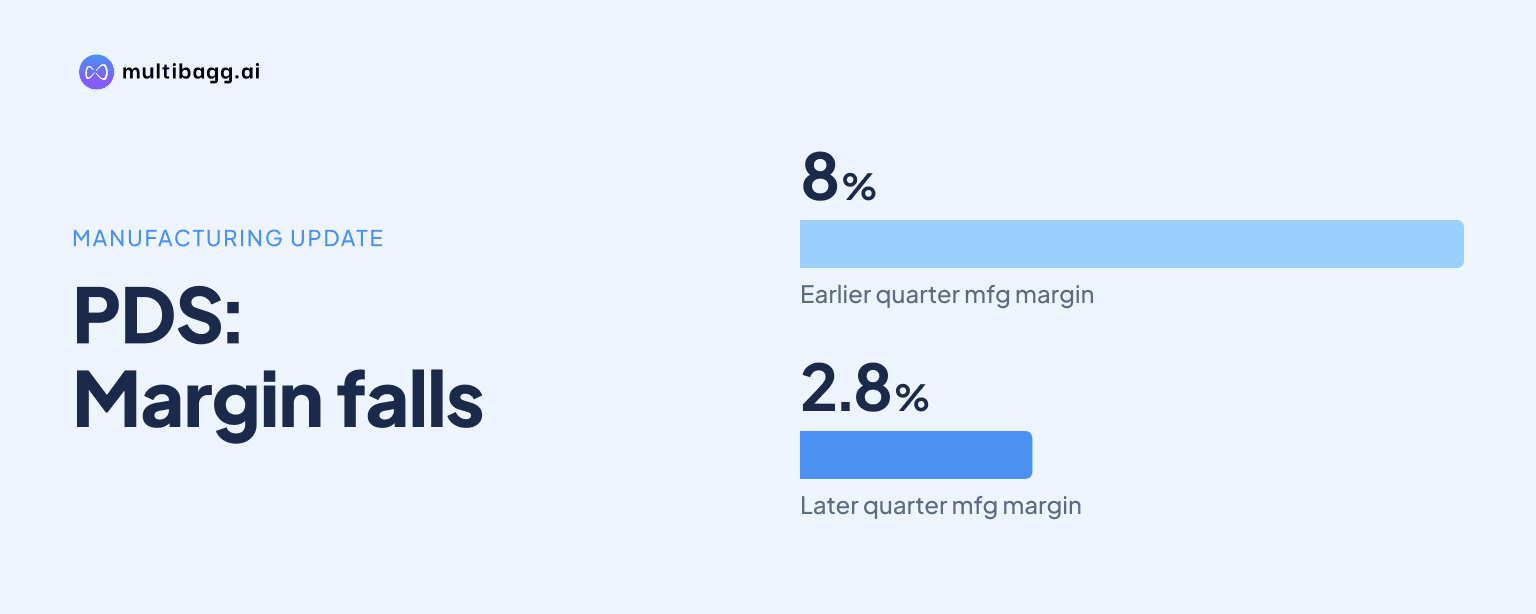
PDS Limited plans to restore manufacturing profitability by shifting Knit Gallery toward value-plus and fashion customers and using its July Busana Group partnership for higher earning-per-minute orders and worker skills, after an analyst cited a margin decline from about 8% to 2.8% in the quarter.
Know PDS inside out
Results, valuation, peers and who's buying, in one view.
Why did PDS manufacturing margin fall to 2.8%?
PDS said manufacturing revenue was almost flat in H1 compared with the same period last year, while an analyst on the call described the segment’s margin as declining from approximately 8% to 2.8% in the quarter. Management attributed the operating pressure to muted revenue growth, a management transition and caution in customer allocations to Bangladesh.
The management change occurred two to three quarters before the call and, according to PDS, is now stabilising. PDS said the transition caused some loss of momentum, but added that the next few quarters were looking better. This was not a numerical margin forecast, and management did not provide a date by which the earlier margin level would return.
Bangladesh was a specific issue because PDS said its manufacturing operations are largely concentrated there, even though the wider group uses a geographically broad sourcing model. Customers had shown caution in allocating Bangladesh orders, management said, leaving Bangladesh manufacturing flat while Knit Gallery was growing within the three-factory manufacturing portfolio.
PDS said its factories are compliant and worker-friendly, which management believes provides a favourable compliance position. However, it did not present compliance as a standalone solution to flat Bangladesh production. Its stated recovery plan instead relies on growing Knit Gallery and improving the value and complexity of Bangladesh orders.
How will PDS improve Knit Gallery profitability?
PDS plans to improve Knit Gallery profitability by moving beyond value customers into value-plus and fashion customers. The Indian factory has mainly served the kids category, and management said its product and design work has resonated with customers, creating the basis for a higher-value customer and product mix.
Management identified this as the first of two principal profitability initiatives for manufacturing. Rather than disclose a segment-wide price increase, PDS described a mix-led approach at Knit Gallery: products historically sold to value accounts would increasingly be offered to customers seeking more fashion-oriented merchandise.
Knit Gallery was the growing business within PDS’s three-factory portfolio while Bangladesh manufacturing was flat. Management said the factory’s growth should drive overall manufacturing-segment growth, making the mix change relevant both to revenue recovery and to profitability rather than only to the price of individual products.
PDS did not disclose Knit Gallery revenue, capacity utilisation, order volumes or the expected contribution of its value-plus and fashion customers. The company therefore provided the commercial direction of the initiative, but not a measurable sales target or a timetable for the new mix to change segment margins.
What does PDS gain from the Busana Group partnership?
PDS said its July partnership with Busana Group of Indonesia should help its Bangladesh factory obtain higher earning-per-minute orders and upgrade worker skills needed to execute them. Management described this as the second major manufacturing-profitability initiative, focused on order quality and production capability in Bangladesh.
Busana Group’s customer list includes HUGO BOSS, PVH, Uniqlo and Lululemon, according to PDS management. PDS did not say that it had secured orders from those individual brands. The disclosed benefit was access to Busana’s customer network and the prospect of higher-value orders, not confirmed business from every named customer.
The partnership combines two mechanisms: a potentially more profitable order mix and worker skill development. PDS said Busana would bring higher earning-per-minute work while helping upgrade employees’ skills to undertake it. That structure matters because customer introductions alone would not establish the factory capability required for more demanding production.
PDS did not disclose order values, revenue contribution, production start dates or the duration of the Busana arrangement. Management said only that the partnership should augment profitability, leaving its financial effect dependent on the conversion of potential customer access into factory orders and successful skill upgradation.
Got a follow-up? Ask IRIS
How does PDS expect Bangladesh manufacturing to recover?
PDS expects Bangladesh manufacturing to recover as customer caution eases, higher-value Busana-supported work develops and Knit Gallery continues to grow. Management called the Bangladesh disruption a minor aberration that should be ironed out, but it did not disclose a target for order allocation, output or factory utilisation.
The comparison within the portfolio shows the immediate imbalance: Knit Gallery was growing and described as very positive, while Bangladesh was flat. Because PDS said manufacturing is largely concentrated in Bangladesh, normalisation there remains important even if Knit Gallery provides the stated near-term engine for segment growth.
PDS also distinguished the manufacturing situation from its broader sourcing platform. Management said the group can shift supply chains across countries when geopolitical disruption affects a single geography, but acknowledged that manufacturing is more directly exposed because it is concentrated in Bangladesh. That distinction explains why customer caution could pressure manufacturing even as the wider model remains diversified.
Management did not quantify the share of manufacturing revenue produced in Bangladesh or the share produced by Knit Gallery. It also did not identify the customers that had reduced Bangladesh allocations. The available evidence therefore supports a recovery plan, but not a precise assessment of how quickly the Bangladesh factories can return to growth.
What broader profitability outlook has PDS provided?
PDS retained a cautious group-level outlook of 50 to 70 basis points of annual improvement in earnings before interest, tax, depreciation and amortisation, or EBITDA, margin. Management said it wanted to see a couple more quarters of growth and profit momentum before taking a less conservative view of the longer-term margin trajectory.
This broader guidance is not a manufacturing-margin target. Management linked its caution to containing the balance sheet and maximising return on capital employed, or ROCE, while pursuing profitable growth. The manufacturing initiatives are therefore part of the operating recovery, but PDS did not specify how much of the 50 to 70 basis-point EBITDA improvement would come from Knit Gallery or Bangladesh.
PDS said it continues to believe in its earlier “555” potential, but management cited difficult geopolitical conditions as a reason for its measured near-term stance. The company said growth, profit trajectory and cash flow had progressed well in recent quarters, while still requiring more sustained evidence before changing its stated approach.
The absence of a manufacturing deadline means progress will need to be assessed through operating indicators rather than a promised quarter-end outcome. Relevant disclosures would include whether Bangladesh allocations improve, whether higher earning-per-minute orders reach production, and whether the growing Knit Gallery business changes the segment’s revenue and margin profile.
Conclusion
PDS has identified a two-part manufacturing recovery plan: Knit Gallery is to move toward value-plus and fashion customers, while the Busana partnership is intended to bring higher earning-per-minute Bangladesh orders and worker skill upgrades. The plan responds to an analyst-cited quarterly margin movement from about 8% to 2.8%, flat H1 manufacturing revenue and customer caution toward Bangladesh allocations.
The next evidence to watch is whether Knit Gallery sustains growth, Bangladesh manufacturing moves beyond flat performance and Busana-supported orders begin contributing to production. Management said the next few quarters looked better and plans to interface with investors at the end of Q3, but it gave no manufacturing-margin target or fixed recovery date.