










PDS expects US to reach 40%-50% of business in five years
Key highlights
- PDS expects the US to account for 40% to 50% of business within four to five years.
- The US contributed 23% of PDS business in the first half ended September 2026.
- PDS said seven of the top 10 US retailers have opened accounts with the group.
- PDS executed Rs 11,366 crore of GMV in the first half, up 12.5% from Rs 10,100 crore.
powered by IRIS
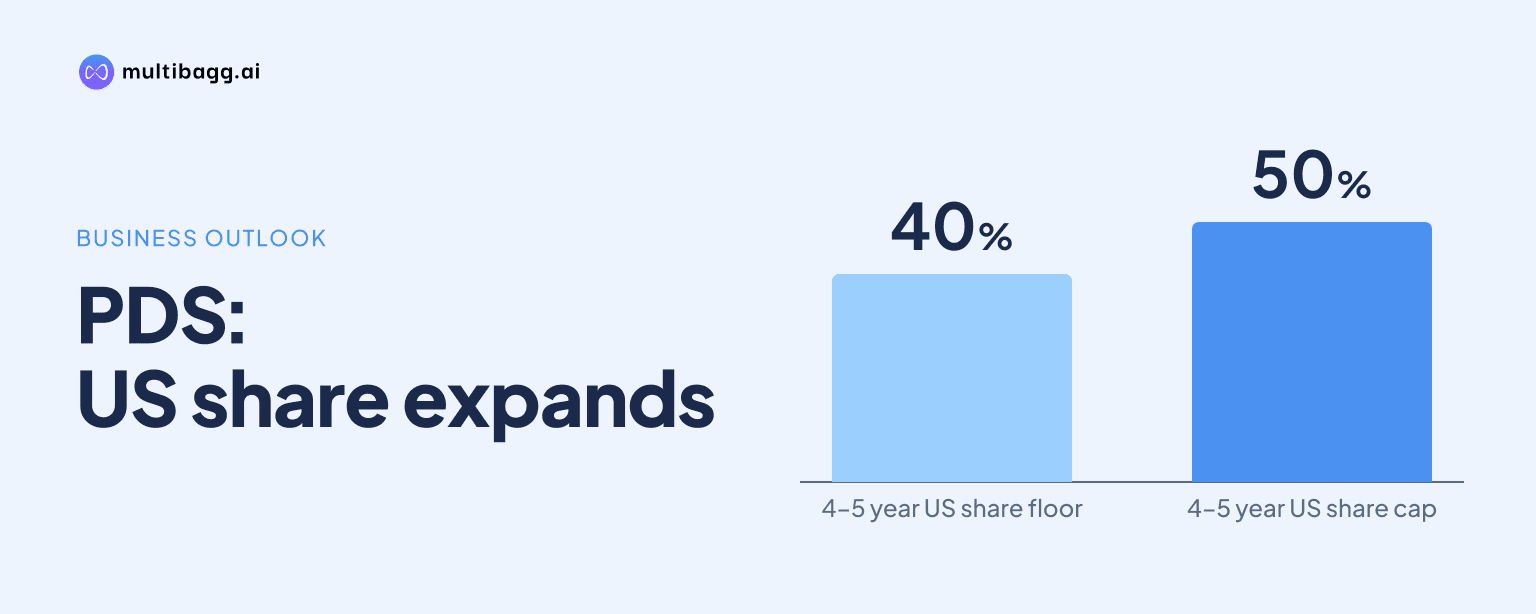
PDS Limited expects the US to represent 40% to 50% of its business within four to five years, versus a 23% contribution in the first half ended September 2026, after opening accounts with seven of the top 10 US retailers. Management said account openings and local teams establish the base, while volume will take two to three years to build.
Know PDS inside out
Results, valuation, peers and who's buying, in one view.
Why does PDS expect the US share to reach 40%-50%?
PDS expects the US to account for 40% to 50% of its business in the next four to five years because it sees strong retailer traction after opening accounts with seven of the top 10 US retailers. Management identified Kohl’s, Fashion Nova, Walmart, Target and CVS as examples of major accounts that have been opened. It said large US retailers can generate high-volume business, but converting opened accounts into the scale PDS requires will take two to three years.
The target follows the US contribution reaching 23% of PDS business in the first half ended September 2026. Management described the US as its fastest-growing market, linking retailer interest to inflation pressures and restructuring that are causing some retailers to use third parties for more design and sourcing work. The 40% to 50% range is management’s long-range expectation based on its current retailer base, not a reported outcome or an annual revenue forecast.
PDS said its US growth is not dependent on a single recently created vertical. In the first half, Krayons, an existing vertical, grew its US sales by 21%, while Zamira increased US sales from Rs 115 crore to Rs 214 crore, an 86% increase. PDS Asia Star, its China subsidiary, grew 47%, according to management. These businesses supplement the Michael Yee vertical, which management said is helping open new doors and secure sourcing-as-a-service work.
How large is PDS's US business today?
PDS recorded US sales of about Rs 1,840 crore in the first half ended September 2026, with Walmart contributing about Rs 200 crore of that total. Management said Walmart’s growth was exponential versus the same period a year earlier, although it did not provide a prior-period sales figure. The US is therefore already a material part of first-half activity before recently contracted orders make a meaningful contribution.
PDS executed gross merchandise value, or GMV, of Rs 11,366 crore in the first half, compared with Rs 10,100 crore in the first half of the prior year. GMV increased 12.5%. Management said first-half GMV did not include a significant contribution from two newly contracted orders: a US customer expected to generate about Rs 100 crore in its first year and a French retailer expected to generate about Rs 2,000 crore in year one.
The US target also sits alongside PDS’s wider push for sourcing and service contracts. Management said its contract from the second-largest French retailer opened more doors, while US account wins give PDS access to retailers that typically place large-volume business. The 23% US mix in the first half reflects both established verticals expanding their accounts and newer US-focused operations at an earlier stage.
Got a follow-up? Ask IRIS
What is driving retailer demand for PDS in the US?
PDS says US retailers are seeking external design and sourcing support as inflation pressures lead them to restructure operations and move more activity to third parties. Management compared this with an earlier European cycle, when retailers reduced costs and outsourced design and sourcing. It said that pattern is now emerging in the US, where PDS has teams in place and accounts opened with seven of the top 10 retailers.
The operating model described by management is a global sourcing and manufacturing platform that can move supply chains between countries. It cited Spring, PDS’s Turkey operation, which shifted from a trading model to a cut, make and dispatch, or CMD, model and moved manufacturing to Morocco and Egypt as Turkish inflation affected factories. Management said Spring’s business increased as customers sought multi-country sourcing rather than direct sourcing from Turkish factories.
That flexibility is relevant to US account growth because retailer demand can be tied to risk diversification as well as cost restructuring. PDS said disruption in a sourcing country can prompt retailers to seek alternatives across geographies. However, management also noted a limitation within its manufacturing segment: Bangladesh order allocations have faced customer caution, and manufacturing revenue was almost flat in the first half from the prior-year period.
What could affect PDS's US expansion plan?
PDS’s 40% to 50% US ambition depends on accounts gaining scale over two to three years, rather than simply being opened. Management said opening accounts and building teams are the key initial steps, but the volume ramp takes time. The first-half US mix of 23% provides a starting point, while the pace will depend on orders from new accounts and established verticals including Krayons, Zamira and PDS Asia Star.
Management is maintaining a cautious near-term financial stance despite continuing to express belief in the “555” potential it has discussed previously. It continued to indicate potential annual earnings before interest, tax, depreciation and amortisation, or EBITDA, margin improvement of 50 to 70 basis points, where 100 basis points equal one percentage point. Management said it wants a couple more quarters of sustained growth and profit momentum while keeping the balance sheet contained and maximising return on capital employed.
Investment levels are another factor. PDS reported Rs 34 crore of profit-and-loss-based investment in new initiatives in the first half, compared with an annualised level of about Rs 70 crore. Management said the annual maintainable run rate before investment increased in 2024-25 had been about Rs 40 crore to Rs 50 crore. It does not anticipate higher investment in businesses that have been in the portfolio for two years, beyond normal-course growth, but said it would separately update investors on the newly commissioned French sourcing-as-a-service contract.
Conclusion
PDS is planning for a substantial geographic shift: the US represented 23% of business in the first half ended September 2026, and management expects 40% to 50% in four to five years. The plan rests on accounts opened with seven top-10 US retailers, Rs 1,840 crore of first-half US sales, contributions from established verticals and retailer demand for outsourced sourcing and design services.
The next measures are whether newly opened US accounts convert into volume over the two-to-three-year period management outlined and whether the US customer’s expected first-year Rs 100 crore contribution begins entering GMV. Investors can also watch the first-year ramp of the French retailer contract, management’s 50-to-70-basis-point EBITDA-margin improvement expectation and any reduction from the Rs 70 crore annualised investment level toward the stated Rs 40 crore to Rs 50 crore maintainable range.