










PDS turns net cash positive as working capital hits minus five days
Key highlights
- PDS moved from Rs 105 crore of net debt in March 2026 to Rs 154 crore of net cash in September 2026.
- Net working capital improved from positive four days in March 2026 to negative five days in September 2026.
- PDS reported H1 FY27 revenue of Rs 7,876 crore, up 23%, and EBITDA of Rs 249 crore, up 62%.
- PDS cut H1 investment in new verticals by 53% to Rs 34 crore from Rs 72 crore a year earlier.
powered by IRIS
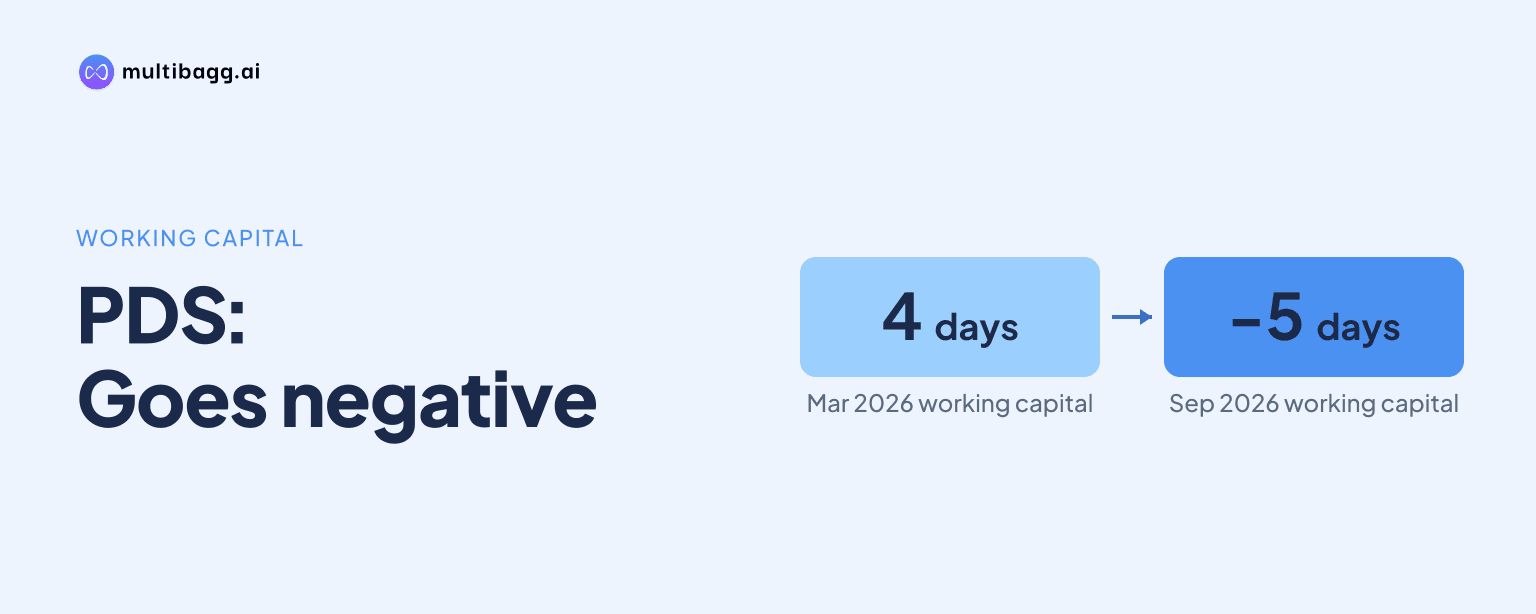
PDS Limited turned net cash positive at September-end FY27, moving from Rs 105 crore of net debt in March 2026 to Rs 154 crore of net cash after net working capital improved from positive four days to negative five days, management said on November 5.
Know PDS inside out
Results, valuation, peers and who's buying, in one view.
How did PDS become net cash positive?
PDS became net cash positive through a Rs 259 crore swing in its net financial position between March 2026 and September 2026. The company reported Rs 105 crore of net debt at the March-end, compared with Rs 154 crore of net cash six months later, marking the balance-sheet milestone highlighted by Group Chief Executive Officer Sanjay Jain and Group Chief Financial Officer Sadik Sunasara.
Management attributed the change principally to improved cash generation, tighter working-capital discipline and greater capital efficiency. Sunasara said lower use of invoice financing and import facilities, combined with increased use of factoring and operationally generated cash, reduced financing reliance even as H1 FY27 revenue rose 23% to Rs 7,876 crore.
PDS also prepaid one long-term facility of Rs 35 crore at its standalone India operation. Management said it continued to assess opportunities to reduce debt, while the company’s finance costs for H1 stood at Rs 78 crore, up 2% in rupee terms but down 7% in dollar terms despite the increase in revenue.
What changed in PDS’s working-capital cycle?
PDS reduced net working capital to negative five days in September 2026 from positive four days in March 2026. The reported nine-day movement was a central part of management’s explanation for the shift from net debt to net cash over the six-month period.
Management presented the negative-five-day position as a result of working-capital discipline and cash-generation efforts rather than as a separate one-off financing event. The improvement came while PDS’s Q2 FY27 revenue reached Rs 4,432 crore, 29% higher sequentially and 30% higher year on year, indicating that the company reported the working-capital change alongside a larger level of business activity.
The shift also coincided with changes in the company’s funding mix. PDS said it had relied less on invoice financing and import facilities, while using more factoring and internally generated cash. This matters because finance costs in Q2 FY27 were 13% lower in dollar terms than in Q2 of the prior year, according to management, although it did not disclose the separate cash impact of each funding mechanism.
Which operating results accompanied PDS’s cash improvement?
PDS’s cash improvement accompanied higher revenue, gross profit and operating profit in H1 FY27. Revenue rose 23% year on year to Rs 7,876 crore, while EBITDA, or earnings before interest, tax, depreciation and amortisation, increased 62% to Rs 249 crore and the EBITDA margin expanded 77 basis points to 3.2%.
The Q2 FY27 result showed a faster pace of profit growth than revenue growth. EBITDA was Rs 153 crore, up 49% year on year, and the margin was 3.5%, which was 44 basis points above the prior-year quarter and 66 basis points above Q1 FY27. Profit after tax was Rs 70 crore in Q2, up 144% sequentially and 44% year on year, while H1 profit after tax was Rs 98 crore, up 44%.
The sourcing business remained the larger operating segment, producing H1 FY27 revenue of Rs 7,542 crore, up 25% year on year, and earnings before interest and tax of Rs 175 crore at a 2.3% margin. Manufacturing reported Rs 452 crore of revenue and Rs 26 crore of earnings before interest and tax, a 5.8% margin, showing a higher segment margin on a substantially smaller revenue base.
Gross margin held at 20% in Q2 FY27 and reached 20% for H1 FY27, up 37 basis points from the prior-year half. Against this, Q2 employee expenses rose 17% sequentially to Rs 396 crore, partly because annual increments and incentive payments were moved to July from October, while other expenses increased 33% sequentially to Rs 340 crore due to freight, licence and marketing fees, and onboarding costs for new software-as-a-service businesses.
Got a follow-up? Ask IRIS
Can PDS sustain its balance-sheet improvement?
PDS said it plans to focus on monetising investments made over the preceding two to three years while continuing to augment cash flow. Investment in new verticals was Rs 34 crore in H1 FY27, down 53% from Rs 72 crore in the comparable prior-year period, putting the company broadly on track for its stated aim of reducing annual investment in such verticals to about Rs 80 crore from nearly Rs 168 crore in FY25.
Management has also rationalised the portfolio by merging Design Arc into Poeticgem and divesting DBS Lifestyle, where it said the path to scale and profitability was less clearly defined. PDS reported return on capital employed of 22%, compared with 28% excluding new verticals, and management expects the gap to narrow as those businesses scale and mature.
Order visibility provides part of the backdrop for management’s execution plans. The order book stood at Rs 5,670 crore in October, 13% above the same period a year earlier, while the Americas grew 54% in Q2 FY27 and 44% in H1 FY27. Management said the French retailer sourcing-as-a-service mandate is entering execution, but maintained a cautious stance because of the broader geopolitical, inflation and interest-rate environment.
PDS has set intermediate profitability goals alongside its cash focus. Management said it aims for annual EBITDA-margin expansion of 50 to 70 basis points and profit-after-tax-margin expansion of 50 to 75 basis points, with a medium-term objective of moving closer to a 3% profit-after-tax margin. The Board also considered an interim FY27 dividend of Rs 2.2 per share, a 33% increase from the previous year.
Conclusion
PDS’s move to Rs 154 crore of net cash at September-end FY27 reflects a reported nine-day improvement in net working capital, reduced dependence on selected financing facilities and rising operating profit. The balance-sheet change occurred alongside 23% H1 revenue growth, a 62% increase in EBITDA and a lower level of investment in new verticals than a year earlier.
Next, investors will be watching whether PDS can retain negative working capital as the Rs 5,670 crore October order book is executed, particularly through the French retailer sourcing-as-a-service mandate. Management’s disclosed targets to lower new-vertical investment to about Rs 80 crore in FY27, pursue further debt reduction and move toward a 3% profit-after-tax margin provide the stated measures for assessing the next phase.