










PDS reviews Ted Baker unit as H1 loss narrows to Rs 11 crore
Key highlights
- Ted Baker's H1 loss narrowed to Rs 11 crore from Rs 30 crore a year earlier.
- Ted Baker income from operations rose 30% to Rs 268 crore in H1 ended September '26.
- PDS said Ted Baker's H1 gross margin was about 22%, versus 18% a year earlier.
- PDS moved to net cash of Rs 154 crore at September-end from net debt of Rs 105 crore at March-end.
powered by IRIS
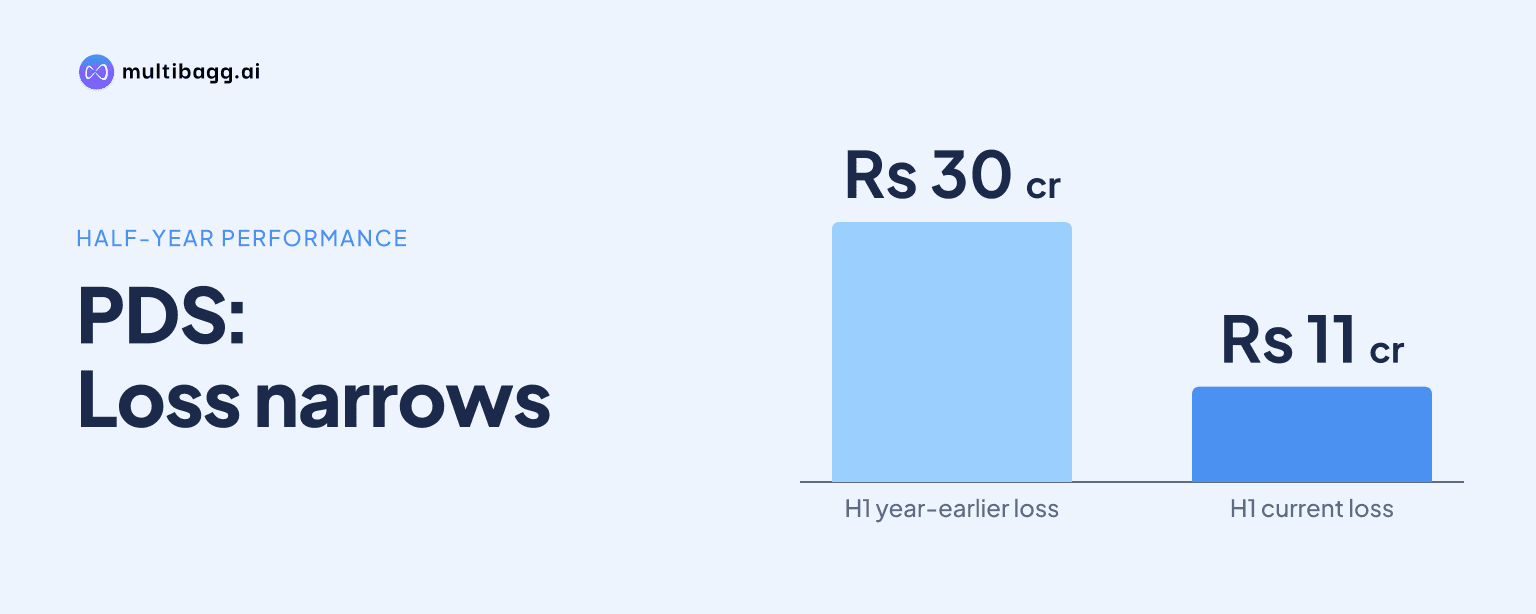
In H1 ended September '26, PDS put its Ted Baker New Lobster operation under review after its loss narrowed to Rs 11 crore from Rs 30 crore, despite income from operations increasing 30% to Rs 268 crore. Management said the revenue base still does not support the operation's current cost structure, with breakeven its first objective.
Know PDS inside out
Results, valuation, peers and who's buying, in one view.
Why is PDS reviewing the Ted Baker unit?
PDS is reviewing Ted Baker because a 30% increase in H1 income did not eliminate a Rs 11 crore loss or cover the operation's existing overhead. Management said customer engagement remained intact, but the business needs materially more revenue than it currently generates to produce healthy profits. The review is therefore focused first on bringing Ted Baker New Lobster to breakeven.
The missing retail-franchisee channel is central to the issue, according to management. PDS said the retail franchisee appointed by ABG in the UK went into administration, removing that opportunity, while the US opportunity was also lost. Management said it had retained costs in anticipation of more retail franchise-led growth, but that growth has not materialised at the expected level.
Ted Baker was described by management as one of PDS's most challenging operations. The unit has sought to support its recovery through business-to-business relationships, which helped it achieve the 30% H1 revenue increase. However, management said the brand is not where it used to be without a retail-store partner in the UK, Europe and the US, where agency income had previously been significant.
How did the Ted Baker unit perform in H1 ended September '26?
Ted Baker's income from operations increased to Rs 268 crore in H1 ended September '26 from Rs 205 crore in the same period a year earlier, while its loss reduced by Rs 19 crore. That comparison shows that the operation generated additional sales while narrowing its deficit from Rs 30 crore to Rs 11 crore, but PDS said the improvement was not sufficient for its internal assessment.
Gross margin was about 22% in H1, compared with 18% in the same period last year, according to management. The H1 gross-margin comparison indicates improvement in underlying trading economics, but management also said the cost base needs greater revenue to generate healthy profit. Gross margin alone has therefore not translated into breakeven for Ted Baker.
Management also reported a sequential movement in gross margin, saying it was 30% in Q1 and 22% in Q2, with the H1 level at about 22%. This decline came even as H1 income reached Rs 268 crore. The figures underline why PDS is considering changes to overheads and operating structure rather than relying only on further sales growth.
What options is PDS considering for Ted Baker?
PDS is exploring a strategic tie-up or partnership with third parties, with ABG support, as one potential route to reach breakeven. Management did not disclose a partner, timetable or financial terms. It said the initial priority is a solution that preserves customer engagement while changing the economics that produced the Rs 11 crore H1 loss.
If a partnership does not materialise, PDS said it may take further cost-rationalisation measures at New Lobster. One option is relocating operations from a relatively high-cost central London location to an area farther from London. Management said tighter cost control could help the business achieve its first milestone of breakeven, even before a larger revenue base is secured.
PDS said it must take action within the current financial year and find an outcome workable for both ABG and PDS. Management identified several possible outcomes: reducing losses, restructuring the business or selling it. These remain options under consideration rather than announced decisions, and the transcript did not set out a valuation, buyer process or targeted completion date.
Got a follow-up? Ask IRIS
How material is the Ted Baker review to PDS's wider H1 results?
The Ted Baker review comes alongside stronger group-level H1 results at PDS. PDS reported profit after tax of Rs 98 crore, up 44% year-on-year, and earnings before interest, tax, depreciation and amortisation of Rs 249 crore, up 62%, with the margin increasing 77 basis points to 3.2%. The Rs 11 crore Ted Baker loss therefore sits within a group that reported a profit for the half year.
PDS's sourcing segment generated H1 revenue of Rs 7,542 crore, up 25% year-on-year, and earnings before interest and tax of Rs 175 crore at a 2.3% margin. Manufacturing reported revenue of Rs 452 crore and earnings before interest and tax of Rs 26 crore at a 5.8% margin. These operating segments provide context for management's emphasis on fixing the loss-making Ted Baker operation.
The group also moved from net debt of Rs 105 crore at the end of March '26 to net cash of Rs 154 crore at the end of September '26. Management attributed lower finance-cost intensity partly to lower use of invoice financing and import facilities, alongside greater factoring and operationally generated cash. That balance-sheet shift gives context to the review, though PDS did not say it had earmarked cash for a Ted Baker restructuring or sale process.
What will determine whether PDS reaches breakeven at Ted Baker?
PDS said reaching breakeven depends on either obtaining a partnership that restores a viable growth path or reducing the cost structure to fit current revenue. The H1 result of Rs 268 crore in income and a Rs 11 crore loss demonstrates that the business has sales traction, but management's assessment is that the current overhead is designed for substantially more revenue.
The outcome will also depend on the future of retail-store partnerships in the UK, Europe and the US. Management linked the loss of agency income to the absence of those partners, while pointing to its business-to-business relationships as the route that supported 30% H1 growth. PDS has not disclosed whether it expects a replacement retail partner, so the operational response remains an unresolved part of the review.
Conclusion
PDS has improved Ted Baker's H1 performance, cutting the loss from Rs 30 crore to Rs 11 crore and raising income from operations from Rs 205 crore to Rs 268 crore. Yet management considers the result inadequate because the operation's central London-led cost base is not supported by present revenue, particularly after retail-franchisee opportunities were lost.
The next development to watch is management's promised action within the current financial year. PDS is assessing a third-party partnership with ABG support, cost reduction and relocation, as well as restructuring or a sale if needed. The key measure will be whether the chosen route can move Ted Baker from the Rs 11 crore H1 loss toward management's stated breakeven milestone.