










Poly Medicure cash holds at Rs 839.1 crore after H1 outflows
Key highlights
- Polymed held Rs 839.1 crore of cash and cash equivalents at September 30, 2026, versus Rs 839.5 crore at March 31, 2026.
- Polymed generated Rs 109.1 crore of H1 FY27 operating cash flow after Rs 143.2 crore of net working-capital investment.
- Polymed spent Rs 124.3 crore on capital expenditure in H1 FY27, resulting in investing cash outflow of Rs 121.1 crore.
- Polymed's cash conversion cycle was 136 days at September 30, 2026, compared with 135 days at March 31, 2026.
powered by IRIS
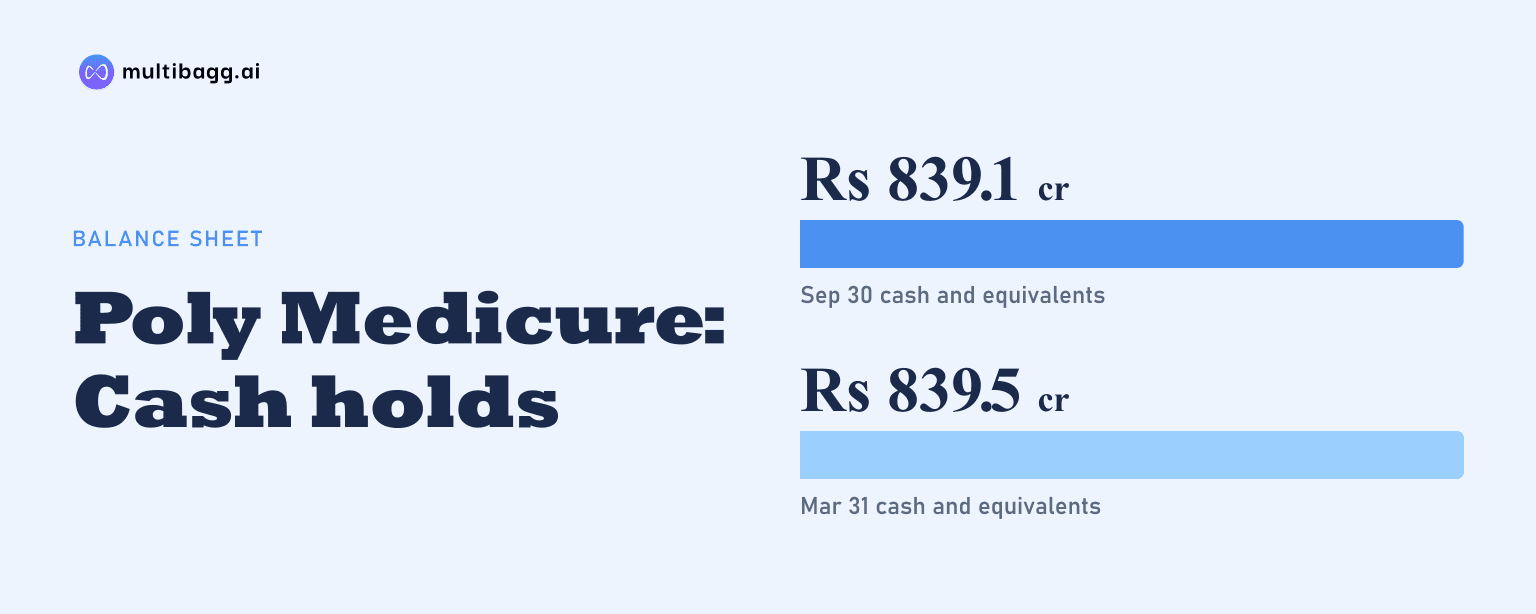
Poly Medicure reported Rs 839.1 crore of cash and cash equivalents at September 30, 2026, after Rs 143.2 crore of working-capital investment reduced H1 FY27 operating cash flow to Rs 109.1 crore and capital expenditure reached Rs 124.3 crore. The closing cash balance was near the Rs 839.5 crore reported at March 31, 2026.
Know Poly Medicure inside out
Results, valuation, peers and who's buying, in one view.
How much cash did Polymed hold at September-end?
Polymed held Rs 839.1 crore of cash and cash equivalents at September 30, 2026, compared with Rs 839.5 crore at March 31, 2026. The presentation says this measure includes investments, other bank balances, and bank deposits classified as both current and non-current.
The cash balance exceeded total debt of Rs 377.1 crore at September-end. Total debt rose from Rs 341.6 crore at March-end, as short-term borrowings increased to Rs 338 crore from Rs 289.5 crore, while long-term borrowings declined to Rs 39.1 crore from Rs 52.1 crore.
Total assets increased by Rs 213 crore over the six-month period to Rs 3,852.4 crore. Net fixed assets, including capital work in progress, or CWIP, increased by Rs 137.5 crore to Rs 1,491.1 crore, while net current assets rose by Rs 70.9 crore to Rs 891.1 crore.
Shareholders’ funds increased by Rs 158.5 crore to Rs 3,307.7 crore at September 30, 2026. The balance included Rs 50.7 crore of equity share capital, Rs 3,214.7 crore of other equity, and Rs 42.3 crore of non-controlling interest.
Why was Polymed's H1 FY27 operating cash flow Rs 109.1 crore?
Polymed reported Rs 109.1 crore of operating cash flow in H1 FY27 because working-capital changes absorbed Rs 143.2 crore from operating cash flow before those changes of Rs 252.3 crore. The pre-working-capital figure included reported earnings before interest, tax, depreciation and amortisation, or EBITDA, of Rs 265.7 crore, Rs 36.2 crore of other operating income and non-cash expense, and Rs 49.7 crore of tax paid.
Inventory was the largest cash use within working capital at Rs 78.3 crore. Changes in debtors used another Rs 39.7 crore, while other working-capital changes used Rs 36.1 crore; a Rs 10.9 crore change in payables partly offset those outflows.
Period-end balances show debtors increased by Rs 28 crore to Rs 559 crore and inventory increased by Rs 78 crore to Rs 512 crore between March 31 and September 30. Creditors rose by Rs 10 crore to Rs 133 crore, consistent with the positive payables movement in the cash-flow statement.
Polymed reported H1 FY27 operating revenue of Rs 1,105.9 crore, up 30.6% from Rs 847.1 crore in H1 FY26. International revenue rose 35.8% to Rs 781.5 crore, while domestic revenue increased 19.3% to Rs 317.8 crore; the presentation does not allocate the working-capital movements to specific geographies or segments.
Got a follow-up? Ask IRIS
How did Polymed use cash for investment and financing in H1 FY27?
Polymed spent Rs 124.3 crore on capital expenditure in H1 FY27, exceeding the Rs 109.1 crore generated from operations. After Rs 50 lakh of proceeds from fixed-asset sales, Rs 30 lakh paid for the Medyneo subsidiary acquisition, Rs 1.4 crore of dividend or governing-share income, and Rs 1.7 crore of interest income, investing cash flow was an outflow of Rs 121.1 crore.
Financing cash flow was an outflow of Rs 17.3 crore despite a Rs 34.6 crore increase in borrowings. The company paid Rs 35.5 crore in dividends, Rs 10.8 crore in finance cost, and Rs 5.7 crore for lease-liability repayment and related interest.
Polymed reported net cash flow generated as an outflow of Rs 29.3 crore in H1 FY27. Its cash-flow statement shows opening cash of Rs 841 crore, an unrealised gain on mutual funds of Rs 27.5 crore, and closing cash of Rs 839.1 crore.
The balance-sheet presentation shows Rs 839.5 crore of cash and cash equivalents at March 31, 2026, whereas the cash-flow statement lists Rs 841 crore of opening cash. Polymed states that the balance sheet and cash-flow statement have been regrouped and reclassified for analytical and presentation purposes, and may differ from the format prescribed under Indian Accounting Standards.
How did Polymed's cash conversion cycle change by September 2026?
Polymed's cash conversion cycle increased by one day to 136 days at September 30, 2026, from 135 days at March 31, 2026. The company calculates the measure using trailing 12-month consolidated revenue.
Debtor days declined by two days to 84 days from 86 days, while inventory days increased by three days to 73 days from 70 days. Creditor days increased by one day to 21 days from 20 days, partly offsetting the inventory movement.
The three-day rise in inventory days was larger than the combined effect of lower debtor days and higher creditor days, producing the one-day increase in the cash conversion cycle. Inventory also rose to Rs 512 crore at September-end from Rs 434 crore at March-end.
Current assets increased to Rs 1,193.9 crore from Rs 1,099.4 crore over the same period, while current liabilities rose to Rs 302.8 crore from Rs 279.2 crore. These movements resulted in net current assets of Rs 891.1 crore, compared with Rs 820.2 crore at March 31, 2026.
Conclusion
Polymed retained Rs 839.1 crore of cash and cash equivalents at September-end despite Rs 143.2 crore of working-capital investment, Rs 124.3 crore of capital expenditure, and an H1 FY27 net cash outflow of Rs 29.3 crore. Fixed assets rose by Rs 137.5 crore, while total debt increased by Rs 35.5 crore during the six months.
The next disclosures will show whether the 136-day cash conversion cycle changes, particularly through inventory days of 73 and debtor days of 84. They will also clarify whether capital expenditure remains above H1 FY27 operating cash flow and how further investment is funded through operating cash generation, cash balances, or borrowings.