










Poly Medicure expects PendraCare EBITDA recovery from 2027
Key highlights
- PendraCare entered an EBITDA loss after Middle East disruption affected a region representing close to 20% of 2025 revenue.
- PendraCare grew about 10% year on year through September despite the Middle East sales disruption.
- Polymed expects selected PendraCare integration projects to begin implementation in Q1 of calendar year 2027.
- Citieffe and Plan 1 Health are operating at mid-teen EBITDA margins, unlike PendraCare.
powered by IRIS
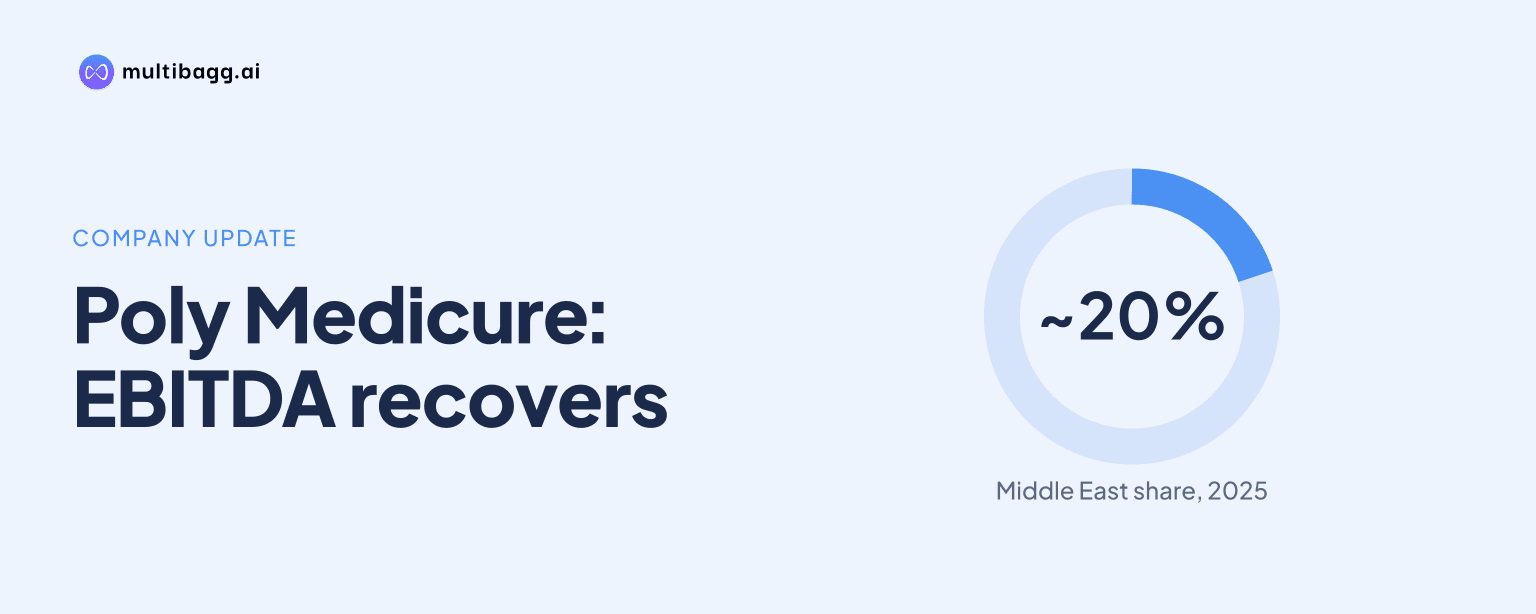
Poly Medicure said PendraCare entered an earnings before interest, tax, depreciation and amortisation (EBITDA) loss after Middle East disruption affected a region that supplied close to 20% of its 2025 revenue, while management expects recovery to begin in calendar year 2027 or financial year 2028 through integration projects and new original equipment manufacturer (OEM) revenue.
Know Poly Medicure inside out
Results, valuation, peers and who's buying, in one view.
Why did PendraCare enter an EBITDA loss?
PendraCare entered an EBITDA loss because higher raw-material costs coincided with the loss of Middle East sales representing close to 20% of its 2025 revenue. Polymed said the business had a sizeable exposure to Iran within the Middle East, where sales had effectively come to a standstill amid the war-related disruption.
The disruption was logistical rather than a stated decline in underlying demand for medical devices. Polymed identified limited container availability, difficulty moving products to ports amid issues around Hormuz, and higher freight rates as the three obstacles. Management said customers were delaying orders while waiting for freight rates to decline, even though demand remained strong.
PendraCare nevertheless grew about 10% year on year through September, but that growth did not offset the lost Middle East business and higher input costs. Polymed also cited growth of about 40% this year with one large OEM customer with whom PendraCare has had a relationship for more than 15 years, showing that sales in other customer accounts continued.
Management said the margin impact was magnified because PendraCare is a relatively small business. Some revenue lost in the Middle East was recovered from other customers, but Polymed said the reduction from a region representing close to one-fifth of 2025 revenue materially affected profitability. Management did not cite a change in PendraCare’s products or broader customer demand as the cause of the loss.
When does Polymed expect PendraCare to recover?
Polymed expects PendraCare’s EBITDA margin recovery to start in calendar year 2027 or financial year 2028. Management said certain integration projects should begin implementation from the first quarter of calendar year 2027, after much of the underlying synergy work was carried out during calendar year 2026.
The planned recovery mechanisms are procurement, supply-chain, distribution and product-development synergies. Polymed cautioned that medical-device projects have long lead times because regulatory approvals can take between one and three years. Management expects some benefits from the integration work to begin accruing in the upcoming financial year.
A large OEM win is the second stated recovery driver. Polymed said PendraCare had secured one significant breakthrough with a large OEM and that revenue should begin accruing from the middle of calendar year 2027. The company did not disclose the contract value, product category, duration or expected contribution to EBITDA margin.
Management said small European assets can grow at 8% to 10% on a standalone secular basis. With procurement, supply-chain, distribution and product-development synergies, Polymed expects growth to move into the mid-teens, although this remains a management expectation contingent on implementation and regulatory clearances rather than a reported 2026 result.
How does PendraCare compare with Polymed’s other subsidiaries?
PendraCare is the loss-making outlier among the three subsidiaries cited by Polymed, while Citieffe and Plan 1 Health are operating at mid-teen EBITDA margins. Management made that distinction after an analyst calculated a 4% to 5% subsidiary margin by subtracting standalone results from consolidated results.
Citieffe’s growth was held back primarily by delayed public tenders in Italy during calendar year 2026. Polymed said Citieffe’s business outside Italy, including the United States and the larger Latin America region, was in line with expectations. This contrasts with PendraCare, where Middle East logistics and the regional sales interruption were the stated constraints.
Plan 1 Health, Polymed’s Italian critical-care subsidiary, was delivering double-digit growth, according to management. Polymed also said its domestic critical-care team, established about a year and a half earlier, was beginning to gain traction after developing products and building customer relationships in India.
The 4% to 5% figure derived from the difference between standalone and consolidated EBITDA includes setup costs for Brazil, the United Kingdom and aspects of the United States. Polymed said those operations remained under operationalisation in the first half, meaning that calculation does not represent the separate EBITDA margin of PendraCare, Citieffe or Plan 1 Health.
Got a follow-up? Ask IRIS
What could delay PendraCare’s recovery?
PendraCare’s recovery could be delayed if Middle East shipping constraints persist beyond the planned first-quarter 2027 start of integration implementation. Polymed did not say container availability, port access around Hormuz or freight costs had normalised, leaving the factors behind the loss of close to 20% of 2025 revenue unresolved.
Regulatory timing is another disclosed constraint. Management said approvals for medical-device initiatives can take one to three years, which could defer the benefits of product-development and supply-chain projects. Polymed also said 30 new product registrations were coming up for registration in Europe, underlining the role of regulatory processes in planned commercial expansion.
The new OEM relationship is also scheduled rather than yet reported in revenue. Polymed expects revenue from the large OEM to start from the middle of calendar year 2027, but the call did not quantify the customer’s annual sales potential. The timing and scale of that contribution will therefore determine how quickly it can offset PendraCare’s Middle East exposure.
How is Polymed’s wider regional business performing?
Polymed’s organic Europe business grew close to 40% in the second quarter, while rest-of-world markets declined 7% in the same period. On a first-half basis, Europe grew 29% and rest-of-world markets declined 1.8%, with management attributing the latter decline primarily to West Asia logistics and freight-cost pressures.
Management attributed Europe’s second-quarter improvement to deeper customer engagement, new projects and customer additions rather than inventory normalisation alone. Polymed added about 28 to 29 customers in the first half and said certain European projects could begin to play out in the fourth quarter and the next financial year.
Polymed said it was responding to Chinese competition in Europe through measures within its control, including customer relationships, clinical engagement and new products. The company said it had 30 new product registrations coming up in Europe and that some registrations already received were beginning commercialisation in higher-value-added segments.
The regional comparison shows that PendraCare’s issue is concentrated in Middle East-linked distribution rather than mirrored across Europe. Europe’s close to 40% organic second-quarter growth followed a prior period affected by customer inventory, tariffs and Chinese dumping, while the rest-of-world decline remained associated with West Asia freight and logistics conditions.
Conclusion
Polymed’s explanation for PendraCare’s EBITDA loss is centred on two linked factors: higher raw-material costs and disrupted Middle East sales from a region that contributed close to 20% of 2025 revenue. PendraCare’s about 10% growth through September and 40% growth with one long-standing OEM customer indicate continuing sales activity, but they did not compensate for the regional disruption.
The next disclosed milestones are implementation of selected synergy projects from the first quarter of calendar year 2027 and anticipated revenue from the new large OEM relationship from mid-2027. Management’s recovery timetable also depends on regulatory approvals that can take one to three years and on whether container access, Hormuz-related port logistics and freight costs improve.