










Poly Medicure says DGHS rule could lift dialysis demand
Key highlights
- Poly Medicure said dialyzers had been reused four to five times before the DGHS single-use direction.
- Poly Medicure reported renal-segment growth of around 20% year on year in the quarter discussed.
- Poly Medicure said it sold more than 300 dialysis machines in H1 FY27.
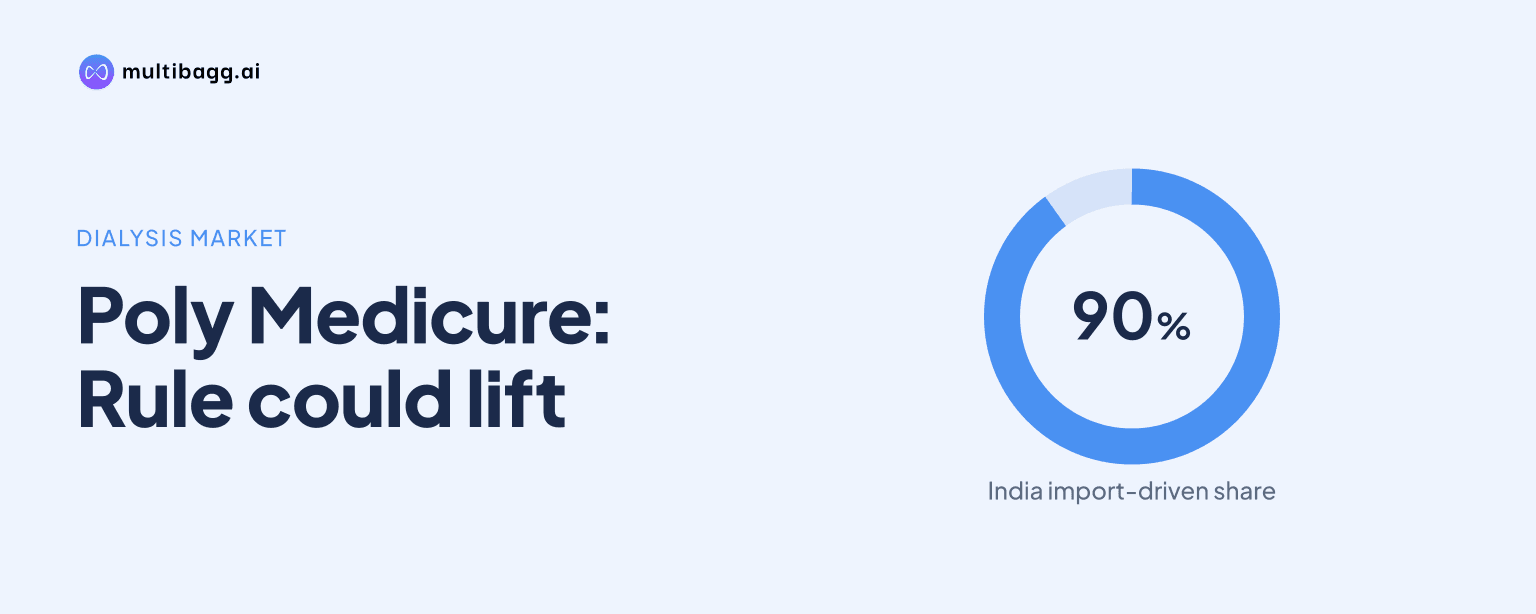
- Poly Medicure said 90% of India’s market remains import-driven.
powered by IRIS
Poly Medicure Limited said a Directorate General of Health Services, or DGHS, single-use direction could increase demand for dialyzers previously reused four to five times. Management said the circular took immediate effect in late October, but added that implementation across India may take time and did not quantify the revenue impact.
Know Poly Medicure inside out
Results, valuation, peers and who's buying, in one view.
How could the DGHS directive change Poly Medicure’s dialysis demand?
The DGHS notification could raise dialyzer consumption by ending their reuse, according to Poly Medicure. Management said dialysis chains had previously used a dialyzer four to five times despite the product being designed for single use, allowing providers to spread the device cost across several treatment cycles.
Poly Medicure said the notification requires medical devices to be used only once and should force dialysis chains to move toward single-use practice. Management described this as a long-run demand driver for dialysis products because hospitals, as well as dialysis chains, would have to follow the direction when it is fully implemented across states.
The mechanism is higher unit consumption rather than a disclosed pricing change. A dialyzer used four to five times requires one device for several treatment cycles, whereas single use requires a new device for each cycle. Poly Medicure did not provide a revenue estimate, expected volume increase or timetable for the impact on its renal segment.
When does the DGHS single-use direction take effect?
The DGHS direction took effect immediately, according to Poly Medicure management, which said the circular was issued around October 22 or October 23. Management said the Government of India notification was intended to address reuse of devices and inadequate sterilisation, which it linked to hospital-acquired infections.
Immediate effect does not mean demand will change uniformly at once. Poly Medicure said India is a large country and implementation will take time, even though states are obligated to act and hospitals will need to comply. This matters because the company’s expectation of added dialysis demand depends on how consistently providers adopt the single-use requirement.
Poly Medicure framed the directive as a change in the operating environment for dialysis centres rather than as a confirmed sales result. Management said it was hopeful the notification would help it sell more products to dialysis centres, but it also said demand would take time to build. The transcript does not disclose audits, enforcement milestones or state-by-state compliance data.
Has Chinese competition in Poly Medicure’s renal segment eased?
No, Chinese competition in dialysis remains in place, according to Poly Medicure, despite renal-segment growth of around 20% year on year in the quarter discussed. Management explicitly said that “nothing has changed” in the competitive landscape, so the reported growth does not establish that competitive pressure has receded.
Poly Medicure has filed an anti-dumping case, and management said the government had initiated the process about four months before the call. Management said it was hearing that the government may take action, but stressed that such matters take longer than expected and said it did not know what form any potential relief might take.
The DGHS direction and the anti-dumping case are separate factors for the renal business. The directive could increase the number of dialyzers used per treatment by restricting reuse, while an anti-dumping outcome could affect competition from imported products. Poly Medicure did not quantify either factor’s potential impact on market share, revenue, pricing or margins.
Got a follow-up? Ask IRIS
What is Poly Medicure’s renal growth and market opportunity?
Poly Medicure reported renal-segment growth of around 20% year on year in the quarter under discussion and identified India as its larger near-term opportunity. Management said 90% of the Indian market remains import-driven and described its domestic renal strategy as import substitution with locally supplied products.
Poly Medicure had sold more than 300 dialysis machines in H1 FY27. Machines are relevant to the renal strategy because management said machine sales require a service organisation, spare-parts availability and service engineers, areas where it said it is well positioned in India.
Consumables and machines have different operating requirements. The DGHS circular directly concerns single-use devices such as dialyzers, while machine sales depend on an ongoing service network. Poly Medicure did not disclose renal revenue, the number of dialysis centres served, its installed machine base or the share of renal sales represented by dialyzers.
When will Poly Medicure expand renal products outside India?
Poly Medicure expects to focus on India for the next 12 to 18 months before placing greater emphasis on overseas renal sales. Management said Southeast Asia is the first international region under consideration and that it is working with consultants to assess the opportunity.
International revenue depends on registrations, which management said normally take one to two years. Poly Medicure has initiated registrations in some markets, but did not name the countries, set an overseas renal-revenue target or specify when first sales outside India could begin.
The domestic and overseas plans therefore have different timing. India combines a 90% import-driven market with an existing service capability for machines and a new single-use direction for consumables. Southeast Asia is a registration-led opportunity, while Poly Medicure’s stated near-term priority remains its Indian renal business.
Conclusion
The DGHS direction is a potential demand catalyst for Poly Medicure because dialyzers had been reused four to five times despite being designed for one use. Renal-segment growth of around 20% year on year shows the business was expanding in the quarter discussed, but management said Chinese competition remains unchanged and did not quantify the directive’s financial effect.
The next issues to watch are implementation of the late-October DGHS circular across states and progress in the anti-dumping case initiated about four months before the call. Poly Medicure’s stated plan is to prioritise India for the next 12 to 18 months, while renal registrations in Southeast Asia, a process management said can take one to two years, remain the gating event for overseas sales.