










Poly Medicure Q2 revenue rose 30.8% while margin fell 212 basis points
Key highlights
- Polymed’s Q2 FY27 consolidated operating revenue rose 30.8% to Rs 580.5 crore.
- Polymed identified Rs 66.1 crore of Q2 FY27 revenue as acquisition impact.
- Polymed’s Q2 FY27 organic operating revenue rose 16.3% to Rs 514.4 crore.
- Polymed’s Q2 FY27 consolidated operating EBITDA margin fell to 24.0% from 26.1%.
powered by IRIS
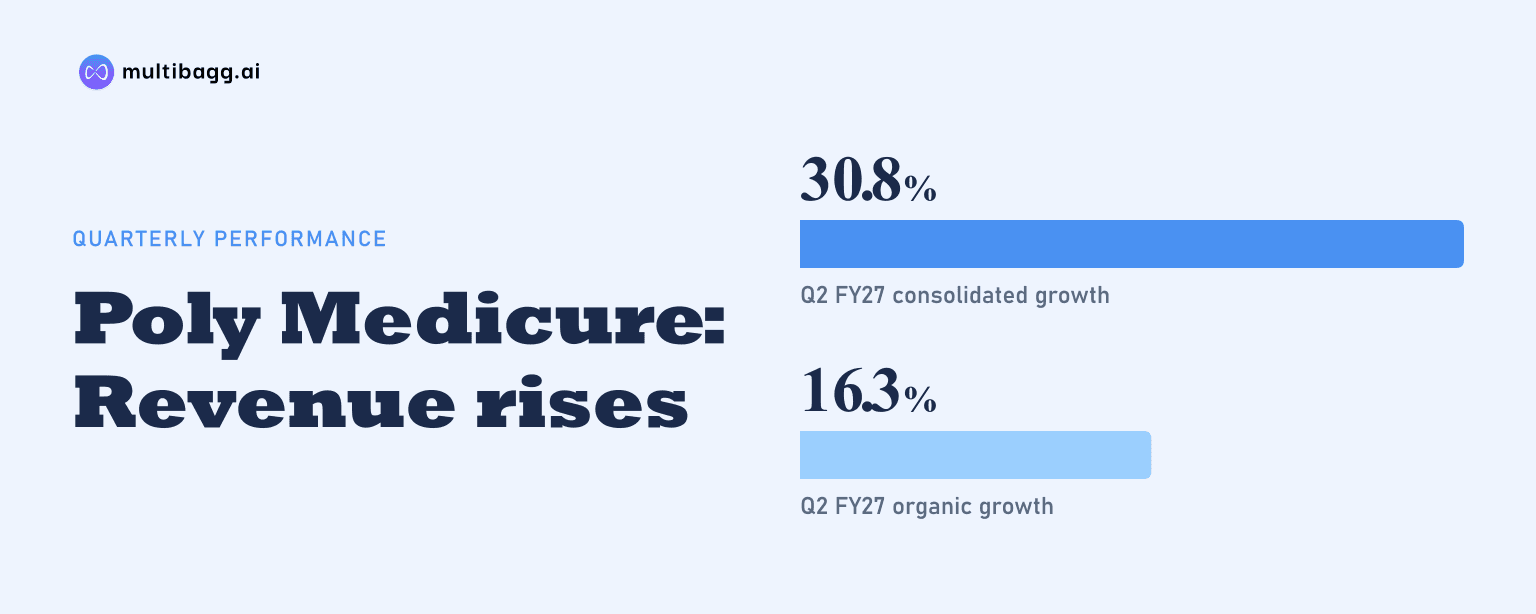
Poly Medicure’s Q2 FY27 consolidated revenue rose 30.8% to Rs 580.5 crore, but acquisitions supplied Rs 66.1 crore of sales and operating EBITDA margin fell 212 basis points to 24.0%. Organic revenue was Rs 514.4 crore, up 16.3% year on year, separating acquired revenue from underlying growth.
Know Poly Medicure inside out
Results, valuation, peers and who's buying, in one view.
How much of Polymed’s Q2 revenue growth came from acquisitions?
Polymed’s acquisition impact increased by Rs 64.5 crore in Q2 FY27, representing about 47% of the Rs 136.6 crore rise in consolidated operating revenue. Reported revenue increased to Rs 580.5 crore from Rs 443.9 crore, while acquisition impact was Rs 66.1 crore in Q2 FY27 compared with Rs 1.6 crore in Q2 FY26.
Organic operating revenue was Rs 514.4 crore in Q2 FY27, compared with a base revenue figure of Rs 442.3 crore in Q2 FY26, producing 16.3% year-on-year growth. The organic rate was therefore below the 30.8% reported consolidated rate because the acquired businesses added revenue to the quarter.
Polymed reported that PendraCare revenue of Rs 1.6 crore was consolidated in Q2 FY26 from September 23, 2025. The acquisition contribution was concentrated in international sales: consolidated international revenue rose 35.0% to Rs 405.3 crore, whereas organic international revenue of Rs 339.2 crore increased 13.6%.
Why did Polymed’s consolidated EBITDA margin fall in Q2 FY27?
Polymed’s operating EBITDA margin fell to 24.0% in Q2 FY27 from 26.1% a year earlier because total expenses rose 34.6%, faster than the 30.8% increase in operating revenue. Operating EBITDA, or earnings before interest, tax, depreciation and amortisation, increased 20.1% to Rs 139.1 crore from Rs 115.8 crore.
Employee benefit expenses rose 48.6% to Rs 130.4 crore, and other expenses increased 34.8% to Rs 130.6 crore. Cost of goods sold rose 28.0% to Rs 173.6 crore, slower than revenue, helping gross profit margin increase 65 basis points to 70.1%; a basis point is one-hundredth of a percentage point.
The consolidated result differed from the standalone business, where operating EBITDA margin rose 69 basis points to 27.4% in Q2 FY27. Standalone revenue increased 17.2% to Rs 488.3 crore and standalone operating EBITDA rose 20.3% to Rs 133.9 crore. Management said the standalone margin was above its 25%-27% guidance range, while the consolidated 24.0% margin was within its 23%-25% range.
Got a follow-up? Ask IRIS
Which markets and segments drove Polymed’s Q2 FY27 sales?
Polymed’s largest reported regional increase came from Europe, where Q2 FY27 revenue rose 61.7% to Rs 214.8 crore and organic revenue increased 39.6% to Rs 183.2 crore. Europe represented 37% of consolidated revenue, up from 30% in Q2 FY26.
India revenue rose 22.0% to Rs 171.8 crore, while the rest of world, or RoW, increased 13.8% to Rs 190.5 crore. RoW organic revenue was Rs 156.0 crore, down 6.8%, contrasting with its reported growth. International sales consequently accounted for 70% of Q2 revenue, compared with 68% a year earlier.
Infusion Therapy remained Polymed’s largest segment at Rs 283.7 crore, but its 11.7% growth was below the group’s 30.8% reported increase. Orthopaedics contributed Rs 42.7 crore and reflects the consolidation of Citieffe revenue, according to the presentation. Cardiology revenue rose 300.8% to Rs 27.0 crore, while Renal increased 19.6% to Rs 50.6 crore.
For H1 FY27, segments beyond Infusion accounted for 51% of revenue excluding export incentive, compared with 42% in H1 FY26. Infusion’s share declined to 49.3% from 57.9%, while Orthopaedics represented 8.4% and Cardiology 8.5%. Polymed also reported 12 product launches to date in FY27 and an R&D team of more than 90 across India, Italy and the Netherlands.
How did Polymed’s sales growth affect profit and cash flow?
Polymed’s Q2 FY27 profit after tax rose 3.6% to Rs 95.1 crore, considerably slower than revenue, while profit margin declined 334 basis points to 15.9%. Profit before tax before exceptional items declined 4.8% to Rs 115.9 crore from Rs 121.7 crore.
Reported profit before tax increased 3.1% to Rs 125.5 crore after a Rs 9.6 crore exceptional gain. The presentation attributes that gain to reversal of a contingent-consideration liability for the PendraCare acquisition because an agreed milestone was not achieved. In H1 FY27, profit after tax fell 2.4% to Rs 180.4 crore despite operating EBITDA rising 19.2% to Rs 265.7 crore.
H1 FY27 operating cash flow was Rs 109.1 crore after working-capital changes, compared with Rs 252.3 crore before those changes. Inventory used Rs 78.3 crore and debtors used Rs 39.7 crore. Cash and cash equivalents stood at Rs 839.1 crore on September 30, 2026, while total debt was Rs 377.1 crore, up from Rs 341.6 crore on March 31, 2026.
Conclusion
Polymed’s Q2 figures show that acquisitions materially changed both the pace and mix of consolidated growth, with Europe up 61.7% and Orthopaedics adding Rs 42.7 crore of revenue. Gross margin rose to 70.1%, yet personnel and other operating costs grew faster than sales, limiting operating EBITDA growth to 20.1% and reducing the consolidated margin to 24.0%.
Investors can watch management’s disclosed 23%-25% consolidated operating EBITDA margin range, against the 24.0% result in Q2 and H1 FY27. Operational milestones include Medyneo’s Brazil rollout, whose first shipment was dispatched in October, and the PACIFIER drug-eluting stent registry, where more than 1,150 of 2,000 patients were enrolled and full enrolment is targeted by the end of FY27.