










Polymed non-infusion businesses reached 47% of FY26 revenue
Key highlights
- Polymed’s renal care and others categories supplied 47% of FY26 operating revenue, compared with 31% in FY23.
- Renal care revenue rose from Rs 76 crore in FY23 to Rs 187 crore in FY26, a 35% CAGR.
- Others revenue increased from Rs 269 crore in FY23 to Rs 691 crore in FY26, a 37% CAGR.
- Infusion therapy represented 53% of FY26 revenue, down from 69% in FY23, despite revenue of Rs 997 crore.
powered by IRIS
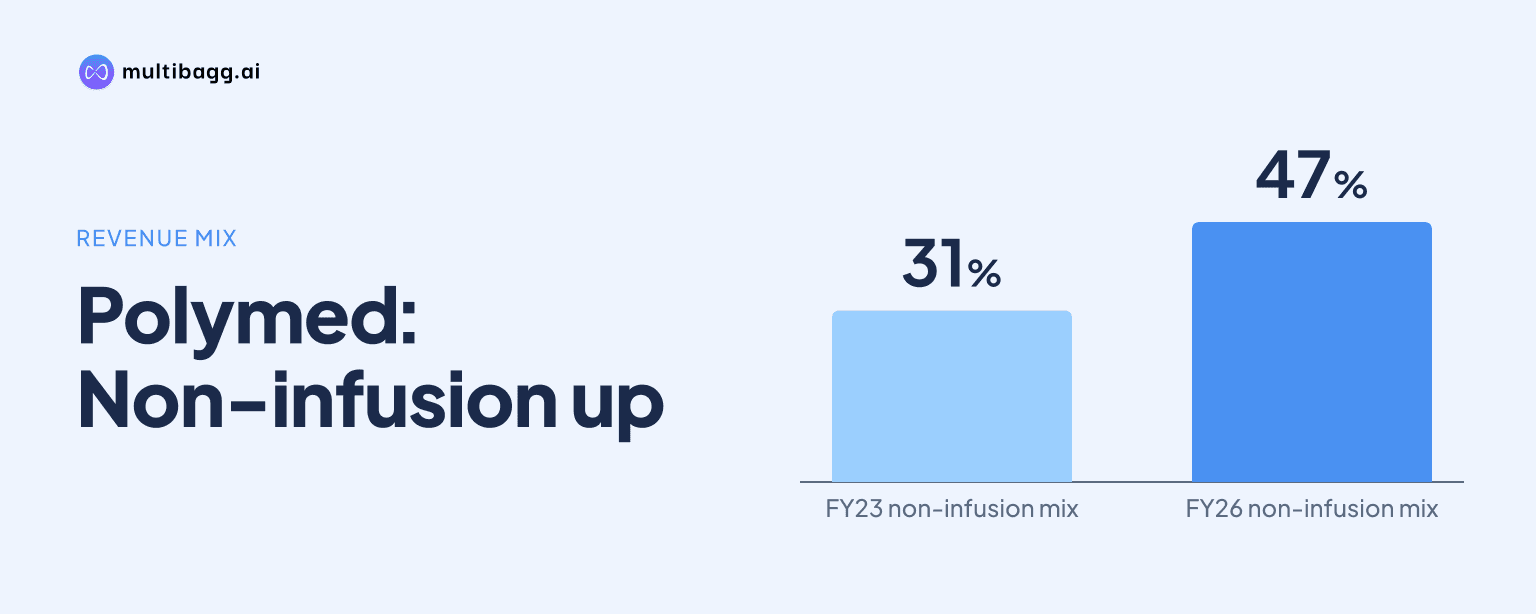
In FY26, Poly Medicure Limited derived 47% of its Rs 1,875 crore operating revenue from renal care and other businesses, up from 31% in FY23. Polymed reported a 35% compound annual growth rate, or CAGR, in renal care and 37% in others between FY23 and FY26, compared with 9% for infusion therapy.
Know Poly Medicure inside out
Results, valuation, peers and who's buying, in one view.
How did Polymed’s revenue mix change by FY26?
Polymed’s reported mix became less concentrated in infusion therapy by FY26: infusion therapy represented 53% of operating revenue, down from 69% in FY23. Renal care increased to 10% from 7%, while others rose to 37% from 24%, taking the combined non-infusion contribution to 47%, or 16 percentage points higher than three years earlier.
Total operating revenue increased by Rs 760 crore from FY23 to FY26, with others adding Rs 422 crore and renal care adding Rs 111 crore. Together, those two categories supplied Rs 533 crore of the increase, while infusion therapy added Rs 226 crore despite declining by Rs 15 crore from Rs 1,012 crore in FY25 to Rs 997 crore in FY26.
Which Polymed businesses drove non-infusion revenue growth?
Polymed’s others category was the largest contributor to non-infusion growth, increasing from Rs 269 crore in FY23 to Rs 691 crore in FY26. Its stated 37% CAGR exceeded the company-wide 19% CAGR, and its revenue share rose by 13 percentage points to 37% over the period.
Renal care increased from Rs 76 crore in FY23 to Rs 187 crore in FY26, producing a Rs 111 crore revenue increase and a stated 35% CAGR. Its share of total operating revenue rose by 3 percentage points to 10%, even as Polymed’s total revenue expanded by Rs 760 crore over the same three years.
Polymed’s renal portfolio includes dialysis machines, dialyzers, blood lines, haemodialysis catheters, peritoneal dialysis sets, fistula needles and transducer protectors. The company dates its renal-care entry to 2018 and describes itself as the first Indian company to manufacture dialyzers. It does not separately disclose revenue for the critical care, cardiology and orthopaedics activities included within the Rs 691 crore others category.
Got a follow-up? Ask IRIS
How did Polymed’s geographic growth compare with segment growth?
Polymed reported revenue growth in each of its three geographies between FY23 and FY26, although the regional mix moved less than the product mix. India rose from Rs 351 crore to Rs 582 crore at an 18% CAGR, retaining a 31% share of operating revenue in both FY23 and FY26.
Europe was the fastest-growing reported region, with revenue increasing from Rs 335 crore in FY23 to Rs 597 crore in FY26 at a 21% CAGR. Rest of World, or RoW, increased from Rs 430 crore to Rs 696 crore at a 17% CAGR; its revenue share fell to 37% from 39%, while Europe’s increased to 32% from 30%.
The comparison shows that the change in revenue composition was primarily segmental rather than geographic. In FY26, Polymed’s revenue was divided among RoW at 37%, Europe at 32% and India at 31%, while infusion therapy alone still represented 53% and the combined renal and others categories represented 47%.
What portfolio expansion supports Polymed’s changing mix?
Polymed identifies a progression from infusion therapy in 1997 to renal care in 2018, critical care in 2019, cardiology in 2024 and orthopaedics in 2025. This sequence provides context for the rise in renal care and others from a combined Rs 345 crore in FY23 to Rs 878 crore in FY26, but the presentation does not allocate others revenue among these newer verticals.
In cardiology, Polymed entered the segment in 2024, launched drug-eluting stents, or DES, in India in 2025 and initiated a 2,000-patient DES clinical trial in India and Europe in 2025. Polymed also acquired Citieffe in 2025 for orthopaedics and states that it aims over time to create a comprehensive portfolio. Its operating platform includes 25 to 30 annual product launches, more than 90 research and development professionals, and product registrations in more than 100 countries.
Conclusion
Polymed’s FY26 data show that renal care and others became material contributors alongside infusion therapy. Infusion remained the largest reported segment at Rs 997 crore and 53% of operating revenue, but the two non-infusion categories generated Rs 878 crore and accounted for Rs 533 crore of the Rs 760 crore revenue increase recorded since FY23.
The next disclosed developments to watch are the 2,000-patient DES trial initiated in 2025 and Polymed’s plan to build a comprehensive orthopaedics portfolio following the 2025 Citieffe acquisition. The presentation gives no trial completion date, cardiology or orthopaedics revenue target, or standalone financial disclosure for the businesses grouped within others.