










Polymed Europe grows nearly 40% on customer wins in Q2 FY27
Key highlights
- Polymed’s European business grew close to 40% organically in Q2 FY27, versus 29% in H1 FY27.
- Polymed added about 28-29 customers in Europe during H1 FY27.
- Rest of World organic revenue fell 7% in Q2 FY27 as Middle East logistics and freight costs disrupted orders.
- Polymed’s standalone international revenue was Rs 313 crore in Q2 FY27, up 15% year on year.
powered by IRIS
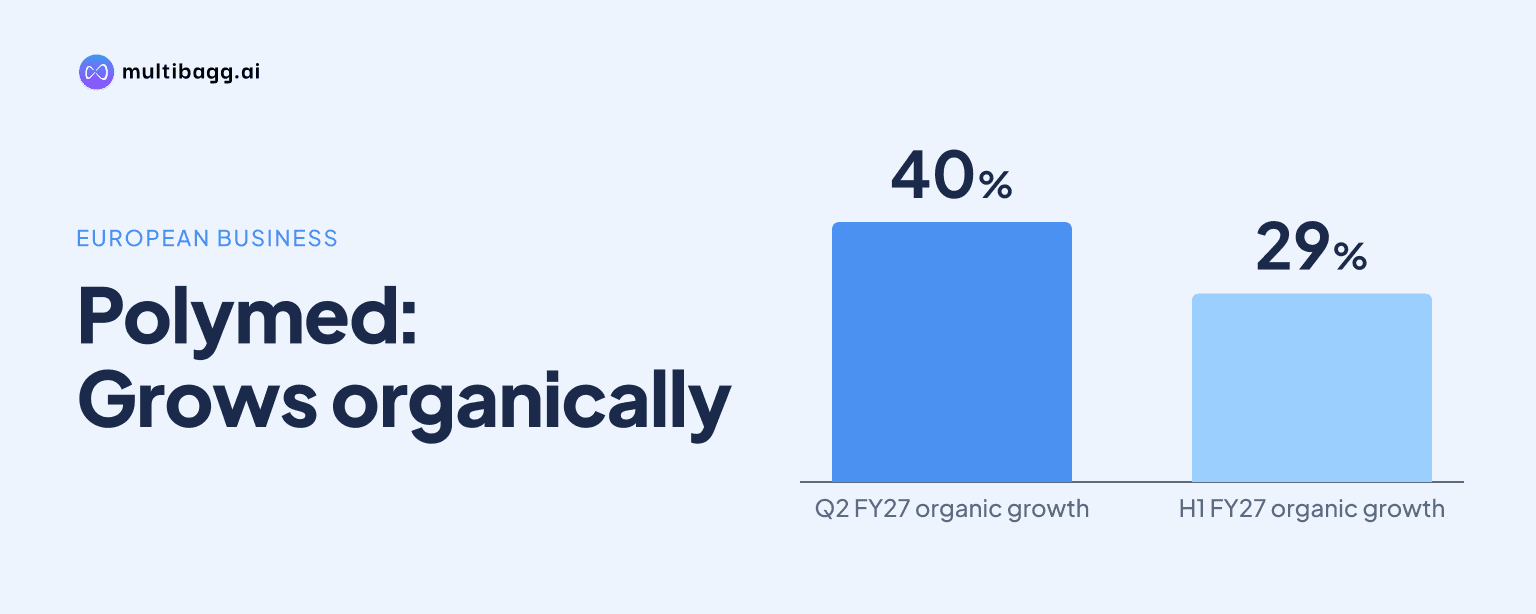
Poly Medicure Limited, referred to as Polymed, reported organic European business growth of close to 40% in Q2 FY27, following 29% growth in H1 FY27, as deeper customer engagement, 28-29 new customers and commercial projects supported the recovery despite continuing Chinese competition.
Know Poly Medicure inside out
Results, valuation, peers and who's buying, in one view.
Why did Polymed’s Europe business grow nearly 40% in Q2 FY27?
Polymed’s European business grew close to 40% organically in Q2 FY27 because customer additions, a larger revenue share from existing accounts and commercial projects contributed to sales. Management said Q1 FY27 had also grown well, but described Q2 FY27 as the point at which the European operation came back strongly. The figure excludes acquisition effects and therefore measures underlying regional growth.
The rebound followed a difficult FY26 for Europe, when management cited over-inventory from the preceding year, tariff-related challenges and Chinese dumping. Management said the current recovery was not predominantly an inventory-normalisation event. It attributed the result to work begun last year to deepen customer relationships, increase clinical engagement and introduce more products while customer inventories normalised.
Management also said some projects in the wider European region have begun to contribute, while others are expected to play out in Q4 FY27 and the next financial year. This means the close to 40% Q2 FY27 growth rate reflected both recovery in established accounts and early project contributions, rather than a single distributor inventory shift.
How did Polymed’s Europe growth compare with other international markets?
Polymed’s Europe growth contrasted with declines in Rest of World markets, where disruption associated with the West Asia conflict continued to affect orders. On an organic basis, Europe grew 29% in H1 FY27 while Rest of World revenue fell 1.8%; in Q2 FY27, Europe accelerated to close to 40% growth while Rest of World fell 7%.
Polymed’s standalone international revenue was Rs 313 crore in Q2 FY27, up 15%, compared with growth of 10% in Q1 FY27. For H1 FY27, standalone international revenue reached Rs 595 crore, up 12.5%. These international figures include regions beyond Europe, so the 15% quarterly growth rate was below Europe’s close to 40% organic expansion because Rest of World revenue declined.
Management traced Rest of World pressure primarily to the Middle East, where container availability, access to ports around Hormuz and higher freight costs made supply more difficult. It said underlying demand for its medical products remained intact, but customers could defer orders while freight rates stayed elevated. Europe’s growth therefore occurred while other export markets faced logistical constraints.
Got a follow-up? Ask IRIS
What customer actions are supporting Polymed’s European recovery?
Customer additions, cross-selling and clinical engagement are supporting Polymed’s European recovery, according to management. It said Polymed added about 28 to 29 customers in Europe in H1 FY27, while increasing revenue share with existing customers and introducing additional products. Across international markets, Polymed reported 30 new customers during the six-month period.
Management said deeper clinical engagement was a specific response to the challenges seen in FY26. Rather than relying only on price or inventory replenishment, Polymed has aimed to strengthen customer relationships and commercialise products in higher-value segments. It also said some products previously under registration had received approvals and were beginning commercialisation.
Chinese competition remains an issue. Management said dumping from China extends beyond medical devices and that Polymed continues to operate in a competitive environment. Its response includes customer relationships, new product launches and clinical engagement, while management said 30 product registrations were coming up in the European market.
Can Polymed sustain Europe’s recovery amid competition and project delays?
Polymed’s ability to sustain the recovery depends on converting projects and registrations while managing continued competition, rather than on inventory normalisation alone. Management said Europe offers a larger opportunity set and expressed confidence in organic growth, but did not provide a specific Europe growth target for FY27.
Polymed has established a direct presence in the United Kingdom and is working on three projects there. Management said one project is expected to go live in Q4 of the current financial year, with further projects expected in the following financial year. It also said it sees opportunities in other European markets under the India-European Union trade agreement and is considering direct presence in key markets.
Performance at European subsidiaries was mixed in the April-to-September period. Citieffe grew about 3% to 4%, with delayed public tenders in Italy identified as the main issue, although management said growth outside Italy, including the United States and Latin America, met expectations. PendraCare grew about 10% year on year through September, but its Middle East exposure, which represented close to 20% of its 2025 revenue, affected growth and earnings.
Management said Citieffe and Plan 1 Health were operating at mid-teens earnings before interest, tax, depreciation and amortisation margins, while PendraCare was loss-making at that level because of lost Middle East revenue and higher raw-material costs. It expects procurement, supply-chain, distribution and product-development initiatives to begin contributing from the upcoming financial year, although regulatory approvals can take one to three years.
Conclusion
Polymed’s close to 40% organic European growth in Q2 FY27 was materially ahead of the 7% decline in Rest of World markets and supported the broader international recovery. Management attributed the result to 28-29 European customer additions, deeper clinical engagement, product cross-selling and project execution, while Chinese competition remains an unresolved market factor.
The next evidence point is whether projects scheduled for Q4 FY27 and the following financial year convert into revenue, alongside progress on 30 upcoming European product registrations. Investors can also watch whether delayed Italian tenders ease for Citieffe and whether PendraCare’s planned projects, including expected revenue from mid-calendar 2027, improve its earnings trajectory.