










Polymed grew to 15 plants after Rs 1,400 crore equity raise
Key highlights
- Polymed expanded from 8 plants in 4 countries in FY20 to 15 plants in 5 countries in FY26.
- Annual production capacity rose from about 1.0 billion units in FY20 to about 1.9 billion units in FY26.
- Polymed raised approximately Rs 400 crore through a 2021 QIP and Rs 1,000 crore through a 2024 QIP.
- Operating revenue increased from Rs 687 crore in FY20 to Rs 1,875 crore in FY26.
powered by IRIS
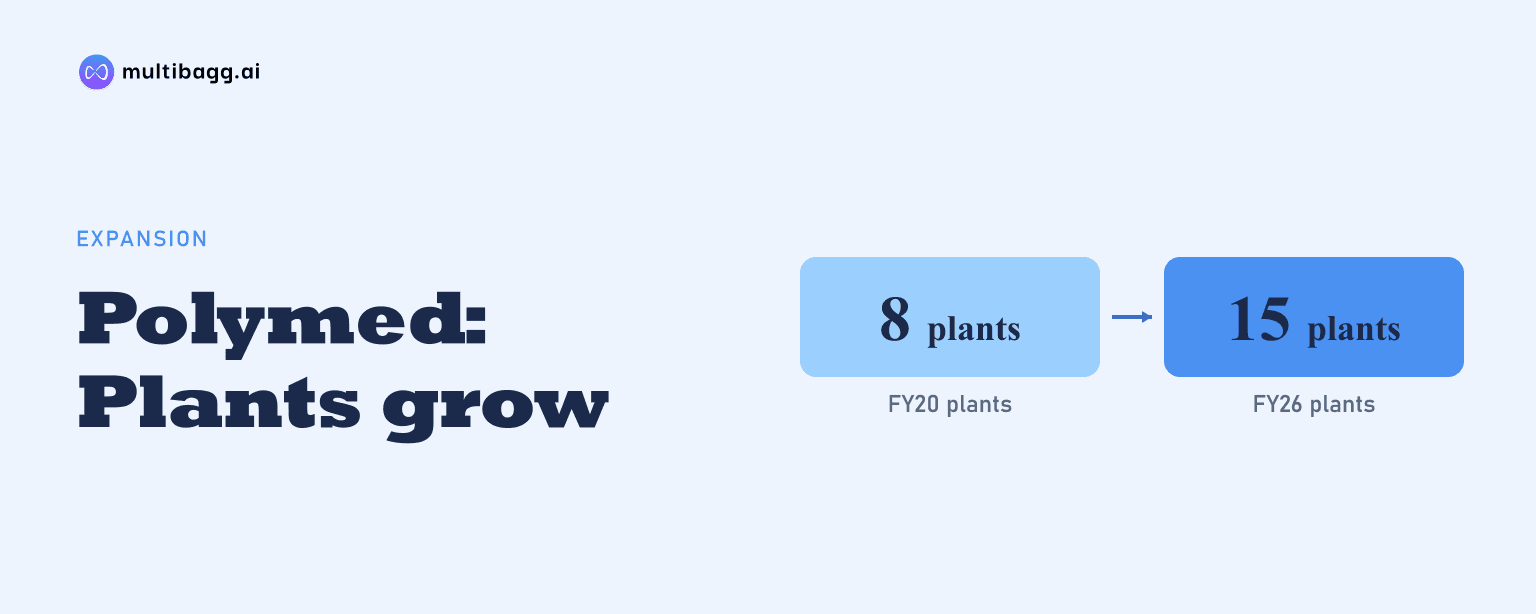
Polymed expanded from eight plants in four countries in FY20 to 15 plants in five countries in FY26, while annual capacity increased from about 1.0 billion to 1.9 billion units after Rs 1,400 crore of institutional equity was raised through qualified institutional placements in 2021 and 2024.
Know Poly Medicure inside out
Results, valuation, peers and who's buying, in one view.
How much did Polymed’s manufacturing footprint expand?
Polymed added seven plants, one manufacturing country and about 0.9 billion annual units of capacity between FY20 and FY26. Its FY20 network comprised eight plants in four countries, with about 63,000 square metres of total plant area and production capacity of about 1.0 billion units a year. By FY26, the company reported 15 plants in five countries, about 95,000 square metres of plant area and annual capacity of about 1.9 billion units.
The larger FY26 network supported manufacturing, packaging and sterilisation activities, which the presentation identifies as part of Polymed’s integrated model. The company also reported significant investment in backward integration, automation and sterilisation, alongside 90-plus research and development professionals and 200-plus quality and regulatory professionals. These capabilities accompany the 15-plant footprint rather than being stated as separate production capacity.
Polymed’s commercial reach was also broader than its manufacturing footprint. The company reported more than 1,000 distributors supplying over 125 countries, product registrations in more than 100 countries and about 550 direct-sales representatives across India, the US, Italy and Mexico. Those channels provide the route to market for products made within the five-country manufacturing base.
How was Polymed’s FY21 to FY26 expansion funded and deployed?
Polymed raised Rs 1,400 crore of institutional equity during FY21 to FY26, comprising an approximately Rs 400 crore qualified institutional placement, or QIP, in 2021 and a Rs 1,000 crore QIP in 2024. The company contrasts this funding phase with FY96 to FY20, when it says growth was funded by internal accruals after a 1996 initial public offering of about Rs 5.4 crore.
Management said the institutional capital was directed towards capacity expansion, deeper penetration in renal care and critical care, and entry into cardiology and orthopaedics. In 2025, Polymed acquired PendraCare and Citieffe, initiated construction of three new plants and began a 2,000-patient clinical trial for drug-eluting stents, or DES, in India and Europe. In 2026, it acquired Medyneo in Brazil and operationalised its Haridwar plant.
The product range listed for FY26 was wider than the FY20 foundation in infusion therapy. The FY20 portfolio included intravenous, or IV, cannulae, IV sets, endotracheal tubes, urine collection bags, transfer bags, blood bags, extension lines and disinfecting caps. The FY26 presentation lists newer products including percutaneous transluminal coronary angioplasty balloons, central venous catheters, DES, peripherally inserted central catheter ports, arterial catheters, drug-eluting balloons, guiding catheters and dialysis machines.
How did Polymed’s revenue and segment mix change as capacity grew?
Polymed’s revenue increased from Rs 687 crore in FY20 to Rs 1,875 crore in FY26, while operating earnings before interest, tax, depreciation and amortisation, or EBITDA, rose from about Rs 166 crore to about Rs 458 crore. The reported operating EBITDA margin changed from about 24.1% in FY20 to about 24.4% in FY26.
The mix shifted toward renal and other products between FY23 and FY26. Infusion Therapy revenue fell from Rs 1,012 crore in FY25 to Rs 997 crore in FY26, while Renal revenue rose from Rs 151 crore to Rs 187 crore and Others increased from Rs 507 crore to Rs 691 crore. Over FY23 to FY26, the presentation reports compound annual growth of 35% for Renal and 37% for Others, compared with 9% for Infusion Therapy.
Portfolio shares reflect the same change. Infusion Therapy represented 69% of the portfolio in FY23 and 53% in FY26, while Renal increased from 7% to 10% and Others rose from 24% to 37%. The change occurred as Polymed added cardiology in 2024 and orthopaedics through the 2025 Citieffe acquisition.
Got a follow-up? Ask IRIS
Which geographies and channels supported Polymed’s FY26 revenue?
Polymed recorded FY26 operating revenue of Rs 696 crore in the rest of the world, Rs 597 crore in Europe and Rs 582 crore in India. All three regions reported higher revenue than in FY23, when the rest of the world contributed Rs 430 crore, India Rs 351 crore and Europe Rs 335 crore.
Europe had the highest reported FY23-to-FY26 compound annual growth rate at 21%, compared with 18% for India and 17% for the rest of the world. Total operating revenue grew at a reported 19% compound annual rate over the same period. Polymed described international business as about 73% of FY20 revenue and about 69% of FY26 revenue.
The 2025 PendraCare acquisition is part of Polymed’s cardiology expansion in overseas markets. PendraCare reported product registrations in more than 60 countries, including Europe and the US, more than 50 distributors and annual capacity of over 1.5 million units. Its product mix in calendar 2025 was 70% guiding catheters, 23% diagnostic catheters and 7% other operating revenue.
What does Polymed plan after FY26?
Polymed’s stated FY27-onwards plan includes two upcoming plants, infrastructure for the next three to five years of growth and 25 to 30 new product launches annually. Management also outlined a plan to double research and development spending, expand clinical engagement and add more than 100 sales associates annually.
In Europe, Polymed reported more than 30 new products under registration. In the US, it reported 15 approvals obtained, more than 10 approvals in the pipeline and group purchasing organisation contracts across multiple accounts. Its go-direct plan covers organic and inorganic expansion in Brazil, Southeast Asia and Europe.
Polymed also plans to integrate PendraCare and Citieffe by combining supply-chain, procurement, research and development, product and customer capabilities. As of September 30, 2026, the presentation reported about Rs 839 crore of cash under its FY27-onwards balance-sheet and liquidity position. The company’s stated plan also includes globalising higher-complexity cardiology and critical-care verticals.
Conclusion
Polymed’s FY20-to-FY26 expansion combined a seven-plant increase, entry into one additional manufacturing country and an increase of about 0.9 billion annual production units with Rs 1,400 crore of institutional equity. Revenue rose from Rs 687 crore to Rs 1,875 crore, while the portfolio became less concentrated in Infusion Therapy as Renal and Others accounted for larger shares by FY26.
The next disclosed milestones are two upcoming plants, the integration of PendraCare and Citieffe, and the planned launch of 25 to 30 products annually. Progress on more than 30 European product registrations, over 10 US approvals in the pipeline and the 2,000-patient DES trial initiated in 2025 are further disclosed matters to watch.