










Pyramid says 10-point utilisation lift adds ₹135 crore
Key highlights
- Pyramid illustrates ₹952 crore of revenue at 70% utilisation and ₹1,351 crore at 100% utilisation.
- Pyramid says each 10-percentage-point utilisation increase can add about ₹135 crore of revenue at Q2FY27 realisations.
- Q2FY27 revenue was ₹238.0 crore, up 48% year on year, while volume rose 21% to 14,798 metric tonnes.
- Pyramid targets about 80% utilisation at Wada in FY27 and plans Kutch additions from March 2027.
powered by IRIS
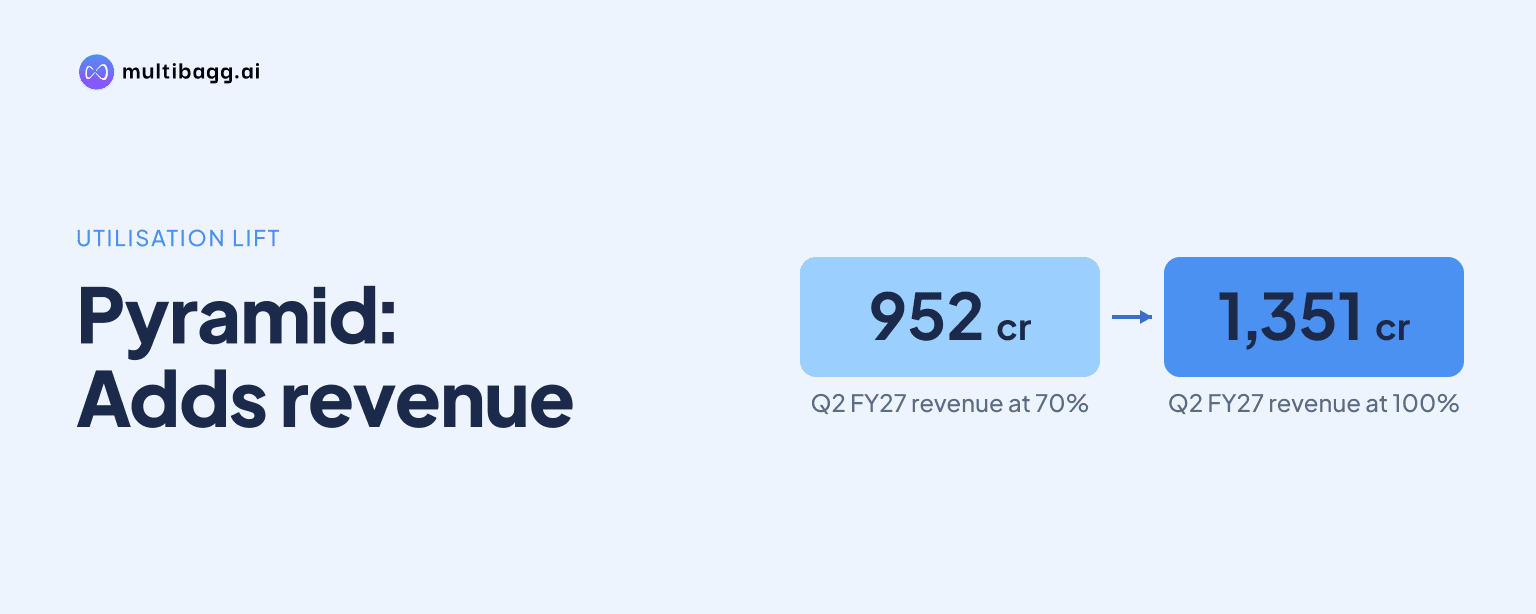
Pyramid Technoplast Limited says every 10-percentage-point increase in utilisation of its existing 83,971 metric tonnes per annum capacity can add about ₹135 crore of revenue at Q2FY27 realisations, with a 70% utilisation run-rate of ₹952 crore. Its illustration rises to ₹1,351 crore at 100% utilisation, although realised revenue will move with polymer prices.
Know Pyramid Technoplast inside out
Results, valuation, peers and who's buying, in one view.
How much revenue can Pyramid add from higher utilisation?
Pyramid illustrates revenue of ₹1,081 crore at 80% utilisation, ₹1,216 crore at 90% and ₹1,351 crore at 100%, compared with ₹952 crore at the 70% Q2FY27 run-rate. The company describes the increase as about ₹135 crore for each additional 10 percentage points of utilisation from its existing 83,971 metric tonnes per annum capacity.
Pyramid’s displayed increase from 70% to 80% is ₹129 crore, while the increases from 80% to 90% and from 90% to 100% are ₹135 crore each. The differing first step means the ₹135 crore figure is an approximation, and the ₹952 crore starting point is an annualised Q2FY27 run-rate rather than reported full-year revenue.
What calculation underpins Pyramid’s utilisation model?
Pyramid bases its model on Q2FY27 revenue of ₹238.0 crore and volume of 14,798 metric tonnes, producing a disclosed realisation of about ₹1.61 lakh per tonne. It applies this Q2FY27 realisation to the 83,971 metric tonnes per annum capacity base and the utilisation levels from 70% to 100%.
The Q2FY27 dashboard shows that realisation of ₹1.61 lakh per tonne was 22% higher year on year, while volume of 14,798 metric tonnes was 21% higher year on year. Pyramid explicitly says realisations move with polymer prices, so the ₹952 crore to ₹1,351 crore range is an illustrative output at the stated pricing level rather than a fixed sales forecast.
How have Pyramid’s revenue and utilisation changed?
Pyramid reported FY26 revenue of ₹681 crore at 67% utilisation, compared with its annualised Q2FY27 illustration of about ₹952 crore at 70% utilisation. The company says Q2FY27 annualises to the higher revenue level with volumes up 14% quarter on quarter, but FY26 reported revenue and a single-quarter annualisation are not like-for-like periods.
For Q2FY27, Pyramid reported revenue of ₹238.0 crore, up 48% year on year, and 70% utilisation. Its dashboard compares the 70% rate with 62% in Q2FY26, while a separate Q2FY27 performance page says utilisation returned to 70% from 62% in Q1FY27.
Pyramid also reported earnings before interest, tax, depreciation and amortisation, including other income, of ₹20.3 crore in Q2FY27, up 61% year on year. Profit after tax was ₹9.5 crore, up 54%, while EBITDA margin was 8.5% against 7.8% in Q2FY26 and EBITDA per tonne was ₹13,718, up 33% year on year.
Got a follow-up? Ask IRIS
Why could higher utilisation change Pyramid’s cost structure?
Pyramid says its plants, solar assets and recycling plant are already funded, so incremental volume mainly carries variable cost. This is the mechanism behind the operating-leverage disclosure: higher output could use existing capacity more fully without equivalent spending on a new plant, subject to demand, production costs and selling realisations.
Pyramid’s FY27 roadmap identifies 14.25 megawatts of solar capacity, with the remaining 1 megawatt still to be deployed, and management estimates annual power-cost reduction of ₹15 crore when the programme is complete. The solar project had investment of more than ₹60 crore and produced H1FY27 savings of ₹3.89 crore, according to the presentation.
Pyramid’s recycling plant, commissioned on October 3, 2025, has annual capacity of 5,000 metric tonnes and is intended to meet 10% to 12% of raw-material needs. Against 30,000 tonnes of high-density polyethylene used for production, management estimated FY27 EBITDA of about ₹2 crore from the plant; Q2FY27 EBITDA profit was ₹33 lakh.
What utilisation and capacity milestones has Pyramid disclosed?
Pyramid targets about 80% utilisation at Wada in FY27. On the company’s existing-capacity illustration, 80% corresponds to ₹1,081 crore of revenue, which is ₹129 crore above the stated ₹952 crore run-rate at 70%; this is a Wada utilisation target, not a company-wide revenue forecast.
Pyramid also says Kutch will add 10,000 intermediate bulk container units a month from March 2027. That addition is described as being on top of the 83,971 metric tonnes per annum existing-capacity illustration, so it is not included in the ₹952 crore to ₹1,351 crore utilisation table.
Management’s FY27 roadmap calls for ₹20 crore to ₹25 crore of capital expenditure according to demand and indicates revenue growth of about 15%. Management also guides for an EBITDA margin of 11% to 12%, compared with 8.6% in FY26 and 9.0% in H1FY27, citing captive solar, recycling, Wada operating leverage and product mix.
Conclusion
Pyramid’s presentation puts a revenue figure on the capacity already in place: the Q2FY27 run-rate moves from ₹952 crore at 70% utilisation to ₹1,351 crore at full utilisation using a realisation of about ₹1.61 lakh per tonne. Reported Q2FY27 revenue of ₹238.0 crore, volume of 14,798 metric tonnes and 70% utilisation provide the operating data underlying that illustration.
The next disclosed markers are Wada’s approximately 80% FY27 utilisation target, deployment of the remaining 1 megawatt of solar capacity and Kutch’s planned addition of 10,000 intermediate bulk container units monthly from March 2027. Management’s ₹20 crore to ₹25 crore FY27 capital-expenditure plan is tied to demand, while its 11% to 12% EBITDA-margin guidance depends partly on solar, recycling, utilisation and product mix.