










Sanghvi Movers Limited Reports 32% Q2 Revenue Growth in FY27
Key highlights
- Sanghvi Movers reported Q2 FY27 revenue from operations of ₹277 crore, up 32% year-on-year.
- Q2 FY27 EBITDA rose 20% to ₹106 crore, while EBITDA margin declined to 36% from 41%.
- Profit after tax increased to ₹40 crore in Q2 FY27 from ₹36 crore a year earlier.
- The group order book stood at ₹1,582 crore as of October 25, 2026.
powered by IRIS
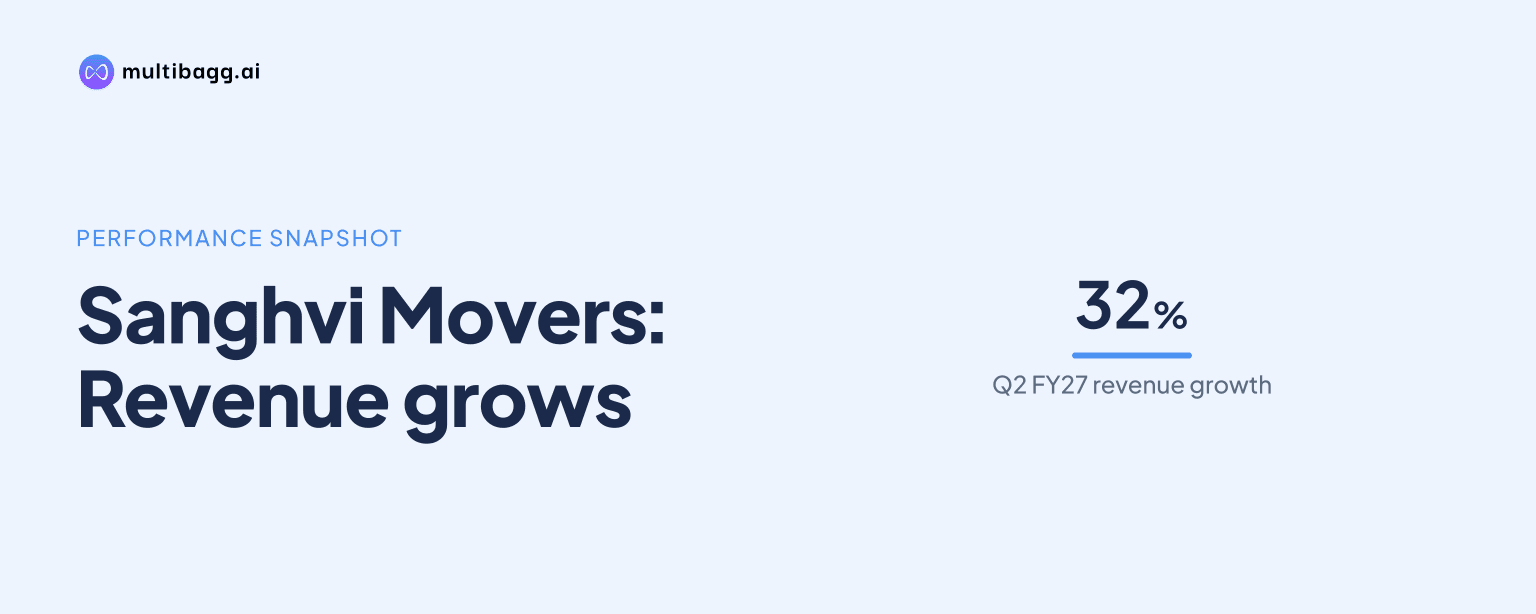
Sanghvi Movers Limited reported 32% year-on-year revenue growth in Q2 FY27, with revenue from operations of ₹277 crore. Total income rose 36% to ₹296 crore, while the company reaffirmed its FY27 total-income guidance of ₹1,400 crore to ₹1,500 crore following the quarter ended September 30, 2026.
Know Sanghvi Movers inside out
Results, valuation, peers and who's buying, in one view.
What did Sanghvi Movers report in Q2 FY27?
Sanghvi Movers reported consolidated revenue from operations of ₹277 crore for Q2 FY27, compared with ₹210 crore in Q2 FY26. Total income rose to ₹296 crore, a 36% year-on-year increase, while EBITDA increased 20% to ₹106 crore.
The company reported an EBITDA margin of 36% for the quarter, compared with 41% a year earlier. Profit after tax rose to ₹40 crore from ₹36 crore in the corresponding quarter of the previous financial year. Cash profit was approximately ₹78 crore.
For the first half of FY27, revenue from operations increased 36% year-on-year to ₹657 crore. Total income for the six-month period rose 38% to ₹689 crore. The H1 figures provide the basis for the company retaining its full-year operating guidance.
What drove Sanghvi Movers' operating performance?
Sanghvi Movers attributed its growth to execution in India and the Middle East, with the quarter also reflecting the scale of its crane rental and renewable engineering, procurement and construction businesses. The company discussed these results on its investor conference call held on November 3, 2026.
Chief Financial Officer Pradeep Mehta presented the quarterly and half-year financial and operating performance, including balance-sheet, cash-flow and capital-expenditure positions. Managing Director Rishi Sanghvi and Chief Executive Officer Gaurang Desai were also listed as management participants in the call.
The quarter's EBITDA growth of 20% was lower than revenue growth of 32%, and the EBITDA margin declined by five percentage points from the year-earlier level. The reported numbers show that higher income did not translate into a comparable increase in the quarterly margin.
How did utilisation and the order book change in Q2 FY27?
Sanghvi Movers said India crane utilisation moderated to 71% in Q2 FY27 from 86% in Q1 because of the seasonal monsoon slowdown. However, Q2 utilisation was ahead of the 70% reported in the prior-year period, and yield improved to 2.20% from 2.04%.
Management said prolonged rains could delay project activity into Q3. It also stated that capitalisation and deployment in India were moderated during the monsoon period, with deployment expected to improve as project activity normalises. These comments frame the lower sequential utilisation as a seasonal operational factor.
The group order book stood at ₹1,582 crore as of October 25, 2026. It comprised ₹683 crore in India and Botswana crane rental, ₹45 crore in GCC crane rental and ₹854 crore in renewable EPC. The company said the order book was largely executable within the current financial year, while noting logistical challenges in West Asia.
Middle East utilisation was 87% in Q2 and 86% for H1, with a reported yield of 3.8% for H1. The contrast with India's monsoon-affected utilisation highlights the role of overseas operations in the period's execution profile.
Got a follow-up? Ask IRIS
What guidance has Sanghvi Movers reaffirmed for FY27?
Sanghvi Movers reaffirmed FY27 guidance for total income of ₹1,400 crore to ₹1,500 crore and EBITDA of ₹525 crore to ₹575 crore. The guidance was retained on the basis of first-half performance and the order book, according to management's comments during the call.
The company linked its India outlook to a longer investment cycle, referring to fixed capital formation and capacity additions in sectors such as cement. Management cited cement capacity rising from 686 million tonnes towards 850 million tonnes by FY30, with around 70-75 million tonnes of commissioning expected during the current year.
These industry references are relevant to crane rental demand because plant construction, expansion and associated installation work require lifting equipment. Sanghvi Movers also said it was prioritising higher-EBITDA assets in the Middle East for FY28, indicating where it sees an operating focus beyond the current year.
How was the Q2 FY27 earnings call disclosed to investors?
Sanghvi Movers disclosed under Regulation 30 of the SEBI Listing Obligations and Disclosure Requirements framework that the audio recording of its investor conference call was available on its website. The filing was dated November 3, 2026, and related to unaudited results for the quarter ended September 30, 2026.
The disclosure was filed with BSE Limited under scrip code 530073 and with the National Stock Exchange of India Limited under the symbol SANGHVIMOV. It followed the company’s earlier notice scheduling the post-results call for November 3 at 4:00 PM IST.
For investors, the filing primarily improves access to management commentary accompanying the results. It does not itself add financial guidance or operating figures beyond confirming that the call recording is publicly available.
Conclusion
Sanghvi Movers delivered year-on-year growth in Q2 FY27, with revenue from operations rising to ₹277 crore and EBITDA reaching ₹106 crore. The result also showed a lower EBITDA margin and a monsoon-related reduction in Indian crane utilisation, while overseas utilisation remained higher and the group order book stood at ₹1,582 crore.
The next disclosed reference point is the company’s FY27 guidance of ₹1,400 crore to ₹1,500 crore in total income and ₹525 crore to ₹575 crore in EBITDA. Investors will also watch the pace at which Indian project activity normalises after the monsoon and the execution of the stated order book during the current financial year.