










Stove Kraft says lower prices masked appliance volume gains
Key highlights
- Stove Kraft said kettle and air-fryer volumes rose over the last year even as value growth was negative or flat because selling prices declined.
- Management said the appliances category is almost 45% above its earlier base.
- Stove Kraft launched one imported air-purifier model and said it saw good traction in its first 2 months.
- Management guided to an 11% to 12% company-level margin for the current year.
powered by IRIS
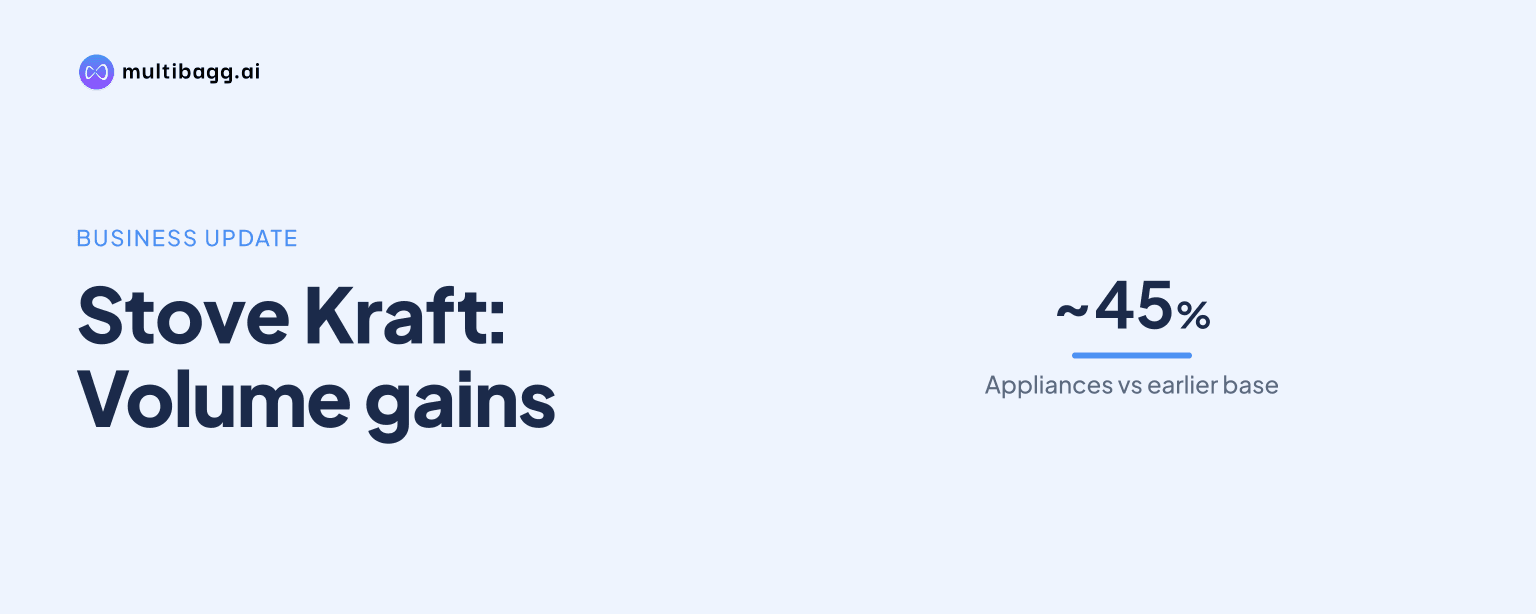
Stove Kraft Limited said lower selling prices made kettle and air-fryer value growth negative or flat despite volume gains, while the appliances category stood almost 45% above its earlier base. Management also said its gradual withdrawal from Black & Decker reduced the reported appliance contribution.
Know Stove Kraft inside out
Results, valuation, peers and who's buying, in one view.
Why did Stove Kraft’s appliance value growth look subdued?
Lower average selling prices and the withdrawal from Black & Decker were the reasons Stove Kraft gave for appliance value growth not reflecting volume gains. Stove Kraft said kettles and air fryers grew in volume over the last year, but value growth in those products was either negative or showed no growth because their average selling prices declined.
Management described a change from the earlier growth phase, when the kettle and air-fryer categories had a smaller base and expanded rapidly in both volume and value. As the categories entered a more competitive phase, Stove Kraft reduced costs and selling prices to acquire market share and seek leadership, meaning the lower average selling price, or ASP, offset the effect of additional units sold.
The appliances category was also affected by Stove Kraft’s decision to gradually let go of the Black & Decker brand. Management did not quantify Black & Decker revenue or say when the withdrawal would be completed, but identified the business being relinquished as part of the appliance-category comparison. Reported category growth therefore includes both pricing changes in core products and a smaller contribution from the departing brand.
Stove Kraft rejected the view that its appliances business was not growing. Management said the category is “pretty large,” at almost 45% above its earlier base, and argued that percentage growth was higher when the base was smaller. The call disclosed product-level volume momentum, but not separate revenue, volume or ASP figures for kettles, air fryers or Black & Decker.
Which products are driving Stove Kraft’s appliance strategy?
Kettles and air fryers are the established products underlying Stove Kraft’s appliance expansion, while air purifiers and chimneys are newer areas being tested or scaled. Management said kettles, launched during the COVID period, are by far the largest in their category, and said Stove Kraft is also very large in air fryers after launching them a few years ago.
Management attributed its appliances position to complete manufacturing and its distribution network, rather than imported products alone. Its stated product process begins with consumer research and a market test; if acceptance is sufficient, Stove Kraft moves into manufacturing. Management said it has generally achieved leadership when it reaches the third phase of completely manufacturing a product, though that was a management view rather than a disclosed market-share measure.
Air purifiers illustrate the earlier stage of this process. Stove Kraft had launched one imported air-purifier model and said the product had been in the market for its first two months, with good traction. Management said the category was being sought across cities, rather than only in northern and western markets, and that Stove Kraft sells through e-commerce, its stores and general trade in the North.
Stove Kraft said it would not dilute company margins when importing new products solely to test customer acceptance. If the air purifier receives sufficient acceptance, management said Stove Kraft would manufacture it during the year, but it did not disclose sales, unit volumes, marketing expenditure or a timetable for local production. Chimneys are now within appliances, and Stove Kraft said it has started manufacturing them for both the Gilma and Pigeon brands, with expected growth in coming quarters.
Got a follow-up? Ask IRIS
How is Stove Kraft expanding appliance capacity?
Stove Kraft is directing near-term investment toward appliance capacity in Delhi and supply-chain capability in China, while management said existing capacity can support revenue of up to Rs 2,500 crore without a broad capacity addition. The Delhi investment is intended to increase appliance capacity, and management said capacity should be fully utilised before the end of next year.
The China investment is described by management as a capability addition rather than a conventional capacity project. It is intended to support sourcing and raw-material backward integration, mitigate supply-chain challenges and improve product costs. Management also cited a cold-spray plant added last year as a technology capability investment, saying it could help the company serve customers unavailable to other Indian producers.
An analyst noted Rs 90 crore of cash-flow spending in the first half against an earlier reference to roughly Rs 100 crore including China investment. Management responded that cash flow and capital expenditure are not identical because cash flow can include payments for earlier investments. It guided that planned capital expenditure was within Rs 50 crore, while investment in the China subsidiary and adjacent land acquisition were outside the originally planned capex.
What margin range did Stove Kraft provide?
Management said the second and third quarters are larger than the first and last quarters, creating financial leverage and normally a 0.5% to 1% difference in margin percentage, absent other meaningful factors. This seasonal comparison applied to Stove Kraft’s overall margins and was not an appliance-segment margin disclosure.
For the current year, management said it was confident of an 11% to 12% margin. It did not provide an appliance-segment margin or an earnings target for the following year when an analyst asked whether earnings before interest, tax, depreciation and amortisation, or EBITDA, could exceed Rs 300 crore next year.
Conclusion
The call indicates that Stove Kraft’s subdued appliance value growth was not presented as a demand problem in kettles and air fryers. Management’s explanation combines higher volumes with lower ASPs, a larger category base and the planned Black & Decker exit. Newer products such as air purifiers and chimneys add potential sources of growth, but Stove Kraft did not disclose their revenue contribution.
The next issues to watch are whether air-purifier customer acceptance leads to manufacturing during the year, whether Delhi appliance capacity is utilised before the end of next year, and how the Black & Decker withdrawal affects reported category value. Management’s disclosed margin range for the year is 11% to 12%, with seasonal differences of 0.5% to 1% between larger and smaller quarters.