










Stove Kraft Q2 FY27 Revenue Rises 23% as Margin Hits 12.9%
Key highlights
- Stove Kraft's Q2 FY27 revenue rose 23.2% year-on-year to ₹584.7 crore.
- Q2 FY27 EBITDA increased 32.7% to ₹75.3 crore and EBITDA margin reached a record 12.9%.
- Q2 FY27 profit after tax grew 35.7% year-on-year to ₹29.0 crore.
- H1 FY27 revenue reached ₹1,065.2 crore, up 30.8% year-on-year.
powered by IRIS
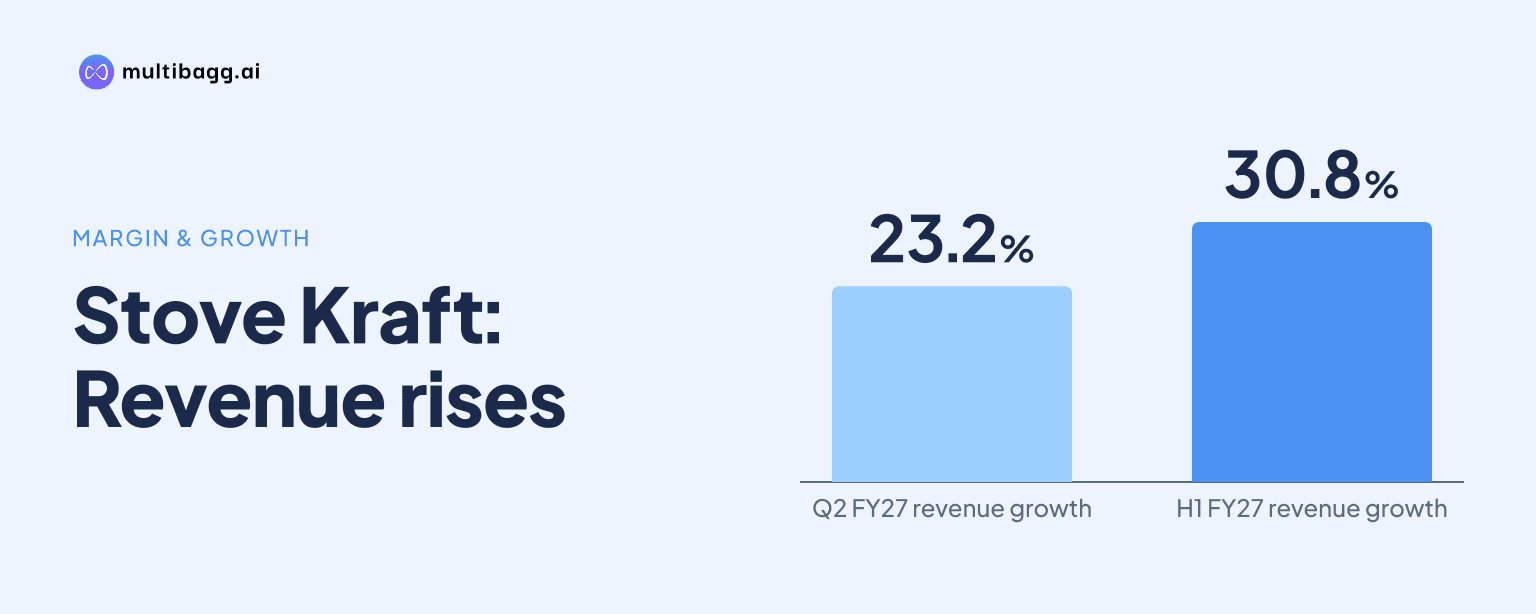
Stove Kraft Ltd reported Q2 FY27 revenue from operations of ₹584.7 crore, up 23.2% year-on-year, and a record EBITDA margin of 12.9%, supported by festive demand, retail and general trade growth, and higher induction cookware sales. Net profit rose 35.7% to ₹29.0 crore during the quarter.
Know Stove Kraft inside out
Results, valuation, peers and who's buying, in one view.
What did Stove Kraft report for Q2 FY27?
Stove Kraft reported broad-based growth in the September-quarter period of FY27, with revenue from operations reaching ₹584.7 crore. The reported 23.2% year-on-year increase came alongside EBITDA of ₹75.3 crore, up 32.7%, indicating that operating profit increased faster than sales. The company also reported a gross margin of 39.6%.
Profit after tax rose to ₹29.0 crore, a 35.7% year-on-year increase. Earnings per share for the quarter stood at ₹8.75, while profit before tax was ₹38 crore. The performance matters because the company combined double-digit revenue growth with a 90-basis-point expansion in EBITDA margin to 12.9%.
The first-half performance was also stronger than the corresponding prior-year period. Revenue for H1 FY27 was ₹1,065.2 crore, up 30.8% year-on-year. This placed the second-quarter result within a period of sustained sales growth rather than an isolated quarterly increase.
What drove Stove Kraft's quarterly sales growth?
Stove Kraft attributed the quarter's growth to retail and general trade channels, with festive demand also supporting sales. The company operates in home and kitchen appliances, including pressure cookers, cooktops, standing hobs and non-stick cookware, categories that can see stronger demand around the festive season.
Induction cookware was a prominent contributor during the quarter, with sales in this category rising 108%, according to the earnings-call summary. The company described this increase as a sharp, event-driven boost. Its reported shift from aluminium products towards stainless-steel and tri-ply offerings was also presented as part of the product mix supporting growth.
The earnings-call material, however, indicated that exports lagged the domestic business. This distinction is relevant because the reported growth was led by India-focused distribution channels rather than a broad-based acceleration across every geography. The available material does not provide an export revenue figure or a country-wise sales breakup.
Why did Stove Kraft's operating margin improve?
Stove Kraft's EBITDA margin reached 12.9% in Q2 FY27, compared with a level 90 basis points lower a year earlier. EBITDA growth of 32.7% exceeded the 23.2% increase in revenue, while gross margin reached 39.6%. These figures indicate that the company generated more operating profit from each rupee of sales than in the comparable quarter.
The available disclosures link the quarter's performance to category mix, including induction cookware and the company's focus on stainless-steel and tri-ply products. They do not provide a detailed bridge separating the contributions of prices, input costs, product mix, manufacturing efficiency or distribution expenses. Investors should therefore distinguish the reported margin outcome from any unreported assumptions about its individual drivers.
The 12.9% EBITDA margin was described as a record for the company in the earnings material. For shareholders, the combination of margin expansion and a 35.7% rise in profit after tax is a key part of the Q2 result, particularly as revenue growth remained above 20%.
Got a follow-up? Ask IRIS
What are the key investment and balance-sheet considerations?
Stove Kraft said borrowings increased because of inventory build-up and China-related capital expenditure. The company has indicated that its China investment is capped at 20 million RMB, or about ₹29 crore to ₹30 crore, covering the Holy One trading arm and a manufacturing joint-venture subsidiary. The initiative is intended to support backward integration.
The company also referred to facility expansion at Himachal Bhatik and Bengaluru, including lines for pressure cookers and small appliances at Bhatti. The stated timeline for these production-related additions was the next six to eight months. The disclosed capex and inventory requirements are therefore important alongside the stronger operating result, as they affect funding needs and working-capital deployment.
Management guided for around 20% growth and referred to an incremental revenue target of ₹1,900 crore to ₹2,000 crore over the next two to three years. These are management targets rather than reported results. The supplied material does not disclose updated debt levels, interest costs, capacity utilisation or a specific timetable for achieving the longer-term revenue objective.
How does the Q2 result affect investors and industry operations?
For investors, the main confirmed takeaway is that Stove Kraft delivered faster growth in EBITDA and net profit than in revenue during Q2 FY27. Revenue of ₹584.7 crore, EBITDA of ₹75.3 crore and profit after tax of ₹29.0 crore provide the clearest financial markers for assessing the quarter. No share-price movement or valuation data was included in the supplied material, so no conclusion can be drawn on the market's immediate reaction.
For operations, the stronger domestic retail and general trade performance highlights the importance of consumer demand and product-category momentum in the kitchenware and appliances segment. The lag in exports and the rise in borrowings for inventory and capital expenditure show that business conditions were not uniformly favourable across all areas. The company is balancing near-term demand fulfilment with manufacturing and sourcing investments.
The next set of disclosures will be important for measuring whether the reported growth remains durable after the festive period, whether the new facilities progress within the stated timeframe, and how inventory and borrowings evolve. The Q2 results establish a higher operating-margin benchmark, while management's growth guidance sets a measurable reference point for subsequent quarters.
Conclusion
Stove Kraft delivered a stronger Q2 FY27, with revenue rising 23.2% to ₹584.7 crore, EBITDA increasing 32.7% to ₹75.3 crore and net profit growing 35.7% to ₹29.0 crore. Domestic retail and general trade, festive demand and induction cookware supported the result, while the 12.9% EBITDA margin was the highest reported by the company in the supplied earnings material.
Investors will next watch progress on the Himachal Bhatik and Bengaluru expansion plans, the China investment capped at 20 million RMB, and the effect of inventory build-up on borrowings. Management's guidance for around 20% growth and its ₹1,900 crore to ₹2,000 crore incremental-revenue target over the next two to three years remain the key disclosed benchmarks.