










Stove Kraft H1 Operating Cash Flow Falls 76% on Working Capital
Key highlights
- Stove Kraft's H1 FY27 net cash from operating activities fell to Rs 25.4 crore from Rs 107.4 crore in H1 FY26.
- Changes in working capital were an Rs 86.3 crore outflow in H1 FY27, versus an Rs 20.8 crore inflow a year earlier.
- Stove Kraft's H1 FY27 profit before tax rose 50.5% to Rs 60.9 crore and revenue rose 30.8% to Rs 1,065.2 crore.
- Stove Kraft ended September 2026 with Rs 60 lakh of cash and cash equivalents, down from Rs 22.0 crore at March 2026.
powered by IRIS
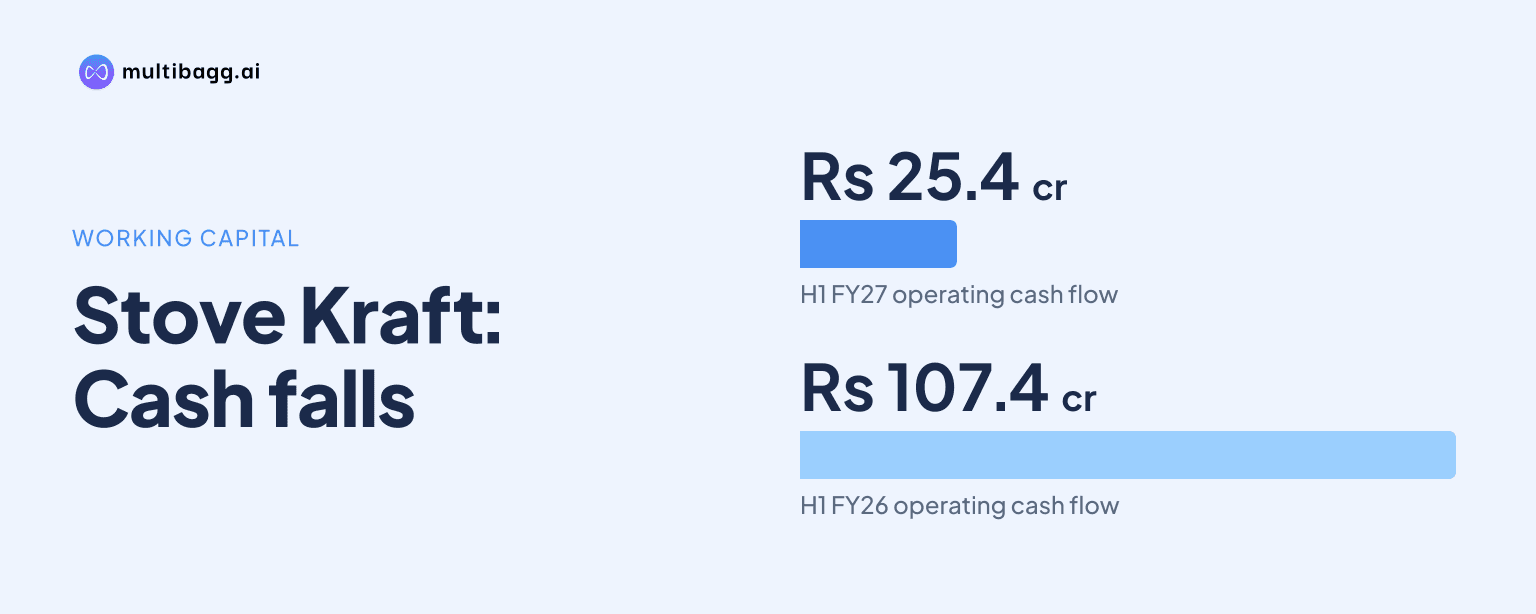
Stove Kraft reported Rs 25.4 crore of net cash from operating activities in H1 FY27, down 76% from Rs 107.4 crore in H1 FY26, as changes in working capital absorbed Rs 86.3 crore despite a 50.5% rise in profit before tax to Rs 60.9 crore.
Know Stove Kraft inside out
Results, valuation, peers and who's buying, in one view.
Why did Stove Kraft's operating cash flow fall in H1 FY27?
Stove Kraft's operating cash flow fell because working-capital changes moved from an Rs 20.8 crore cash inflow in Sep-25 to an Rs 86.3 crore outflow in Sep-26. This Rs 107.1 crore change outweighed the increase in operating profit before working-capital changes, which rose by Rs 30.9 crore to Rs 123.7 crore.
Cash generated from operations before direct taxes was Rs 37.4 crore in Sep-26, compared with Rs 113.6 crore in Sep-25. Direct taxes paid also increased to Rs 12.1 crore from Rs 6.2 crore, leaving net cash from operating activities at Rs 25.4 crore rather than the prior-year Rs 107.4 crore.
Did Stove Kraft's profit increase despite lower operating cash?
Stove Kraft's reported profit increased despite the reduction in operating cash. Revenue from operations rose 30.8% to Rs 1,065.2 crore in H1 FY27, profit before tax rose 50.5% to Rs 60.9 crore, and profit after tax increased 44.8% to Rs 46.0 crore from Rs 31.8 crore.
Earnings before interest, tax, depreciation and amortisation, or EBITDA, rose 39.7% to Rs 129.1 crore from Rs 92.4 crore. EBITDA margin increased to 12.1% from 11.3%, while gross profit rose 34.8% to Rs 422.1 crore and gross-profit margin reached 39.6%, compared with 38.4% in H1 FY26.
The difference emerged after the Rs 123.7 crore operating profit before working-capital changes was adjusted for the Rs 86.3 crore outflow. In H1 FY26, the comparable operating profit was Rs 92.8 crore and working-capital changes added Rs 20.8 crore, producing cash generated from operations of Rs 113.6 crore.
Which balance-sheet changes coincided with the outflow?
Stove Kraft's working-capital outflow coincided with increases in several current-asset balances between 31 March 2026 and 30 September 2026. Inventories rose by Rs 196.8 crore to Rs 556.8 crore, trade receivables rose by Rs 50.5 crore to Rs 165.5 crore, and other current assets rose by Rs 61.0 crore to Rs 93.6 crore.
Current liabilities also increased during the period. Trade payables other than dues to micro and small enterprises increased to Rs 531.1 crore from Rs 336.2 crore, while current borrowings rose to Rs 104.3 crore from Rs 80 lakh. The cash-flow statement does not allocate its Rs 86.3 crore working-capital outflow among individual balance-sheet accounts.
Stove Kraft had Rs 60 lakh of cash and cash equivalents at 30 September 2026, after beginning the half year with Rs 22.0 crore. The cash-flow statement reported a Rs 21.3 crore net decrease in cash and cash equivalents during Sep-26, while the presentation gave no separate cash-balance target.
Got a follow-up? Ask IRIS
How did investing and financing flows affect Stove Kraft's cash?
Stove Kraft recorded an Rs 86.2 crore cash outflow from investing activities in Sep-26, compared with an Rs 70.3 crore outflow in Sep-25. Financing activities provided Rs 39.6 crore in Sep-26, reversing a Rs 36.9 crore financing outflow in the previous-year period.
The balance sheet reported property, plant and equipment of Rs 539.6 crore at 30 September 2026, up from Rs 519.0 crore at 31 March 2026. Capital work-in-progress increased to Rs 31.8 crore from Rs 14.8 crore, although the presentation does not reconcile the Rs 86.2 crore investing outflow line by line to asset additions.
Operating cash flow of Rs 25.4 crore, investing outflow of Rs 86.2 crore and financing inflow of Rs 39.6 crore together resulted in the reported Rs 21.3 crore reduction in cash. The company ended Sep-25 with Rs 2.9 crore of cash and cash equivalents, versus Rs 60 lakh at the end of Sep-26.
What do Stove Kraft's Q2 FY27 working-capital days show?
Stove Kraft reported net working-capital days of 32 in Q2 FY27, down from 45 days in Q1 FY27 and 51 days in Q2 FY26. Management attributed the quarter-on-quarter reduction to better inventory utilisation and strong festive-season demand.
Inventory days fell to 144 in Q2 FY27 from 158 in Q1 FY27, but remained above 128 days in Q2 FY26. Receivable days declined to 26 from 28 sequentially and 37 a year earlier, while payable days were 138, compared with 140 in Q1 FY27 and 114 in Q2 FY26.
These day-count measures cover Q2 FY27, whereas the cash-flow statement covers the six months to September 2026. The quarterly improvement therefore indicates a later-period change in working-capital efficiency, but it does not alter the reported Rs 86.3 crore H1 FY27 cash outflow from working-capital changes.
Conclusion
Stove Kraft's H1 FY27 results show that growth in reported earnings did not translate proportionately into operating cash. Revenue reached Rs 1,065.2 crore, EBITDA was Rs 129.1 crore and profit before tax was Rs 60.9 crore, but the Rs 86.3 crore working-capital outflow reduced net operating cash flow to Rs 25.4 crore.
The next disclosed measure to watch is whether net working-capital days remain below the 45 days reported in Q1 FY27 after reaching 32 days in Q2 FY27. Management linked the Q2 movement to inventory utilisation and festive-season demand, while inventory stood at Rs 556.8 crore and trade receivables at Rs 165.5 crore on 30 September 2026.