










Stove Kraft retail revenue rises 70% as stores reach 360
Key highlights
- Stove Kraft retail revenue increased 70.3% year on year to Rs 83.8 crore in H1 FY27.
- Pigeon reached 360 outlets in Q2 FY27 after adding 16 stores during the quarter.
- Pigeon had 199 franchisee-model stores, equal to 55.3% of its 360-store network.
- Pigeon reported average sales of Rs 4.47 lakh per store per month in Q2 FY27.
powered by IRIS
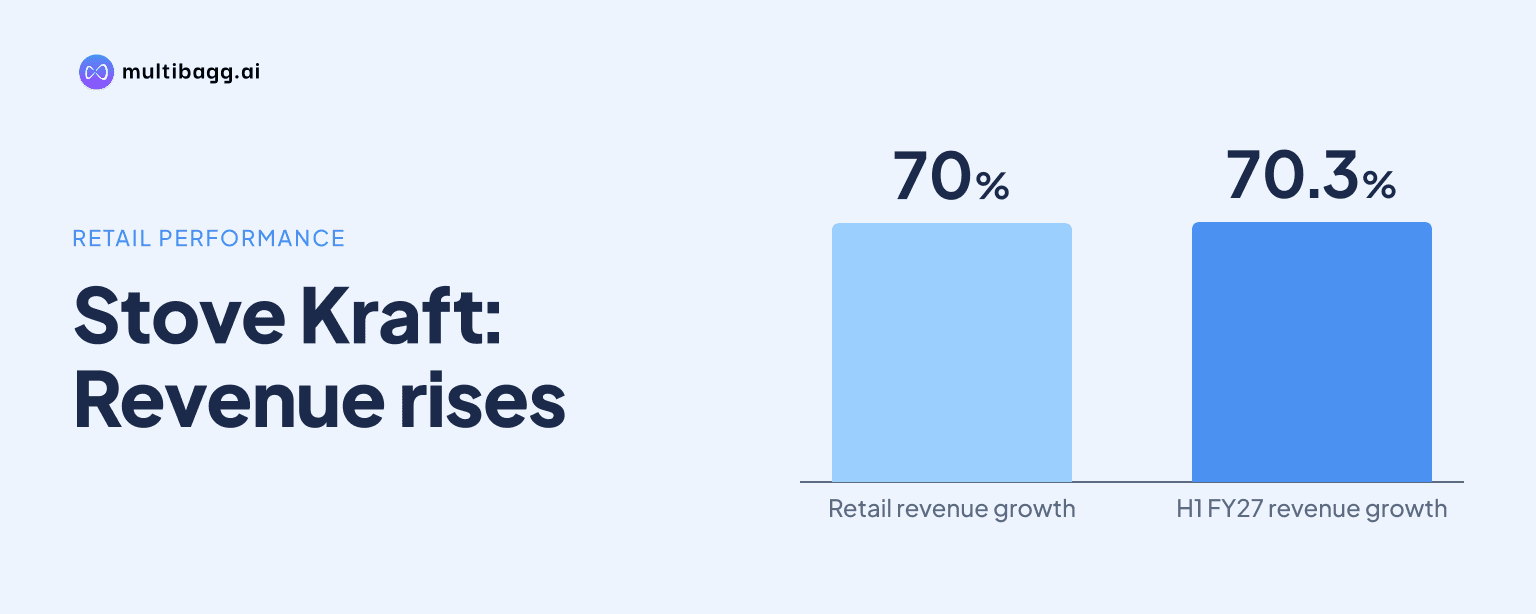
Stove Kraft Limited’s retail-channel revenue rose 70.3% year on year to Rs 83.8 crore in the first half (H1) of financial year (FY) 2027, while its Pigeon network reached 360 outlets after 16 additions in the second quarter (Q2) FY27. The company said 199 of the 360 Pigeon stores operated under franchisee models.
Know Stove Kraft inside out
Results, valuation, peers and who's buying, in one view.
How fast did Stove Kraft’s retail channel grow?
Stove Kraft’s retail channel was its fastest-growing domestic channel in H1 FY27, rising 70.3% from Rs 49.2 crore in H1 FY26 to Rs 83.8 crore. In Q2 FY27, retail revenue increased 57.1% to Rs 42.3 crore from Rs 26.9 crore a year earlier, based on the company’s channel-wise reporting.
The H1 FY27 result extended a multi-period increase in retail sales. Revenue rose from Rs 17.9 crore in H1 FY24 to Rs 33.4 crore in H1 FY25, then Rs 49.2 crore in H1 FY26 and Rs 83.8 crore in H1 FY27. Stove Kraft reported a 67.2% compound annual growth rate for retail over the H1 FY24 to H1 FY27 period.
Retail represented 7.9% of Stove Kraft’s H1 FY27 channel mix, compared with 7.2% in Q2 FY27. E-commerce remained the largest channel at 35.3% of H1 FY27 revenue, followed by general trade at 30.4%, leaving retail smaller in contribution despite its faster growth rate.
What expanded in Stove Kraft’s Pigeon outlet network?
Stove Kraft had 360 Pigeon stores across 22 states and 172 Indian cities at the end of Q2 FY27. The company added 16 stores during the quarter and said Pigeon expanded into nine new cities, taking the outlet count 35 above the 325 stores reported in Q3 FY26.
The Pigeon network rose from 328 outlets in Q4 FY26 to 346 in Q1 FY27 and 360 in Q2 FY27. The 14-store increase in Q2 FY27 followed an 18-store increase in the preceding quarter, meaning the network added 32 outlets during the first half of FY27 from its Q4 FY26 base.
Pigeon reported 141,308 new customers and 322,119 units sold in the disclosed retail metrics. Pressure cookers and small appliances contributed 30% of Pigeon revenue, while cooktops, hobs and chimneys contributed 20%; Stove Kraft did not provide a revenue split for the remaining categories.
How is Stove Kraft shifting Pigeon toward franchise formats?
Stove Kraft reported 199 Pigeon stores under franchisee models out of 360 total outlets in Q2 FY27. This represented 55.3% of the network, with the remaining 161 stores accounting for 44.7%.
The store-format data shows 110 company-owned franchise-operated outlets and 89 franchise-owned franchise-operated outlets in Q2 FY27, together making up the 199 franchisee-model stores. Their combined count was 136 in Q3 FY26, comprising 73 company-owned franchise-operated and 63 franchise-owned franchise-operated stores.
The 35-store net increase between Q3 FY26 and Q2 FY27 occurred alongside a 63-store rise in franchisee-model outlets and a 28-store reduction in the other outlet base. This describes the reported operating mix change; the presentation does not disclose a target franchise share for Pigeon.
Got a follow-up? Ask IRIS
How do Pigeon and Gilma retail operations compare?
Stove Kraft’s Pigeon network was larger than Gilma’s in Q2 FY27, with 360 Pigeon stores compared with 17 Gilma stores. Pigeon operated in 22 states and 172 cities, while the relaunched Gilma premium brand had stores in three states and 10 cities in southern markets.
Pigeon’s average sales per store per month were Rs 4.47 lakh, compared with Rs 4.64 lakh for Gilma. Gilma’s figure was reported alongside 830 units sold and 600 customers, against Pigeon’s 322,119 units and 141,308 new customers.
All 17 Gilma stores operated under the franchisee model in Q2 FY27, according to Stove Kraft. Gilma reported chimneys as 66% of revenue and hobs as 27%, whereas Pigeon identified pressure cookers and small appliances as 30% of revenue and cooktops, hobs and chimneys as 20%.
How does retail growth fit Stove Kraft’s wider H1 FY27 performance?
Stove Kraft reported consolidated revenue of Rs 1,065.2 crore in H1 FY27, up 30.8% year on year, and earnings before interest, tax, depreciation and amortisation of Rs 129.1 crore, up 39.7%. Retail’s 70.3% growth was more than twice the group revenue growth rate for the half year.
Pigeon brand sales reached Rs 938 crore in H1 FY27, up from Rs 686 crore in H1 FY26, while original equipment manufacturer sales increased to Rs 119.6 crore from Rs 117.1 crore. Other-brand revenue, including LED, Gilma, Black & Decker and Skava, declined to Rs 7.7 crore from Rs 11.8 crore.
The consolidated product mix in H1 FY27 included induction cooktops at 32%, pressure cookers at 22%, nonstick cookware at 22%, small appliances at 18% and gas cooktops at 5%. Induction cooktop revenue grew 188.9% year on year, while gas cooktop revenue declined 6.6%.
Conclusion
Stove Kraft’s retail result combines faster channel revenue growth with a larger Pigeon store base and a higher franchisee-model presence. Retail revenue reached Rs 83.8 crore in H1 FY27, Pigeon reached 360 stores in Q2 FY27, and 199 of those stores operated under franchisee models.
The presentation does not disclose a future outlet target or a planned franchise-share target, leaving the pace of additional Pigeon openings and format conversion unresolved. The next reported comparison can show whether retail growth remains ahead of general trade’s 52.2% and e-commerce’s 24.2% H1 FY27 growth rates, and whether Gilma expands beyond 17 stores.