








Peers
Price Chart Comparison
Documents
Investor Presentation
Q3 FY26
Investor Presentation
Q2 FY26
Investor Presentation
Q1 FY26
Available on Pro Plan
Unlock reports, presentations, and AI-powered insights.
Investor Presentation
Q4 FY25
Available on Pro Plan
Unlock reports, presentations, and AI-powered insights.
Investor Presentation
Q3 FY25
Available on Pro Plan
Unlock reports, presentations, and AI-powered insights.
Investor Presentation
Q2 FY25
Available on Pro Plan
Unlock reports, presentations, and AI-powered insights.
Investor Presentation
Q4 FY24
Available on Pro Plan
Unlock reports, presentations, and AI-powered insights.
Investor Presentation
Q3 FY24
Available on Pro Plan
Unlock reports, presentations, and AI-powered insights.
Actions
AI Mode
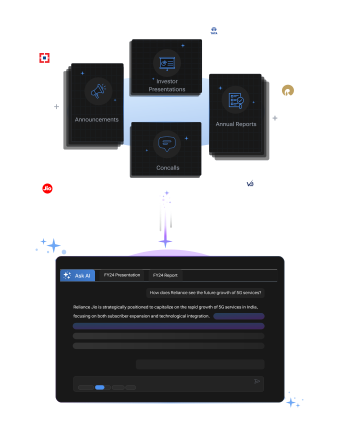
Get instant AI-powered insights about company performance, financials, and strategy. Ask questions about trends, competition, and developments while receiving responses backed by official documents and market data, with clear attribution to source documents.
Ask AI


Frequently Asked Questions about Stove Kraft Ltd
Stove Kraft Ltd (STOVEKRAFT) is currently trading at 488.00 per share. Stock prices fluctuate during market hours on NSE and BSE based on demand, company updates, and overall market conditions. Refer to the live price chart above for the most recent price movement.
Stove Kraft Limited manufactures and sells kitchen and home appliances under brands including Pigeon, Gilma and BLACK+DECKER (licenced), operating manufacturing facilities in Bengaluru and Baddi and a multi‑channel distribution network spanning exclusive Pigeon stores, 600+ distributors and exports to the USA and Mexico. Retail expansion is a central growth lever: Stove Kraft opened 17 new exclusive stores in Q3, operates 313 stores across 21 states and is targeting 500 exclusive outlets by April 2027, with average monthly sales per store at INR 4.27 lakh, signalling aggressive roll‑out and franchise focus. Financially mixed near term: 9MFY26 revenue rose 4.9% Y‑o‑Y to INR 1,192.9 crore with improved gross margins (~38.8% for 9M), while Q3FY26 saw revenue and PAT compression; the company is actively reducing debt (noted reduction to ~INR 806 million) and improving working capital metrics. Product and manufacturing upgrades are tangible: Stove Kraft commissioned a cast iron foundry, automated roller coating lines, launched new product categories such as air fryers and personal care items, and installed a 4 MWp rooftop solar plant — reflecting vertical integration and cost focus to support margin improvement.
Over the past 52 weeks, Stove Kraft Ltd has traded between a low of ₹454.40 and a high of ₹822.55. The 52-week high and low indicate the stock’s price range over the last year and help investors understand its volatility and recent trading levels.
Stove Kraft Ltd has a market capitalization of approximately 1,627.56. Market capitalization represents the total value of a company’s outstanding shares and helps investors understand its size, stability, and relative risk compared to other listed companies.
Stove Kraft Ltd’s investment profile depends on its business fundamentals, valuation, and long-term outlook. The stock currently trades at a PE ratio of 18.53 and operates in the Consumer Durables sector. Investors typically assess financial performance, growth prospects, and individual risk tolerance before making investment decisions.
Based on its market capitalization of 1,627.56 Cr, Stove Kraft Ltd is classified as a Small Cap stock. Large-cap stocks are generally more stable, while mid-cap and small-cap stocks tend to offer higher growth potential along with higher price volatility.
Stove Kraft Ltd operates in the Consumer Durables sector. Sector classification matters because companies in the same sector are often affected by similar economic conditions, regulatory changes, and competitive dynamics, which can influence overall stock performance.
The Price-to-Earnings (PE) ratio of Stove Kraft Ltd is 18.53. The PE ratio compares a company’s share price to its earnings and is commonly used to assess valuation. Comparing the PE ratio with sector peers and historical levels provides better context.