










Stove Kraft cash drops to Rs 50 lakh after H1 net outflows
Key highlights
- Stove Kraft's cash and cash equivalents fell to Rs 50 lakh at September 30, 2026 from Rs 21.95 crore at March 31, 2026.
- Net cash from operating activities declined to Rs 39.85 crore in H1 2026 from Rs 107.41 crore in H1 2025.
- Inventories increased by Rs 196.83 crore in H1 2026, compared with a Rs 29.40 crore cash release in H1 2025.
- Net proceeds from short-term borrowings were Rs 103.47 crore in H1 2026, and current borrowings reached Rs 104.30 crore.
powered by IRIS
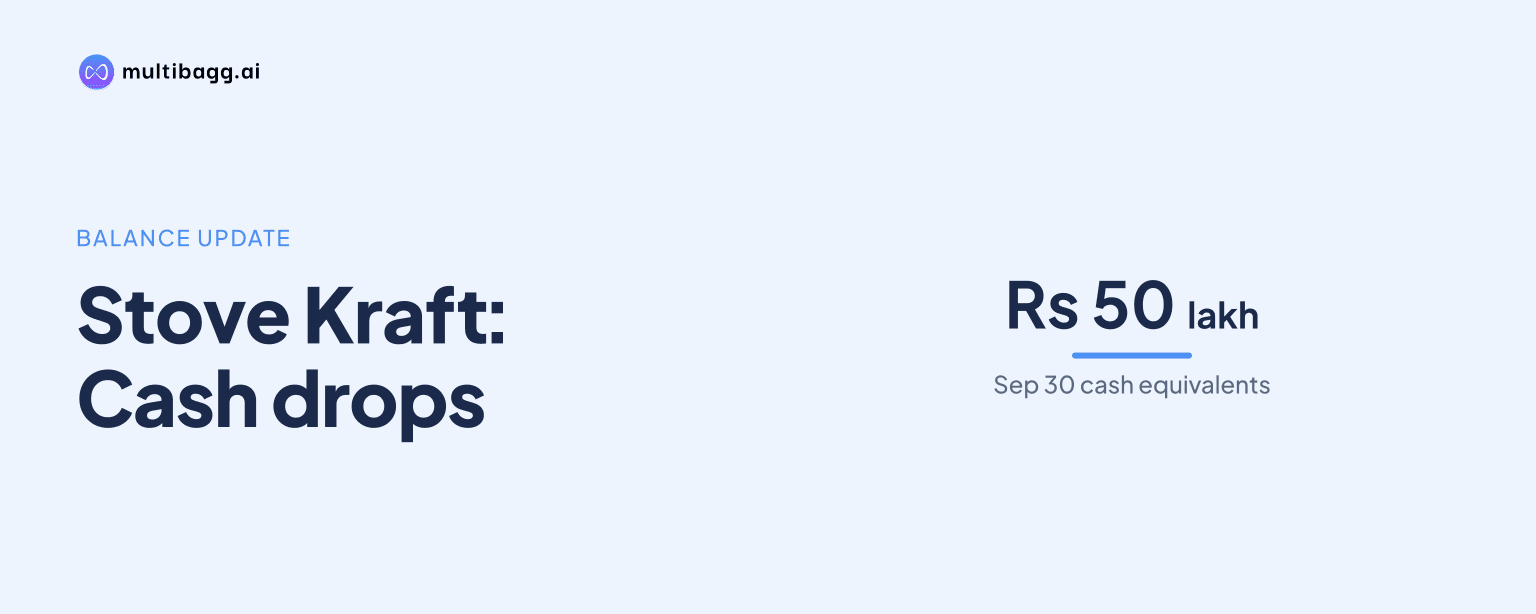
Stove Kraft Limited ended the half year to September 30, 2026 with cash and cash equivalents of Rs 50 lakh, down from Rs 21.95 crore at March 31, 2026, after Rs 100.86 crore of investing outflows and Rs 39.85 crore of operating cash generation. Stove Kraft funded part of the cash requirement with Rs 103.47 crore of net short-term borrowing proceeds.
Know Stove Kraft inside out
Results, valuation, peers and who's buying, in one view.
Why did Stove Kraft's cash balance decline in H1 2026?
Stove Kraft's cash balance declined by Rs 21.45 crore in the half year ended September 30, 2026 because investing outflows of Rs 100.86 crore exceeded the combined Rs 79.41 crore generated by operating and financing activities. Cash and cash equivalents consequently fell from Rs 21.95 crore at the beginning of the period to Rs 50 lakh at the end.
The September 30, 2026 closing balance comprised Rs 38.4 lakh of remittances in transit, Rs 6.5 lakh in bank current accounts and Rs 5.1 lakh of cash on hand. In the corresponding half year ended September 30, 2025, cash equivalents increased by Rs 18.2 lakh to Rs 2.95 crore, rather than falling as they did in the latest period.
Cash equivalents are narrower than the wider bank-related balances in current assets. Stove Kraft reported Rs 11.87 crore of bank balances other than cash and cash equivalents at September 30, 2026, compared with Rs 8.50 crore at March 31, 2026, with the balance sheet classifying these amounts separately.
How did working capital affect Stove Kraft's operating cash flow?
Working capital reduced Stove Kraft's operating cash generation because inventories increased by Rs 196.83 crore, trade receivables by Rs 48.40 crore and other assets by Rs 59.90 crore in H1 2026. These cash uses followed operating cash profit before working-capital movements of Rs 123.92 crore.
The inventory movement differed sharply from H1 2025, when it contributed a Rs 29.40 crore cash release instead of consuming Rs 196.83 crore. Trade receivables also absorbed more cash in H1 2026, at Rs 48.40 crore, than the Rs 26.16 crore recorded in the prior-year half.
Higher trade payables partially offset the outflows, rising by Rs 204.52 crore in H1 2026 compared with a Rs 9.35 crore increase in H1 2025. Cash generated from operations was Rs 51.90 crore, down from Rs 113.62 crore, and net income taxes paid of Rs 12.05 crore left net operating cash flow of Rs 39.85 crore versus Rs 107.41 crore a year earlier.
What investments used Stove Kraft's cash in H1 2026?
Stove Kraft used Rs 100.86 crore in investing activities in H1 2026, compared with Rs 70.30 crore in H1 2025. The largest item was Rs 76.48 crore paid for property, plant and equipment and other intangible assets, higher than the Rs 71.45 crore spent in the previous corresponding half year.
The company also invested Rs 21.76 crore in a wholly owned subsidiary during the period. Stove Kraft incorporated Guangzhou Jiawo Import & Export Co. Ltd in the People's Republic of China in the September 2026 quarter after the board granted in-principle approval on May 25, 2026, and made the investment on August 12, 2026.
Other investing movements included a Rs 4.43 crore net investment in margin-money deposits, Rs 1.61 crore of disposal proceeds from property, plant and equipment and intangible assets, and Rs 19.1 lakh of interest received from bank deposits. Capital work-in-progress rose to Rs 31.85 crore at September 30, 2026 from Rs 14.82 crore at March 31, while property, plant and equipment increased to Rs 539.65 crore from Rs 518.96 crore.
Got a follow-up? Ask IRIS
How did Stove Kraft finance its cash requirements?
Stove Kraft generated Rs 39.56 crore from financing activities in H1 2026, reversing an Rs 36.93 crore financing outflow in H1 2025. Net proceeds from short-term borrowings were Rs 103.47 crore, compared with net repayments of Rs 42.35 crore in the prior-year half, making this the main financing inflow.
The balance sheet reflects that short-term funding movement. Current borrowings were Rs 104.30 crore at September 30, 2026, up from Rs 83.6 lakh at March 31, 2026, while non-current borrowings declined to Rs 1.15 crore from Rs 1.58 crore. The filing does not disclose the instruments, interest rates or maturity profile underlying the short-term borrowings.
Financing outflows included Rs 16.46 crore of interest and other finance charges paid, Rs 15.40 crore of lease-liability payments, Rs 11.58 crore in dividends and Rs 12.12 crore of net supplier-credit repayment. Finance costs recognised in the income statement rose to Rs 17.20 crore in H1 2026 from Rs 13.43 crore in H1 2025.
Did Stove Kraft's profit translate into operating cash?
Stove Kraft reported Rs 46.21 crore of profit for H1 2026, up from Rs 31.79 crore in H1 2025, while net operating cash flow after tax was Rs 39.85 crore, down from Rs 107.41 crore. The difference reflects the Rs 196.83 crore inventory increase, Rs 48.40 crore rise in receivables and Rs 59.90 crore increase in other assets.
Profit before tax rose to Rs 61.11 crore from Rs 40.50 crore as revenue from operations increased to Rs 1,065.25 crore from Rs 814.53 crore. Stove Kraft reports one Kitchen and Home Appliances segment, so the filing provides no product-category breakdown of sales, inventory or working-capital changes.
Depreciation and amortisation of Rs 48.19 crore and interest and other finance costs of Rs 17.20 crore were among the adjustments that lifted operating cash profit before working capital to Rs 123.92 crore from Rs 92.81 crore. The subsequent working-capital movements, rather than the reported profit level, drove the year-on-year reduction in operating cash flow.
Conclusion
Stove Kraft's H1 2026 statements show that higher revenue and profit did not prevent a reduction in cash and cash equivalents to Rs 50 lakh. Inventory, receivables and other assets absorbed cash, while Rs 100.86 crore of investing outflows exceeded cash generated from operations and financing combined, despite Rs 103.47 crore of net short-term borrowing proceeds.
The next results will show whether the Rs 196.83 crore inventory build-up and higher receivables unwind or require further funding, and whether current borrowings remain near Rs 104.30 crore. Investors can also watch the cash effect of the Rs 21.76 crore investment in the China subsidiary and the unresolved appeals for assessment years 2022-23 and 2023-24 involving additional tax demands of Rs 1.35 crore.