










Stove Kraft reduces net working-capital days to 32 in Q2 FY27
Key highlights
- Stove Kraft's net working-capital days declined to 32 in Q2 FY27 from 51 in Q2 FY26.
- Inventory days fell to 144 in Q2 FY27 from 158 in Q1 FY27, but remained above 128 days in Q2 FY26.
- Inventories increased to Rs 556.8 crore on 30 September 2026 from Rs 360 crore on 31 March 2026.
- H1 FY27 changes in working capital used Rs 86.3 crore of cash, versus a Rs 20.8 crore cash source a year earlier.
powered by IRIS
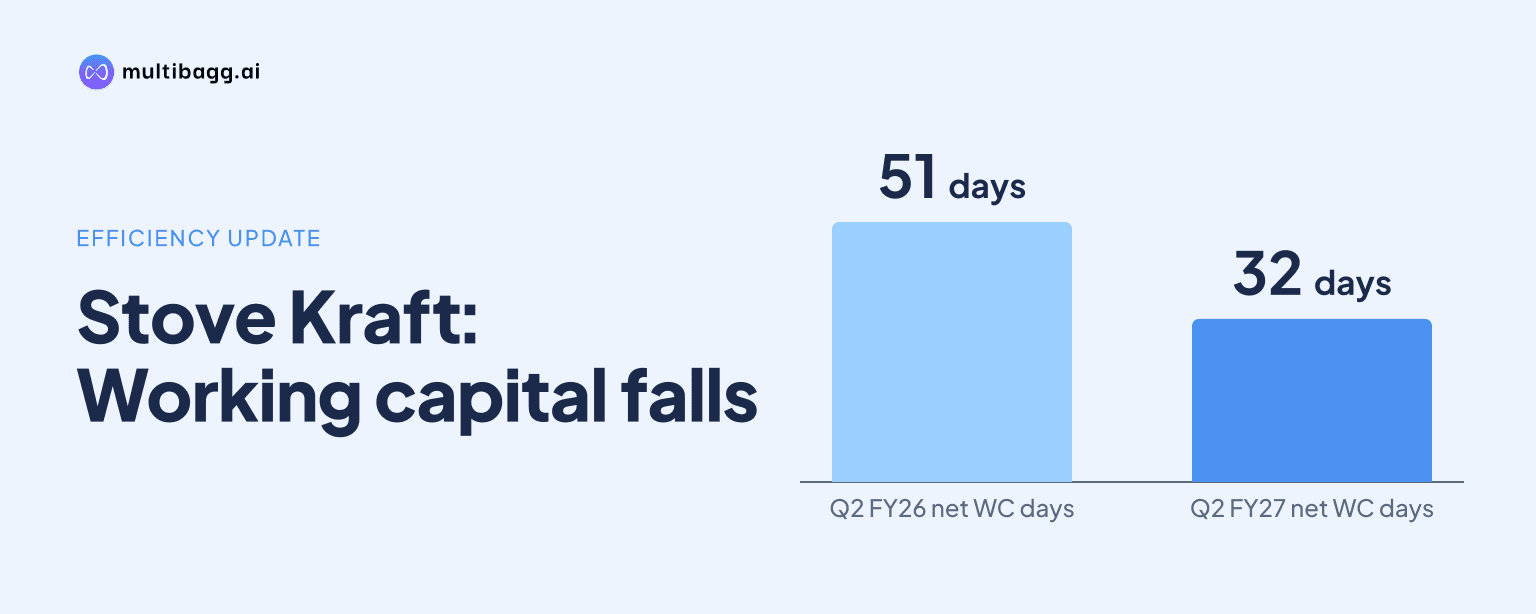
Stove Kraft reduced net working-capital days to 32 in Q2 FY27, from 51 in Q2 FY26 and 45 in Q1 FY27, as inventory days fell by 14 sequentially and receivable days declined to 26. Inventories nevertheless stood at Rs 556.8 crore on 30 September 2026, compared with Rs 360 crore on 31 March 2026.
Know Stove Kraft inside out
Results, valuation, peers and who's buying, in one view.
How did Stove Kraft reduce net working-capital days to 32?
Stove Kraft reduced net working-capital days by 19 days year on year and by 13 days quarter on quarter to 32 in Q2 FY27. The disclosed operating-cycle components were 144 inventory days, 26 receivable days and 138 payable days, compared with 158, 28 and 140 days, respectively, in Q1 FY27. The 14-day sequential reduction in inventory days was the largest component of the improvement.
Stove Kraft attributed the move from 45 days in Q1 FY27 to 32 days in Q2 FY27 to better inventory utilisation and strong festive-season demand. Net working-capital days were also below the 51 days reported in Q2 FY26, even though inventory days of 144 were 16 days above the 128 days reported a year earlier. Lower receivable days and higher payable days relative to Q2 FY26 also contributed to the year-on-year result.
What changed in Stove Kraft's inventory, receivables and payables?
Stove Kraft's inventory days declined to 144 in Q2 FY27 from 158 in Q1 FY27, but remained above the 128 days in Q2 FY26. In balance-sheet terms, inventories increased to Rs 556.8 crore at 30 September 2026 from Rs 360 crore at 31 March 2026. The source therefore shows sequentially faster inventory utilisation alongside a higher inventory balance at the half-year date.
Trade receivables increased to Rs 165.5 crore at 30 September 2026 from Rs 115 crore at 31 March 2026, while receivable days fell to 26 from 28 in Q1 FY27 and 37 in Q2 FY26. Revenue from operations rose to Rs 584.7 crore in Q2 FY27, 23.2% above Rs 474.4 crore in Q2 FY26. For H1 FY27, revenue was Rs 1,065.2 crore, up 30.8% from Rs 814.5 crore in H1 FY26.
Supplier obligations also expanded at the reporting date. Trade payables other than micro and small enterprise dues rose to Rs 531.1 crore on 30 September 2026 from Rs 336.2 crore on 31 March 2026, while dues to micro and small enterprises increased to Rs 33.9 crore from Rs 22.6 crore. Payable days eased by two days sequentially to 138 from 140, but were 24 days above the 114 days reported in Q2 FY26.
What do the balance-sheet changes show about supplier funding?
Stove Kraft's current liabilities increased to Rs 874 crore at 30 September 2026 from Rs 555.4 crore at 31 March 2026, led by higher trade payables and borrowings. Current borrowings were Rs 104.3 crore at the September date, compared with Rs 80 lakh at 31 March 2026. Suppliers credit, shown separately from trade payables, decreased to Rs 43 crore from Rs 55.1 crore over the same period.
The increase in trade payables other than micro and small enterprise dues was Rs 194.9 crore, compared with a Rs 50.5 crore increase in trade receivables. Inventory rose by Rs 196.8 crore, while other current assets increased to Rs 93.6 crore from Rs 32.6 crore. These balance-sheet movements occurred during a quarter in which net working-capital days shortened to 32.
Total current assets reached Rs 829.5 crore at 30 September 2026, compared with Rs 540.1 crore at 31 March 2026, while total assets increased to Rs 1,524.9 crore from Rs 1,174.2 crore. Cash and cash equivalents fell to Rs 60 lakh from Rs 22 crore. Total equity rose to Rs 538.5 crore from Rs 504.2 crore, whereas total liabilities increased to Rs 990 crore from Rs 669.9 crore.
Got a follow-up? Ask IRIS
How did working-capital movements affect Stove Kraft's cash flow?
Stove Kraft reported an Rs 86.3 crore use of cash from changes in working capital for the six months ended September 2026, compared with an Rs 20.8 crore source of cash in the six months ended September 2025. That shift reduced cash generated from operations to Rs 37.4 crore from Rs 113.6 crore, despite operating profit before working-capital changes increasing to Rs 123.7 crore from Rs 92.8 crore.
Net cash from operating activities was Rs 25.4 crore in September 2026, down from Rs 107.4 crore in September 2025, after direct taxes paid of Rs 12.1 crore versus Rs 6.2 crore. Investing activities used Rs 86.2 crore, compared with Rs 70.3 crore a year earlier, while financing activities generated Rs 39.6 crore after using Rs 36.9 crore in the previous period. The resulting net cash decrease was Rs 21.3 crore, leaving Rs 60 lakh of cash and cash equivalents at period end.
How did Stove Kraft's profitability and return ratios change in Q2 FY27?
Stove Kraft's Q2 FY27 revenue from operations was Rs 584.7 crore, and earnings before interest, tax, depreciation and amortisation were Rs 75.3 crore, up 32.7% from Rs 56.8 crore in Q2 FY26. The earnings margin increased to 12.9% from 12.0%, while profit after tax rose 35.7% to Rs 29 crore from Rs 21.4 crore. Gross profit increased to Rs 231.7 crore from Rs 182.8 crore, with gross-profit margin at 39.6% versus 38.5%.
For H1 FY27, earnings before interest, tax, depreciation and amortisation were Rs 129.1 crore, 39.7% above Rs 92.4 crore in H1 FY26, while profit after tax rose 44.8% to Rs 46 crore. Return on capital employed increased to 15.6% in Q2 FY27 from 13.9% in Q1 FY27 and 15.3% in Q2 FY26. Return on equity was 10.4%, compared with 9.3% in Q1 FY27 and 9.2% a year earlier.
Conclusion
Stove Kraft's Q2 FY27 working-capital result combined a 14-day sequential reduction in inventory days, lower receivable days and payable days of 138, producing 32 net working-capital days. The improvement came alongside a Rs 196.8 crore increase in inventory from 31 March 2026 and inventory days that remained 16 days above the Q2 FY26 level.
The next results will indicate whether the festive-season demand and inventory-utilisation factors cited by management continue, particularly with inventories at Rs 556.8 crore on 30 September 2026. Cash conversion also remains an unresolved measure to follow after H1 FY27 working-capital changes used Rs 86.3 crore and net operating cash flow was Rs 25.4 crore.