










Stove Kraft Q2 revenue reaches Rs 585 crore, margin hits 12.9%
Key highlights
- Stove Kraft reported Q2 FY27 revenue of Rs 585 crore, up 23.2% from Rs 475 crore in Q2 FY26.
- Q2 FY27 EBITDA rose 32.7% to Rs 75.3 crore and EBITDA margin reached 12.9%.
- Q2 FY27 profit after tax increased 35.7% to Rs 29 crore, with margin rising to 5.0% from 4.5%.
- Net working-capital days fell to 32 in Q2 FY27 from 45 days in Q1 FY27.
powered by IRIS
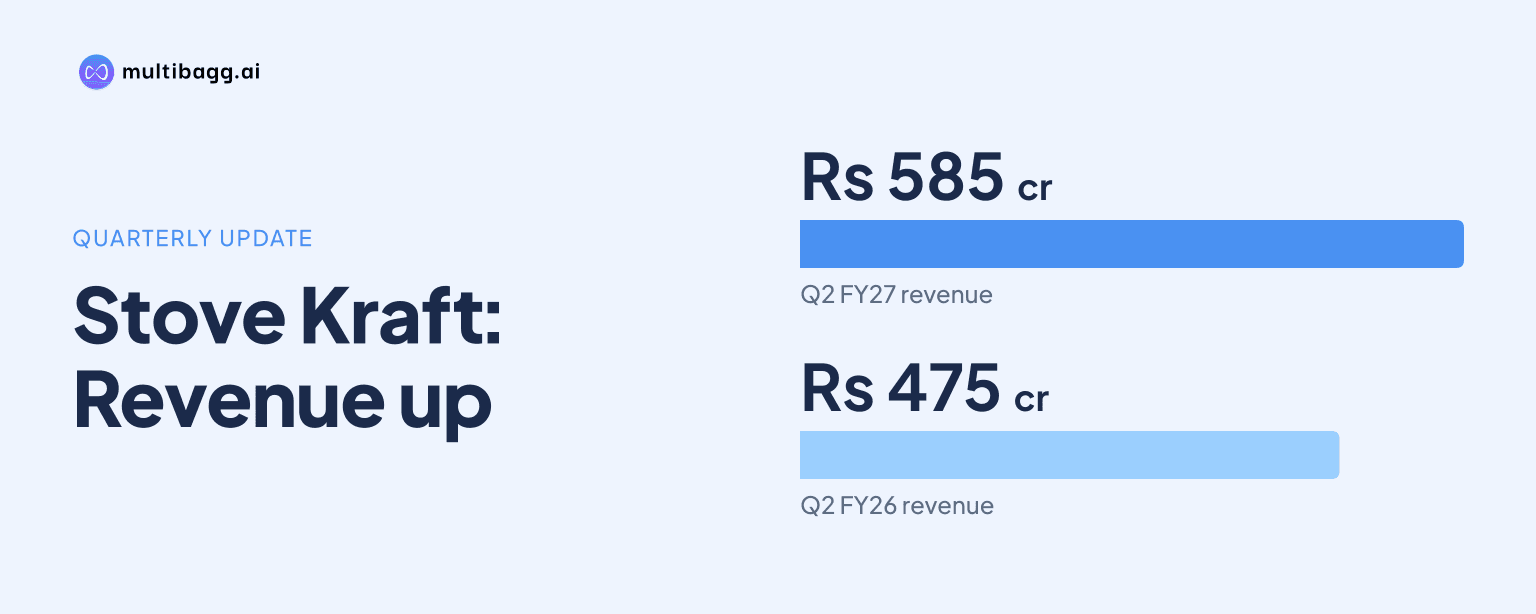
Stove Kraft Limited reported record Q2 FY27 revenue of Rs 585 crore and its highest-ever EBITDA margin of 12.9%, with revenue rising 23.2% year on year. EBITDA increased 32.7% to Rs 75.3 crore and profit after tax rose 35.7% to Rs 29 crore, management said on its November 05, 2026 earnings call.
Know Stove Kraft inside out
Results, valuation, peers and who's buying, in one view.
How did Stove Kraft perform in Q2 FY27?
Stove Kraft delivered Rs 585 crore of consolidated revenue in Q2 FY27, compared with Rs 475 crore in Q2 FY26, making it the company’s highest second-quarter revenue, management said. The Rs 110 crore increase translated into 23.2% year-on-year growth in the detailed financial update, while management earlier described overall revenue growth as 23.5%.
Profit growth exceeded revenue growth in the quarter. EBITDA, or earnings before interest, tax, depreciation and amortisation, rose to Rs 75.3 crore from Rs 56.8 crore, while profit after tax increased to Rs 29 crore from Rs 21.4 crore. Management attributed the faster rise in profitability to operating and financial leverage, operational efficiencies and cost-optimisation measures despite raw-material cost volatility.
The first-half comparison also showed growth extending beyond one quarter. Consolidated revenue for H1 FY27 reached Rs 1,065 crore, up 30.8% from Rs 814.5 crore in H1 FY26. Profit after tax for the six-month period rose 44.8% to Rs 46 crore from Rs 31.8 crore, which management said reflected operating leverage and its focus on profitable growth.
Which products and channels drove Stove Kraft’s Q2 growth?
Stove Kraft’s induction cooktop category grew about 108% year on year in Q2 FY27, while pressure cookers grew 46.8% and small appliances increased 9.1%. Management linked pressure-cooker growth to demand trends and its ability to respond to opportunities arising after geopolitical disruptions, supported by manufacturing capacity.
The company introduced portable blenders, new air-fryer models, mixer-grinder models, an immersion heating rod and toasters under Pigeon during Q2 FY27. These launches added products across kitchen-appliance categories, while Pigeon had recorded a 21% compound annual growth rate over the preceding three years, according to management.
General trade and e-commerce were the principal channel growth drivers in Q2 FY27. General trade rose 52.2% year on year and e-commerce increased 24.2%; management also cited a 16.3% three-year compound annual growth rate for general trade in H1 FY27. Modern retail grew 11.9% in Q2 and 27.3% in H1 FY27, while the company’s own retail channel expanded 70.3% in H1.
Stove Kraft added 16 Pigeon stores across nine cities in Q2 FY27, taking its Pigeon exclusive-store count to 360. The store additions complemented online, general-trade and modern-retail distribution, which management identified as part of an omnichannel strategy intended to extend consumer reach and support future revenue growth.
Got a follow-up? Ask IRIS
What changed in Stove Kraft’s margins and working capital?
Stove Kraft’s gross margin was 39.6% in Q2 FY27, compared with 38.5% in Q2 FY26. EBITDA margin reached 12.9% from 12.0% a year earlier, and management described 12.9% as the company’s highest quarterly EBITDA margin.
Profit after tax margin reached 5.0% in Q2 FY27, compared with 4.5% a year earlier. For H1 FY27, gross margin was 39.6%, compared with 38.4% in H1 FY26, while gross profit increased 34.8% to Rs 422 crore from Rs 313 crore. The H1 gross-margin improvement was 120 basis points, where 100 basis points equal one percentage point.
Net working-capital days fell to 32 days in Q2 FY27 from 45 days in Q1 FY27. Management said better inventory utilisation and seasonal demand drove the reduction, although it also explained in the question session that inventory had been built to support larger second- and third-quarter demand and to maintain more uniform manufacturing through the year.
Return on capital employed, or ROCE, was 15.6% in H1 FY27, up from 12.6% in FY26, and return on equity, or ROE, was 10.4%, versus 8.3%. Management presented these changes alongside its focus on capital efficiency, working-capital optimisation and disciplined capital allocation rather than as a separate financial target.
What expansion plans did Stove Kraft disclose?
Stove Kraft said it had relaunched Gilma as a premium brand in southern markets, with 17 stores operating across Telangana, Andhra Pradesh and Karnataka at the time of the call. Management said Gilma was generating about Rs 1 crore of monthly sales and was intended to address customers seeking technologically superior and more innovative products than those positioned under the value-oriented Pigeon brand.
Management’s stated Gilma plan is to reach about 100 stores within 24 months, initially largely through direct-to-consumer sales in company-owned stores and later through its website and marketplaces. It said Pigeon could add between 75 and 100 stores a year, with the combined network targeted at about 500 stores by around FY28. Management also said Gilma margins were slightly higher than Pigeon’s, while marketing investment would be required to build the brand.
The company also outlined a China investment plan capped at CNY20 million, equivalent to about Rs 29 crore to Rs 30 crore, spanning its wholly owned trading subsidiary and a manufacturing joint venture. Management said the brownfield facility would make triply circles, a bonded-metal input for pressure cookers and cookware, as backward integration aimed at supply-chain risk mitigation and cost optimisation.
In India, Stove Kraft said it had applied to expand its existing Baddi, Himachal Pradesh facility and to acquire land adjacent to its Bengaluru factory through the Karnataka Industrial Areas Development Board. Management said these investments, along with China operations and inventory, had absorbed cash during the period, and expected the China manufacturing facility to start around late December or early January, subject to the stated process.
Conclusion
Stove Kraft’s Q2 FY27 results show revenue growth of 23.2% accompanied by faster increases in EBITDA and profit after tax, plus higher gross and EBITDA margins. The comparison with Q2 FY26 indicates that product-category gains, channel growth and operating-efficiency actions coincided with higher reported profitability, while H1 FY27 revenue growth of 30.8% extended that trend across six months.
The next items to watch are management’s plan for Gilma to reach about 100 stores in 24 months, Pigeon’s proposed annual addition of 75 to 100 stores and the target of roughly 500 combined stores by around FY28. Management also expects export growth by year-end as replacement products and the IKEA partnership begin to contribute, and said the China manufacturing facility could start around late December or early January.