










Stove Kraft Q2 PAT rises 35.7% as EBITDA margin reaches 12.9%
Key highlights
- Stove Kraft reported Q2 FY27 revenue of Rs 584.7 crore, up 23.2% year on year.
- Stove Kraft's Q2 FY27 EBITDA rose 32.7% to Rs 75.3 crore and margin reached 12.9%.
- Stove Kraft's Q2 FY27 PAT rose 35.7% to Rs 29.0 crore, with PAT margin at 5.0%.
- Stove Kraft's induction-cooktop revenue grew 108.0% year on year in Q2 FY27.
powered by IRIS
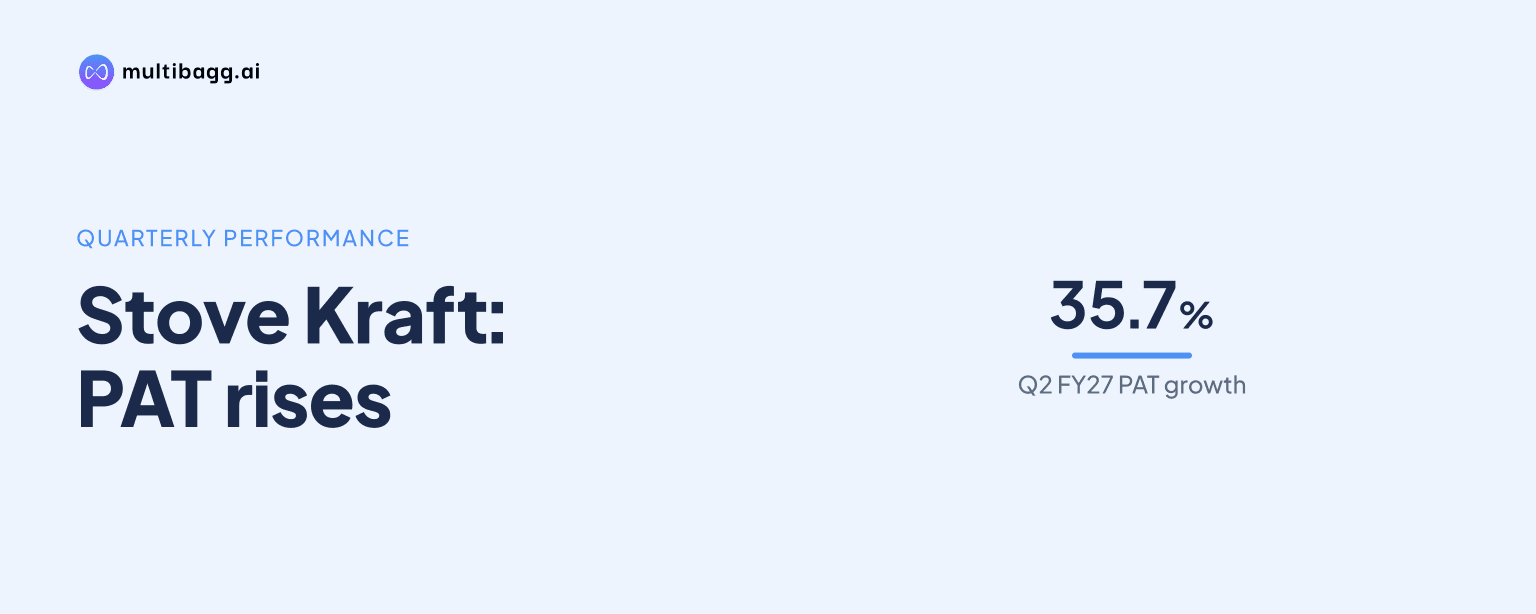
For the quarter ended 30 September 2026, Stove Kraft Limited reported profit after tax (PAT) of Rs 29.0 crore, up 35.7% year on year, as revenue rose 23.2% to Rs 584.7 crore and earnings before interest, tax, depreciation and amortisation (EBITDA) margin reached 12.9%.
Know Stove Kraft inside out
Results, valuation, peers and who's buying, in one view.
How did Stove Kraft's Q2 FY27 financial performance change?
Stove Kraft increased revenue from operations to Rs 584.7 crore in Q2 FY27 from Rs 474.4 crore in Q2 FY26, a year-on-year increase of 23.2%. Revenue was also 21.7% above Rs 480.6 crore in Q1 FY27, showing a sequential increase in the quarter ended 30 September 2026.
Gross profit rose 26.8% year on year to Rs 231.7 crore from Rs 182.8 crore, faster than revenue growth. Gross-profit margin consequently reached 39.6% in Q2 FY27, compared with 38.5% in Q2 FY26, and was unchanged from 39.6% in Q1 FY27.
EBITDA increased 32.7% to Rs 75.3 crore from Rs 56.8 crore, while PAT increased 35.7% to Rs 29.0 crore from Rs 21.4 crore. PAT margin rose to 5.0% from 4.5% over the year-on-year comparison, meaning both EBITDA and PAT increased faster than revenue.
Why did Stove Kraft's EBITDA margin reach 12.9%?
Stove Kraft's EBITDA margin reached 12.9% in Q2 FY27, up 0.9 percentage points from 12.0% in Q2 FY26, because EBITDA growth of 32.7% exceeded revenue growth of 23.2%. The margin was also above 11.2% in Q1 FY27, when EBITDA was Rs 53.8 crore on revenue of Rs 480.6 crore.
Managing Director Rajendra Gandhi attributed the Q2 FY27 outcome to demand across key product categories, integrated backend manufacturing capabilities and operational efficiencies. He said these mechanisms helped Stove Kraft improve EBITDA margin amid inflationary pressures and geopolitical disruptions, while gross-profit margin increased to 39.6% from 38.5% a year earlier.
The first half showed the same direction of change, with EBITDA rising 39.7% to Rs 129.1 crore in H1 FY27 from Rs 92.4 crore in H1 FY26. H1 FY27 revenue increased 30.8% to Rs 1,065.2 crore, gross profit rose 34.8% to Rs 422.1 crore and PAT grew 44.8% to Rs 46.0 crore, lifting EBITDA margin to 12.1% from 11.3%.
Which Stove Kraft product categories drove Q2 FY27 growth?
Stove Kraft's induction cooktops recorded the fastest disclosed product-category growth in Q2 FY27, rising 108.0% year on year, followed by cookers at 46.8%. Small appliances grew 9.1%, whereas non-stick cookware declined 1.6% and gas cooktops declined 6.4%, showing differing performance across the portfolio.
Small appliances represented the largest Q2 FY27 revenue share at 36%, followed by pressure cookers at 24%, gas cooktops at 18%, non-stick cookware at 15% and induction cooktops at 6%. The 108.0% growth rate in induction cooktops therefore came from a smaller disclosed revenue share than small appliances and pressure cookers.
Pigeon continued to drive growth momentum, according to management, supported by value positioning and retail expansion. In Q2 FY27, Pigeon sold 322,119 units and added 141,308 customers; pressure cookers and small appliances contributed 30% of its revenue, while cooktops, hobs and chimneys contributed 20%.
Got a follow-up? Ask IRIS
How did Stove Kraft's channels and stores perform in Q2 FY27?
Stove Kraft generated 38.2% of Q2 FY27 revenue through e-commerce, the largest disclosed channel share, followed by general trade at 31.8%. Modern retail accounted for 12.4%, original equipment manufacturing (OEM) for 8.1%, and own retail for 7.2%.
Management said e-commerce and general trade performed well, alongside healthy growth in modern retail and expansion of the own-retail network. Stove Kraft expanded into nine new cities in Q2 FY27, while Pigeon added 16 stores and reached 360 operational stores across 22 states and 172 cities; 198 stores were under the franchisee model.
Pigeon's average sales were Rs 4.47 lakh per store per month, and it reported a 15% repeat-purchase rate among 141,308 new customers in Q2 FY27. Gilma, which management relaunched as a premium brand in southern markets, operated 17 franchise stores in three states and 10 cities, with average sales of Rs 4.64 lakh per store per month.
What is Stove Kraft's stated plan after Q2 FY27?
Stove Kraft management said it intends to sustain growth after the quarter ended 30 September 2026 through product innovation, premiumisation and deeper distribution penetration. Management also identified manufacturing efficiencies, working-capital optimisation and disciplined capital allocation as areas of focus to support profitable growth and margin improvement.
Gilma's premium-market relaunch forms part of that plan, with its 17 operational stores in three states and 10 cities under the franchise model. The brand added 600 customers and sold 830 units in Q2 FY27, with chimneys contributing 66% of revenue and hobs contributing 27%.
Management's outlook remains subject to risks identified in the 4 November 2026 release, including industry conditions, political and economic changes, tax laws, exchange-rate movements, interest and other costs. Stove Kraft said its forward-looking statements are based on assumptions it does not guarantee and actual results may differ materially.
Conclusion
Stove Kraft's Q2 FY27 results combined 23.2% revenue growth with a 35.7% rise in PAT and a 12.9% EBITDA margin, compared with 12.0% a year earlier. Gross profit, EBITDA and PAT all rose faster than revenue, while induction cooktops grew 108.0% and gas cooktops and non-stick cookware declined.
The next results will show whether Stove Kraft can execute its stated innovation, premiumisation and distribution plans while maintaining its focus on manufacturing efficiency, working-capital optimisation and capital allocation. Developments to watch include the nine-city expansion, Pigeon's 360-store network and Gilma's 17-store franchise footprint.