










What a Change in Congress Means for US–China Trade
Key highlights
- The US-China trade truce now runs to 10 January 2027, extended by two months on 23 September 2026.
- China's draft export controls on 40 technology systems, 23 tied to AI, are open for public comment until 15 November 2026.
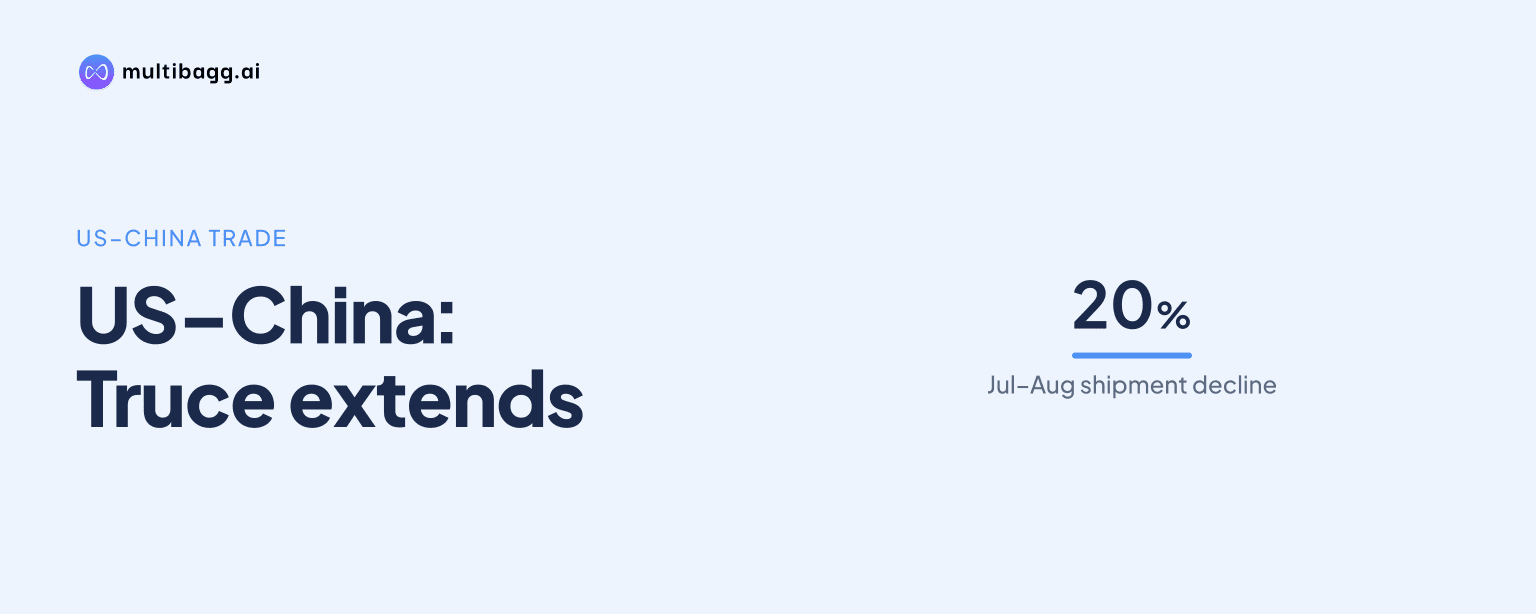
- Chinese magnet shipments to the US fell to 512 metric tons in August 2026, down 20% from July.
- A US House committee advanced a bill in January 2026 giving Congress 30 days to review advanced chip sales to adversary countries.
powered by IRIS
A change in control of Congress would not by itself end the US-China trade truce, which now runs to 10 January 2027, because the truce is a deal between two governments. It would change who chairs committees, which China bills reach a vote and how hard hearings press on chips, investment and tariffs. China hawks sit in both parties.
When does the US-China trade truce end?
The truce now ends on 10 January 2027. Treasury Secretary Scott Bessent told Fox News on 23 September 2026 that the deal, due to expire in November, would be extended, CNBC reported. It dates from a meeting between Donald Trump and Xi Jinping in South Korea in October 2025. It limits new tariff increases and suspended China's export controls (government limits on what can be sold abroad) on rare earths (metals used in magnets, electronics and defence equipment) and other critical minerals.
Many had expected six months or longer, according to CNBC. Bessent said Beijing needs to deliver more. Scott Kennedy of the Center for Strategic and International Studies said the short extension suggests the US is unsatisfied with China's offers.
On 28 September, CNBC reported that each country plans to cut tariffs on $30 billion of goods. The US list covers 77 items, mostly toys, sports equipment and Christmas decorations. China's list covers 1,619 items, mostly farm goods. It was not clear when the cuts take effect.
CNBC reported on 25 September that Trump and Xi are expected to meet twice more this year, at the Asia-Pacific Economic Cooperation (APEC) summit in Shenzhen in November and the G20 summit in Miami in December.
What tariffs do Chinese goods face after the IEEPA ruling?
Chinese goods face several layers of US tariffs, and the total differs by product. After the Supreme Court ruled against tariffs imposed under IEEPA (the International Emergency Economic Powers Act), new Section 301 duties (tariffs allowed after a finding of unfair trade practices) took effect on 24 July 2026, Morgan Lewis reported. Holland & Knight's summary lists China at a flat 12.5% in the final action text and at 13% in its country table. Morgan Lewis says the new duties add to other duties unless an exemption applies, and goods under Section 232 (national security tariffs on steel, aluminium, autos, copper and semiconductors, among others) are exempt. In 2025, before the court ruling, the US imposed effective tariffs of more than 40% on Chinese goods and China more than 30% on US goods, CNBC reported on 28 September.
What is still unresolved on rare earths, technology and chips?
Rare earth licensing remains unresolved. China suspended some critical mineral export controls for 12 months from November 2025, CNBC reported on 23 September. Chinese customs data cited there show magnet shipments to the US fell to 512 metric tons in August, down 20% from July. Reuters reported that some US firms waited over six months for licences.
On 16 October 2026, China published draft export controls on 40 strategic technology systems, 23 of them tied to artificial intelligence, The National reported. The list includes AI chips, large language models (the AI systems behind chatbots), solar energy and biotechnology. Public comment runs to 15 November, and a final version follows. Wendy Cutler of the Asia Society Policy Institute said the truce is fragile and argued a US response is a matter of time.
On US chips, a rule effective 15 January 2026 moved sales of Nvidia's H200 chip to mainland China to case-by-case review, Caixin reported. CNBC reported on 22 January that Trump said the US would approve such sales if it receives 25% of the proceeds.
Got a follow-up? Ask IRIS
What can Congress do on China?
Congress can pass laws, hold hearings and fund agencies, but the truce is an executive deal. China hawkishness (a tough stance on China) is bipartisan, according to the Asia Group, which counted 56 China-related hearings in 2025, up 47% from 2024. Outbound investment limits (rules on US money flowing into Chinese companies) became law in the defence policy bill Trump signed on 18 December 2025, Arnold & Porter reported. The GAIN AI Act, a bipartisan bill requiring US chipmakers to prioritise domestic buyers before exporting to China, was left out of that bill after the White House lobbied against it, Bloomberg News reported.
In January 2026 the House Foreign Affairs Committee advanced a bill giving Congress 30 days to review and block advanced chip sales to adversary countries. All but two members voted for it, CNBC reported on 26 February. A Senate companion has backing from Republican Jim Banks and Democrat Elizabeth Warren. CNBC said the House bill faces an uphill climb.
Control of each chamber after the vote decides who chairs committees and which bills get floor time. A bill also needs the president's signature, so hearings and investigations are the tools that do not depend on the White House. The Asia Group wrote in early 2026 that Democrats may have more flexibility on China heading into the midterms, though their ability to pass laws remains limited. Tariff law is another lever: the temporary 10% global tariff used after the court ruling could have run beyond 150 days only if Congress passed a law, the National Association of Manufacturers said.
How could this reach China stocks, chip stocks and supply chains?
The Hang Seng Index (Hong Kong's main stock index) closed at 23,525 on Tuesday 3 November (Hong Kong time), up 0.57%, and the Hang Seng Tech Index rose 0.74% to 3,867, The Standard reported.
US chip stocks fell sharply in late October. The Philadelphia semiconductor index fell 7.2% on 30 October and 15.4% in October, according to 24/7 Wall St, which linked the fall to Intel's weak guidance and doubts over AI data centre spending. The Nasdaq Composite closed at 25,437.00 that day. Chip export rules for China are one of several factors that can move these stocks.
Supply chains are exposed through farm goods. US soybeans were 23% of China's soybean imports in the first five months of 2026, against 40% before the 2018 tariffs, CNBC reported on 23 September.
Conclusion
Taken together, the truce, the layered tariffs and China's draft technology rules describe a relationship held together by short deadlines. A new Congress could add pressure through hearings and chip bills, but the truce dates and tariff rates are set by the two governments.
Dates to watch are the counting of the midterm vote, the end of China's comment period on 15 November, the APEC summit in Shenzhen in November and the G20 summit in Miami in December if the leaders attend, the US Federal Reserve meeting on 8 and 9 December, the end of the US stopgap funding law on 11 December, and the truce deadline of 10 January 2027.