










Why Nasdaq Fell After the Democratic Sweep
Key highlights
- Nasdaq-100 futures fell 2.2% at the worst reading at 10:27 am IST on 4 November, per Fox Business, before Reuters showed a loss of about 0.8% on 4 November.
- The Nasdaq-100 closed 30 October at 28,384.85, 9.1% below its 6 October record close, before the election result.
- The Philadelphia Semiconductor Index fell 15.4% in October, including a 7.2% drop on 30 October.
- Nasdaq-100 futures were down only 0.46% by 11:56 am IST on 4 November, per CNBC, against 2.2% at the worst reading.
powered by IRIS
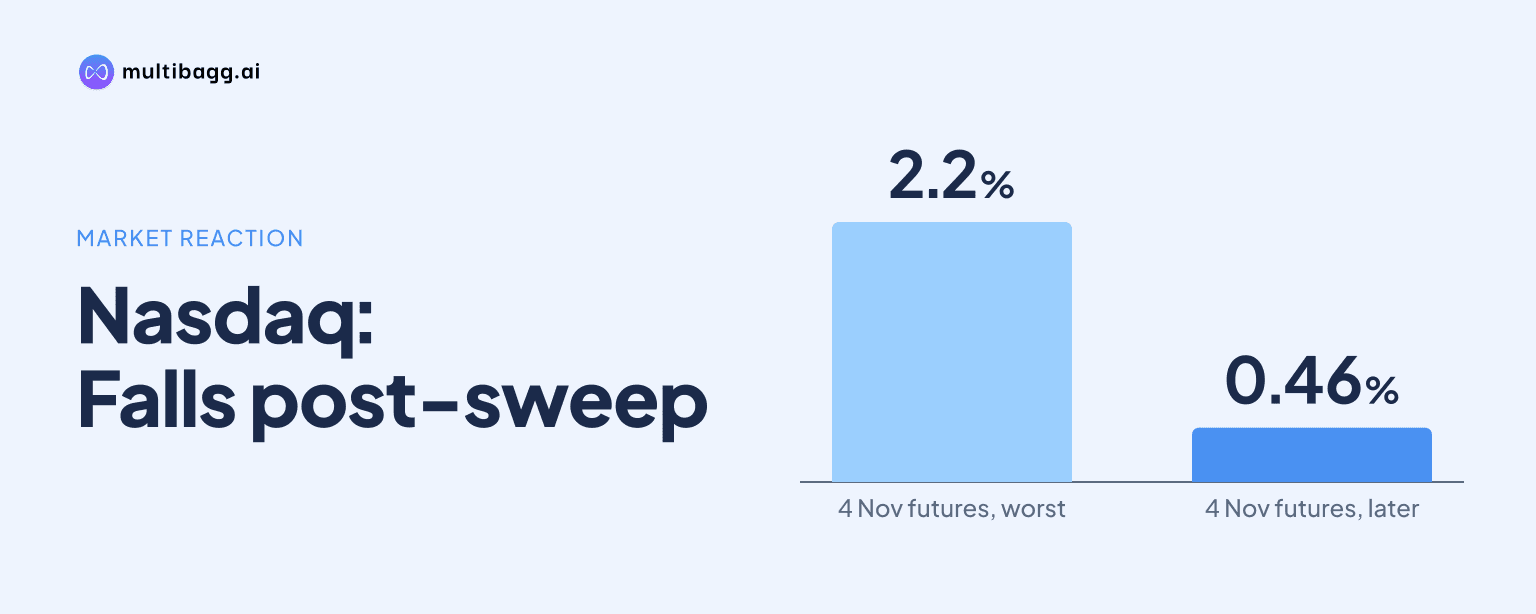
After Democrats were projected to win Congress, Nasdaq futures fell more than 2% in Asian hours on 4 November, then cut the loss to about 0.8%, according to Reuters. Investors feared tighter scrutiny of AI and Big Tech, but the Nasdaq-100 was already 9.1% below its record at the 30 October close.
How far did Nasdaq futures fall after the Democratic sweep?
At the worst point, Nasdaq futures fell about 2% to 2.2%, and later readings showed a smaller loss. Futures are contracts on an index's future value. They trade almost round the clock, including when US cash markets are shut. Each reading below is an overnight or Asian-hours figure with its time.
US cash trading opens at 8 pm IST on 4 November, so no Nasdaq close for the post-result session exists yet. On 3 November, before the results, the Nasdaq Composite rose 0.83% to close at 25,372.01, according to The Herald Business. The futures fall came after that close.
Why did the Nasdaq fall more than the wider market?
AI-linked shares, which have led the bull market, led the overnight decline, according to CNBC. Reuters said investors feared the result could disrupt the data-center buildout behind the AI trade, bring tighter regulatory scrutiny of tech and AI firms, and raise the chance of political gridlock. Charu Chanana, chief investment strategist at Saxo, said the sharper fall in Nasdaq futures also reflects worries about more scrutiny of AI and Big Tech. None of the pages checked named a specific antitrust bill, so the scrutiny worry is general.
Texas is a specific worry. The AP projected that Democrat Gina Hinojosa, who has pledged a data-center moratorium (a pause on new projects), beat Republican incumbent Greg Abbott for Texas governor, according to CNBC. Wells Fargo puts Texas at about 27% of US data-center gigawatts.
Fiscal stimulus expectations played a part too. Chanana said markets appeared to be pricing in a stronger-than-expected Democratic showing, which could lower hopes for further stimulus (extra government spending or tax support). Tai Hui of J.P. Morgan Asset Management sees the same shift as a positive, because fiscal deficits are likely to be more controlled. CNBC reported that the 10-year Treasury yield fell nearly 5 basis points to 4.902% as investors sought shelter from the equity selloff.
Got a follow-up? Ask IRIS
How much of the fall came from the election and how much from the AI selloff before it?
On the numbers seen, most of the damage predates the vote. On 30 October the Nasdaq Composite fell 2.86% to 25,437.00, its lowest close since 31 July, according to 247 Wall St. The Nasdaq-100 fell 3.46% to 28,384.85, which left it 9.1% below its 6 October record close of 31,224.47.
Intel fell 28.6% on weak guidance on 30 October, and Amazon's plan for about $220 billion of capital spending in 2026 deepened doubts about whether AI investment will pay off. CNBC said AI shares led the market lower again on 2 November. Nick Ferres of Vantage Point Asset Management said the Goldman Sachs Broad AI basket fell 15% in October and the Nasdaq is catching up on the downside.
The worst futures reading was smaller than the Nasdaq-100 fall on 30 October alone, and later readings were smaller still. No source checked splits the move into an election share and a trend share, so the two cannot be separated with the data available.
Was the reaction bigger than forecasters expected?
At the worst point, yes, but the gap narrowed. In a note reported by CNBC on 2 November, JPMorgan gave a Democratic sweep a 66% probability and an S&P 500 move of between a 0.25% fall and a 0.5% rise. Fox Business reported S&P 500 futures down 1.3%, outside that range, while Reuters and CNBC later showed 0.6% and 0.34%. Futures and the cash index are different measures, and the cash session has not yet traded. Michael Arone of State Street Global Advisors said the big risk is investors overreacting to a blue wave, and Chanana said the initial selloff may not last.
Did Indian markets follow the Nasdaq lower?
Not so far. According to The Week at 10:56 am IST on 4 November, the Sensex rose as much as 0.62% to 77,396.04 and the Nifty 50 rose 0.56% to a high of 23,946.35. The same article said Indian IT stocks were wobbly on AI disruption fears, with TCS among the laggards.
Conclusion
The Nasdaq fell sharply in the first futures readings after the projected Democratic sweep, but the loss shrank within hours and sat on top of an AI selloff that had already pushed the Nasdaq-100 9.1% below its record. The election added three worries: scrutiny of AI and Big Tech, a slower data-center buildout, and lower stimulus hopes. The results are projected, not certified.
The first cash reading comes when US markets open at 8 pm IST on 4 November. Final seat counts and certification of the projected results, including Texas, are next. The new Congress takes office in January 2027, and until then the Republican-led Congress sits with President Trump holding veto power. The stopgap funding law runs through 11 December, and the Federal Reserve meets on 8 and 9 December after raising its range to 3.75% to 4% on 16 September and holding it on 28 October.