










Democrats Win Congress: What It Means for Stock Investors
Key highlights
- Nasdaq-100 futures fell as much as 2% overnight after Democrats were projected to win both chambers, then trimmed the loss to 0.46% by 11:56 am IST on 4 November, according to CNBC.
- NBC News estimates about 255 House seats for Democrats against 218 needed, a figure that could shift by a few seats.
- The Sensex touched an intraday high of 77,396.04, up 0.62%, on the morning of 4 November, according to The Week.
- The stopgap funding law expires on 11 December, and the Federal Reserve meets on 8 and 9 December.
powered by IRIS
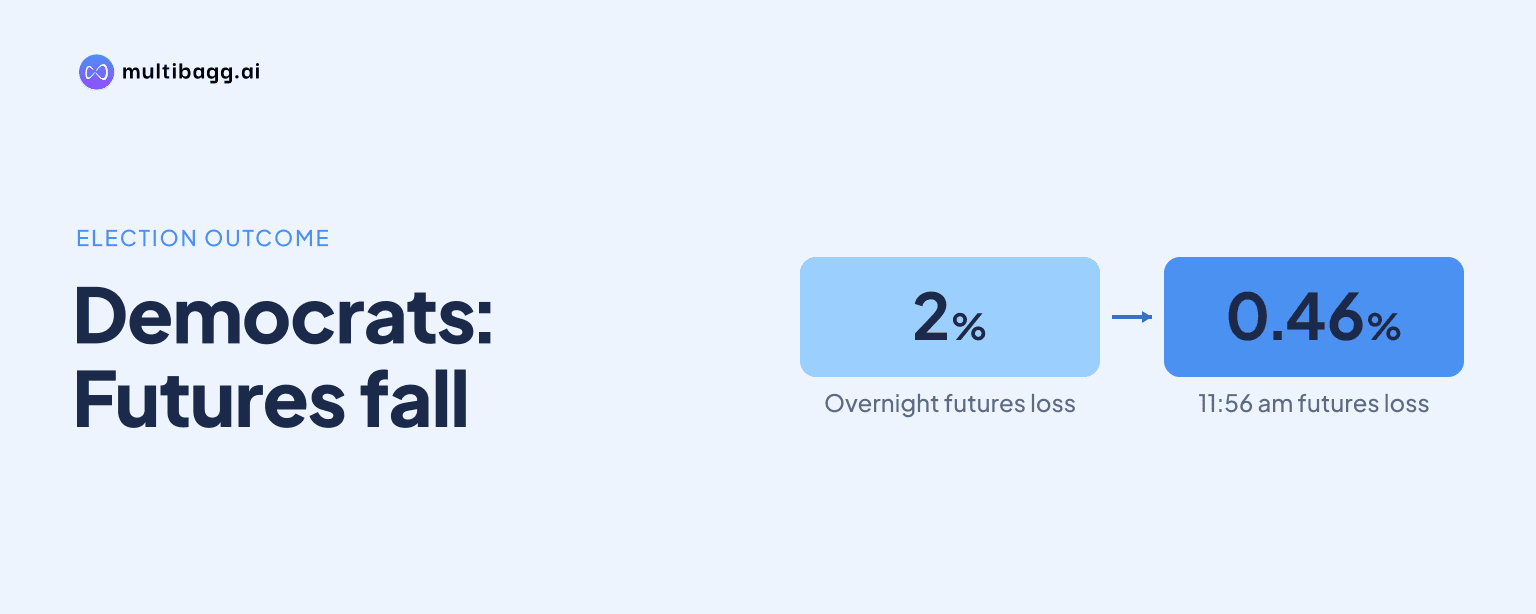
Democrats are projected to win both chambers, but Donald Trump stays president and keeps his veto. Nasdaq-100 futures (contracts that bet on where an index will open) fell as much as 2% overnight, CNBC reported, before trimming the loss to 0.46% by 1:26 am New York time (11:56 am IST) on 4 November. The Sensex rose as much as 0.62%.
What did the midterm result deliver?
Democrats are projected to control both chambers of Congress from January 2027. The results are projections, not certified counts, and counting continues. NBC News estimates about 255 House seats for Democrats against 218 needed for a majority, and says that figure could move by a few seats either way.
The new Congress convenes on 3 January 2027. Until then the current Republican-led Congress sits in a lame-duck session (the period between the election and the new term). Trump remains president for the full term and can veto any bill.
Before the vote, JPMorgan put a Democratic sweep at 66% and expected the S&P 500 to move between a 0.25% fall and a 0.5% rise in that case. That was its pre-election estimate, not a result.
How did markets react on 4 November?
US stock futures fell and US Treasury yields (the return on US government bonds) dropped. These are early readings, since US cash markets open at 8 pm IST and no 4 November US close exists yet.
CNBC reported late on 3 November (US time) that S&P 500 futures were down 1.1% and Nasdaq-100 futures down 2%. In a Reuters report at 11:12 am IST on 4 November, S&P 500 futures were down 0.6%, and Nasdaq futures, down more than 2% at one point, had cut losses to 0.8%. CNBC's live page showed Nasdaq-100 futures down 0.46% and S&P 500 futures down 0.34% at its 11:56 am IST update. Reuters said AI-linked shares led the selling, on worries about tighter tech regulation and a slower data centre buildout.
Investors moved into government bonds. Reuters put the 10-year Treasury yield down 6 basis points at 4.906%. A basis point is one hundredth of a percentage point.
Some analysts say the AI slide predates the vote. Jesper Koll of Monex Group said the AI momentum has turned negative, with or without the Republicans having a majority.
What can a Democratic Congress change, and what can it not?
A Democratic Congress can block Republican bills, investigate and slow nominations. A Democratic Congress cannot, on its own, change laws that Trump opposes. The reasons are structural.
In the House, a majority controls the daily agenda and holds subpoena power (the right to demand documents and testimony). In the Senate, a majority is needed to confirm Trump's picks. Most bills still need 60 Senate votes, and an analysis by Australia's ABC News calls it almost certain that Democrats fall short of that. Overriding a veto needs two-thirds of both chambers.
Budget reconciliation bills (special budget bills that skip the 60-vote rule) are an exception. Impeachment needs only a House majority, but removing a president needs two-thirds of the Senate. Democrats are divided on whether to try it.
Christopher Hodge of Natixis said Natixis still does not think the direct economic implications are huge. Michael Arone of State Street Global Advisors has warned that investor overreaction is a risk of its own. Both views are opinions, not data.
Got a follow-up? Ask IRIS
How does it play out across tech, tariffs, healthcare, yields and India?
The effects differ by channel, and most are expectations, not enacted policy. The table sums them up, and sibling articles in this series cover each in depth.
On tech, JPMorgan said a Democratic sweep could trigger an AI stock selloff if it brings more regulation of data centres. It also expected bills limiting AI expansion to struggle against a Trump veto. Nick Ferres of Vantage Point Asset Management noted the Goldman Sachs Broad AI basket fell 15% in October and is down over 24% from its peak.
On tariffs, ABC reports Democrats plan to introduce bills to remove them in their first 100 hours in the House. With the 60-vote rule and the veto, those bills would lack the power to become law.
On healthcare, NBC News reports Democrats plan to reverse Trump's cuts to Medicaid (US public health insurance for low-income people) and extend the Affordable Care Act (ACA, also called Obamacare) tax credits. Tai Hui of J.P. Morgan Asset Management called reversing the healthcare spending cuts in the One Big Beautiful Bill (Trump's 2025 tax and spending law) a likely point of contention.
On yields, JPMorgan said Democratic control could mean less deficit spending and lower long-dated yields. Charu Chanana of Saxo said lower yields could eventually give some relief.
For India, the Sensex rose as much as 0.62% to an intraday high of 77,396.04 and the Nifty 50 as much as 0.56% to 23,946.35 on 4 November, according to The Week's report published at 10:56 am IST. Brent crude eased to a four-week low near $103 a barrel, which helps an oil-importing economy. The Week linked the rise to the US result, foreign inflows and easing oil prices together, without separating their effects.
Conclusion
Taken together, the result changes expectations more than law. Democrats gain investigative and blocking power in January 2027, but Trump's veto and the Senate's 60-vote rule limit what reaches his desk. That leaves the market debating tech regulation, tariffs and healthcare spending without new rules, while the 4 November moves remain early and could reverse.
Several dates will show how much changes. Final seat counts will settle the margin. The stopgap funding law expires on 11 December, and ABC notes a lapse would be the fourth shutdown of Trump's second term. The Federal Reserve meets on 8 and 9 December, after holding its range at 3.75% to 4% on 28 October. Trade bills and AI rules will take longer.