










Will a Democratic Congress Slow the AI Data Center Boom?
Key highlights
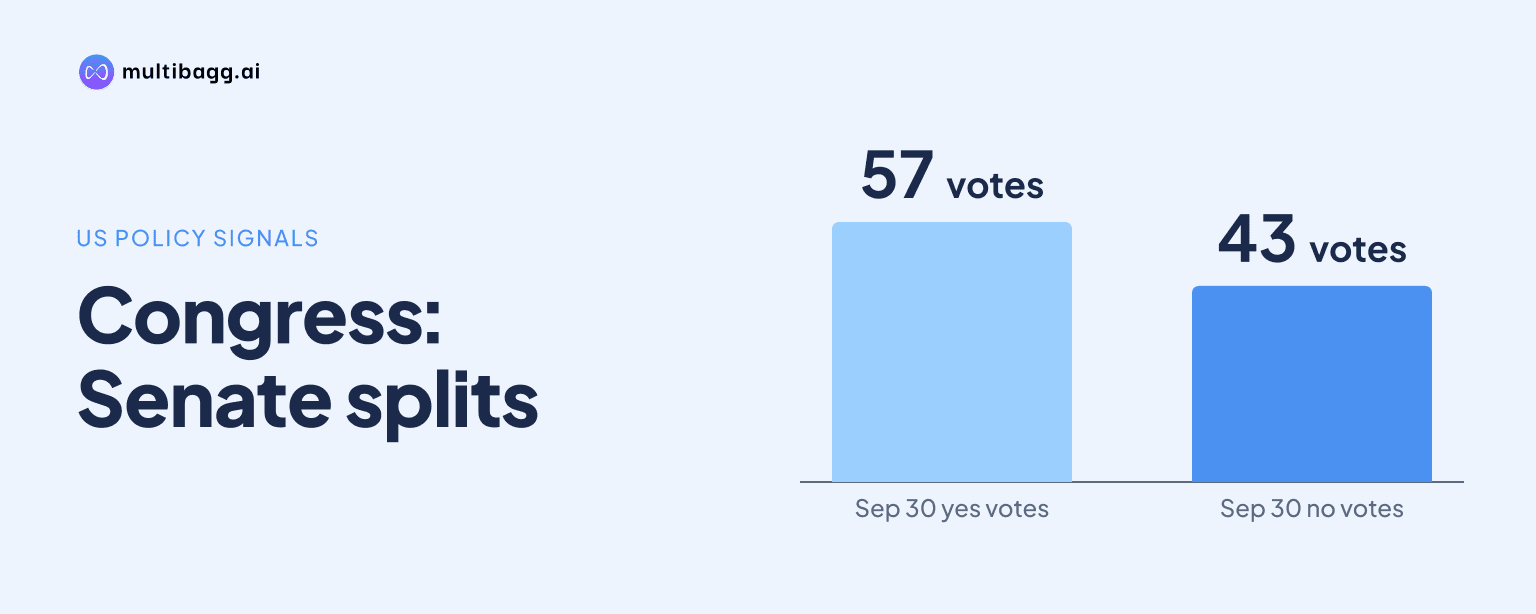
- The Senate voted 57 to 43 on 30 September on a data center cost bill that the House passed 417 to 3.
- Wells Fargo estimates Texas holds about 27% of US data center gigawatts.
- CoreWeave fell 3.7% in Robinhood overnight trading as results came in, according to CNBC.
- FERC's 18 June 2026 orders cover six grid operators but not ERCOT, the Texas grid.
powered by IRIS
A Democratic Congress can pressure the AI data center boom but cannot easily stop it. Democrats are projected to win both chambers, yet President Trump keeps his veto, and most building decisions sit with states and utility regulators. Texas, about 27% of US data center capacity, measured in gigawatts of power, according to Wells Fargo, may matter more than Washington.
What did the result change for data center stocks?
The result changed sentiment first and law not at all. Stock futures fell as results came in. At 10:24 pm New York time on 3 November (8:54 am IST on 4 November), CNBC reported Nasdaq-100 futures down 2% and S&P 500 futures down 1.1%, on fear that Democrats would slow the data center buildout. By the time CNBC updated its live page at 1:26 am New York time (11:56 am IST), the falls had narrowed to 0.46% and 0.34%. Data center operator CoreWeave was down 3.7% in overnight trading on the Robinhood app. Futures are contracts to buy or sell an index at a set price on a later date. They trade almost round the clock, so these moves are early signals, not closing prices.
AI shares had already fallen through October, before the vote. Demand news stayed strong, though. In after-hours trading on 3 November, server maker Super Micro rose more than 9% after guiding fiscal 2027 net sales to $72 billion to $82 billion, and network equipment maker Arista Networks gained 12% after its quarterly guidance beat estimates.
Can a Democratic Congress stop data centers from being built?
Not on its own. The new Congress takes office in January 2027, and until then the Republican-led Congress keeps sitting. Any bill needs both chambers and Trump's signature, and overriding a veto takes two-thirds of each chamber. AP reporting carried by PBS says Trump has embraced building more data centers, so a Democratic bill that limits them would face a hard path.
What Democrats gain is oversight. A majority can hold hearings, demand documents from companies and regulators, and shape budget fights.
Can Democrats change who pays for data center power?
This is the area where a bill has already been tested. On 30 September a bill from Sen. Jon Husted, an Ohio Republican, won 57 votes to 43 in the Senate, short of the 60 needed to move most bills forward there. The House had passed it 417 to 3. It would have required utility regulators to consider adopting a federal standard under which large power customers cover the cost of grid upgrades built to serve them.
Democrats called it a suggestion. Schumer said, "They want it optional, which means zero. We want it mandatory." Sen. Martin Heinrich, a New Mexico Democrat, sponsored a bill that would direct the Federal Energy Regulatory Commission (FERC) to write rules requiring large customers to pay for needed upgrades. About 6 in 10 Americans support limiting new data centers, according to the AP report on the vote, so both parties have reason to act. A mandatory version would still need Trump's signature.
FERC is already moving. On 18 June 2026 it ordered six regional US grid operators, including PJM and MISO, to show their rules handle large loads and cost shifts to existing customers fairly. The orders do not cover ERCOT, the Texas grid.
Got a follow-up? Ask IRIS
Will states matter more than Washington?
For building permits and local power approvals, yes. Maine shows the split inside the Democratic Party. Its Democratic-controlled legislature passed a moratorium of more than a year on larger data centers, and Democratic Gov. Janet Mills vetoed it on 24 April 2026 because it lacked an exemption for a planned project in Jay.
Texas is the larger test. CNBC reported that the AP projected Democrat Gina Hinojosa to defeat Gov. Greg Abbott, and that she has pledged a data center moratorium. Scott Ladner of Horizon Investments said the AI trade could hinge on the Texas result for a couple of days. The race call is a projection, and how she would put a moratorium in place has not been reported.
What do analysts expect for data center spending?
Analysts quoted by Reuters on 4 November see regulatory risk, with Texas the most exposed. Jake Dollarhide of Longbow Asset Management said a sweep may bring regulatory pressure on AI. Tapas Strickland of Moomoo ANZ said the AI rollout could slow, possibly sharply in Texas. He said Texas and Georgia together account for about a third of AI data center spend and projects.
Conclusion
Congress has limited direct power over data center construction, a bigger say over who pays for grid costs, and little ability to pass anything over a Trump veto. States and the Texas governor's race carry the sharper threat, and analysts expect the pressure on AI spending to fall hardest on Texas. Indian investors who hold US stocks or Nasdaq-linked funds are exposed directly. Others feel it through global sentiment.
Watch the final seat counts, since all results are projected, and the confirmed Texas count. The stopgap funding law runs to 11 December, and the Federal Reserve meets on 8 and 9 December after holding its range at 3.75% to 4% on 28 October. FERC's follow-up on the grid operator responses and any revived Husted or Heinrich bills are the next signs on power costs.