










The 11 December Funding Deadline: Shutdown Risk After the Midterms
Key highlights
- The stopgap law H.R. 6500 expires on 11 December 2026, and a funding lapse would begin on 12 December.
- Across 22 shutdowns since 1976, the S&P 500 gained an average of 0.3% during them and 13% over the next 12 months (Carson Group).
- The House passed the stopgap 370 to 48 on 1 September 2026.
- The US has had three funding lapses since October 2025, including a 43-day shutdown that ended on 12 November 2025 and a 76-day Homeland Security shutdown.
powered by IRIS
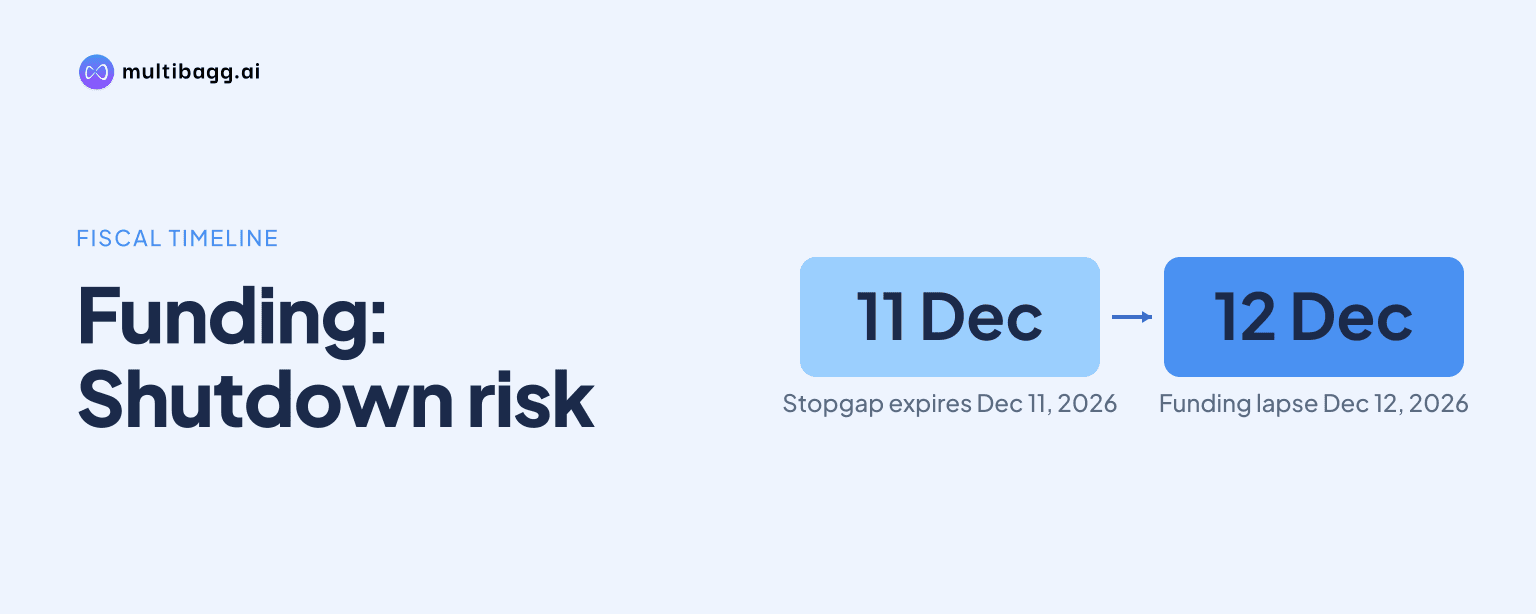
US federal funding runs out on 11 December 2026. Democrats are projected to win both chambers, but the outgoing Republican-led Congress sits until 3 January and must pass a stopgap or a full-year package, or face a shutdown. Past shutdowns left the S&P 500 roughly flat, with an average gain of 0.3% according to Carson Group.
When does US government funding run out?
US government funding runs out after 11 December 2026, so a lapse would begin on 12 December. The stopgap law signed on 2 September funds agencies through 11 December, according to the White House. The stopgap law, H.R. 6500, keeps most programs at last year's spending levels until then. The House passed it 370 to 48.
A stopgap, formally a continuing resolution, keeps agencies running at old spending levels while Congress finishes the 12 regular spending bills. As of 3 November, the House had passed 3 of the 12 bills and the Senate none, according to the Committee for a Responsible Federal Budget. On 1 September CBS News reported that none had cleared the Senate Appropriations Committee.
The National Flood Insurance Program and surface transportation extensions also end around the same date, according to Holland & Knight. Without a new law, agencies covered by the 12 bills would face a partial shutdown, according to Holland & Knight.
What can the lame-duck Congress do?
The Republican-led Congress has three main options, according to Holland & Knight (9 October). It can pass an omnibus or several minibuses, which are bundles of the 12 spending bills, for full-year funding. It can pass a shorter stopgap into January or March 2027. It can combine the two. If nothing passes by 11 December, a partial shutdown follows.
Timing is tight. Members return on 9 November and the new Congress is sworn in on 3 January, according to ABC News. Australia's ABC News reported on 4 November that new funding bills are the top priority, and that a lapse would be the fourth shutdown of Trump's second term. Most bills need 60 Senate votes to pass, and Fox News's Chad Pergram wrote on 1 October that Republicans would need at least seven Democrats. A bill Trump vetoes becomes law only with two-thirds support in both chambers.
How does the projected result change incentives?
The result changes who holds the stronger hand after 3 January, and so each side's preferred bill. Pergram, writing before the vote, said Republicans might push to fund the government through fall 2027 straight away if Democrats won a chamber, rather than accept a short bill running into a Democratic-controlled year. Democrats, he wrote, would likely argue that voters had spoken and press for a stopgap.
A clash with Trump in early 2027 is then possible, with a shutdown then if not in December, according to Pergram. House Appropriations Committee Chairman Tom Cole predicted on 1 September either a yearlong stopgap in December or a shutdown, according to CBS News. Both views predate the result.
Precedent exists. After Democrats won the House in 2018, the outgoing Congress failed to agree on funding, and a then-record 35-day shutdown began on 22 December 2018 and ran into the new Congress until 25 January 2019, according to Fox News's Chad Pergram and the Motley Fool. Lapses are also recent: 43 days from 1 October to 12 November 2025, a brief partial shutdown that began on 31 January and ended when Trump signed a funding bill on 3 February 2026, according to the AP, and a record 76-day Homeland Security shutdown that ended on 30 April 2026, according to NPR.
Got a follow-up? Ask IRIS
How have stocks behaved in past shutdowns?
Stocks have mostly shrugged them off, though studies differ. Carson Group found that across 22 shutdowns since 1976 the S&P 500 gained an average of 0.3% during them and 13% over the following 12 months, according to CBS News. CFRA's Sam Stovall found in January 2019 that the index went essentially nowhere across 20 shutdowns since the mid-1970s. The counts differ, probably because analysts define shutdowns and funding gaps differently.
On 1 October 2025, the first day of the 43-day shutdown, the S&P 500 closed up 0.3% at a record, according to CBS News. These are averages across different periods, and the 2018-19 gain probably reflected other factors too, so they do not predict 11 December. The Fed also meets on 8 and 9 December, two days before the deadline.
Does the deadline matter for Indian investors?
Only indirectly, if at all, through global risk sentiment, the dollar and FPI (foreign portfolio investor) flows, and none of the sources reviewed measured a link between US shutdowns and Indian indices. The debt ceiling is a separate matter, covered in an earlier article in this series, because the 11 December date concerns annual spending bills and not the US borrowing limit.
Conclusion
Together, the findings show a short fuse and a shifted bargaining position. Funding lapses on 12 December unless a Republican-led Congress passes a bill that needs Democratic votes in the Senate, and the Senate had passed none of the 12 spending bills as of 3 November. History shows shutdowns have not reliably moved the S&P 500, but no source reviewed forecasts the reaction this time.
Watch the return of members on 9 November, final seat counts that confirm the projected majorities from 3 January, and the Fed meeting on 8 and 9 December. Then watch 11 December itself: a stopgap, a full-year package or a lapse from 12 December, and whether health center funding, which expires on 31 December according to Holland & Knight, is attached.