










Oil, Gold and Bitcoin After the Democratic Sweep
Key highlights
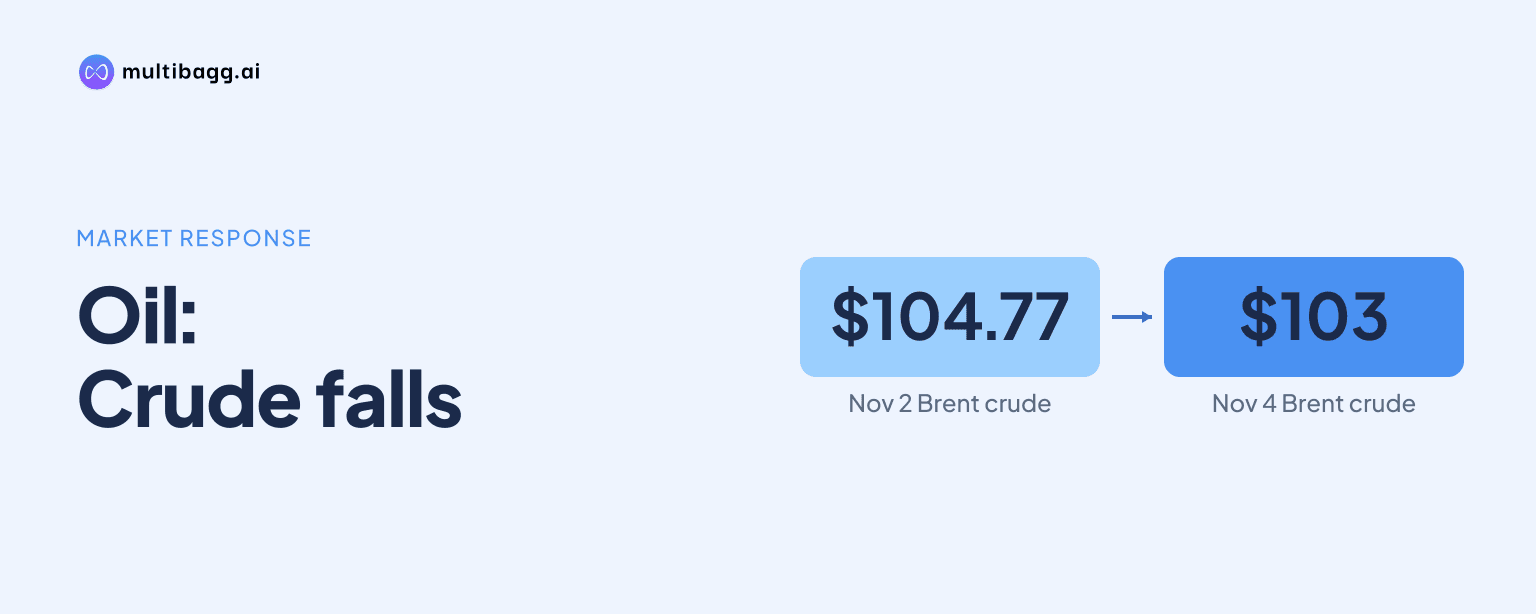
- Brent crude settled at $104.77 a barrel on 2 November, down 7.6%, then eased to about $103 on 4 November (10:56 am IST).
- Spot gold rose 0.5% to $3,947.49 an ounce at 0415 GMT on 4 November and was at $4,015.71 by 0634 GMT, after losing 11.0% in the eight weeks before the vote.
- Bitcoin fell to about $75,700 as early results arrived, then recovered to $77,910.46 by 12:14 pm IST, while US spot ETFs had about $515 million of outflows in two trading days.
- The CLARITY crypto bill failed a Senate procedural vote 49 to 50 on 15 September 2026 and lapses on 3 January 2027 if not passed.
powered by IRIS
Brent crude eased to a four-week low near $103 a barrel on 4 November (10:56 am IST, according to The Week), and oil has followed US-Iran talks rather than the vote. Gold rose 0.5% to $3,947.49 an ounce by 0415 GMT, according to Reuters, and moved past $4,000 by 0621 GMT, according to FXStreet. Bitcoin recovered to about $77,900.
Did the Democratic win move oil prices?
Mostly no. Oil moved on Iran headlines before the vote and kept moving on them after it. Brent settled at $104.77 a barrel on Monday 2 November, down 7.6%, after Iran and Qatar held a third day of talks, according to CNBC. Oil had gained more than 10% in October on fears of a military escalation after the midterms.
On Wednesday 4 November, Brent eased to a four-week low near $103, according to The Week. ING's Warren Patterson and Ewa Manthey linked the pullback to US-Iran talks, but said it was probably too early to think escalation risks had passed, after US strikes on Iran's Qeshm Island on Monday.
The new Congress does not take office until January 2027, and Trump keeps his veto power, which limits what the result can change for oil soon. TD Securities' Ryan McKay said diplomacy headlines alone are unlikely to remove the risk premium without a concrete end to the war.
Why did gold rise after the vote?
Gold rose because the dollar and Treasury yields fell. Spot gold was up 0.5% at $3,947.49 an ounce at 0415 GMT on 4 November (9:45 am IST), according to Reuters, and moved past $4,000 by 0621 GMT, according to FXStreet. BullionVault showed $4,015.71 at 0634 GMT. The dollar softened, according to Reuters, and the 10-year Treasury yield fell nearly 5 basis points to 4.902%, according to CNBC. Pepperstone's Chris Weston said falling nominal and real yields were supporting gold.
The vote explains little of the level. Gold had lost 11.0% over the eight weeks before the vote, according to BullionVault, and it closed down 3.6% on 30 October at its lowest since October 2025, per CNBC. It was already rising on Monday as oil fell, with spot gold at $3,943.62 that afternoon in New York.
Limits remain. CME FedWatch showed a 78% chance of a Fed rate rise in December, which raises the cost of holding gold, since it pays no interest. StoneX's Matt Simpson had called $4,000 the obvious resistance level, and gold crossed it later that morning. Gold rose in the eight weeks after each of the last four midterms (0.5% to 11.9%, per BullionVault), but four cases do not make a rule.
How did Bitcoin react to the result?
Bitcoin fell as early results came in, then recovered. It had climbed close to $78,000 late on 3 November (US time), dropped more than $2,000 to about $75,700, and was back at $77,910.46 by 12:14 pm IST on 4 November, according to CoinDesk. TDX Strategies' Dick Lo said Bitcoin dropped initially in response to the Democratic sweep, according to CoinDesk.
The vote was not the only pressure. US spot Bitcoin ETFs (exchange-traded funds) had net outflows of about $515 million in the first two trading days of November, matching their October total, according to SoSoValue data cited by CoinDesk. Nasdaq futures had fallen more than 2% early on 4 November before paring losses to about 0.3% lower, according to CoinDesk.
Got a follow-up? Ask IRIS
What does a Democratic Congress mean for crypto rules?
It could make a market structure law harder to pass, though not impossible. The CLARITY Act (a bill setting crypto market rules) passed the House 294 to 134 in July 2025. The Senate motion to open debate failed on 15 September 2026, with 49 votes for and 50 against, short of the 60 needed. If the Senate does not act in the lame-duck session before 3 January 2027, the bill expires, according to CryptoTicker.
If Democrats take both chambers as projected, CryptoTicker expects Maxine Waters to be in line to chair House Financial Services, with subpoena power over the Trump family's crypto business. A Senate deal would probably need stricter rules on officials' crypto holdings, it says. Bankless noted in March that 37% of House Democrats voted for CLARITY.
What does this mean for India?
The result matters to India mainly through oil. India's crude import bill was $90.6 billion in April to September, up 46.3% on almost flat volumes, according to PPAC data reported by ThePrint. For gold, the World Gold Council put India's April to June demand at 131.4 tonnes, down 6%, but its value was a record Rs 1.98 lakh crore, according to World Gold Council data reported by Telangana Today, and Reuters says the council expects 2026 demand at a six-year low. On crypto, Budget 2026-27 left India's flat 30% tax on crypto gains and the 1% TDS (tax deducted at source) on transfers unchanged, according to Outlook Money. Both now sit in the Income-tax Act, 2025, which replaced the 1961 Act from 1 April 2026, and a US result does not alter them.
Conclusion
Together, the moves show the result mattered unevenly. Oil followed Iran. Gold rose as the result pushed the dollar and yields lower, while Fed rate-hike odds remain a limit. Bitcoin's first reaction was to the sweep, but it recovered within hours, and ETF outflows and tech-stock weakness were already weighing on it. Crypto regulation is the slower channel, and it depends on a Senate that is projected, not certified, to be Democratic.
Next, watch the final seat counts and the US payrolls report on Friday 6 November. The stopgap funding law runs to 11 December, and the Fed meets on 8 and 9 December, with a hike priced at 78% by CME FedWatch. The CLARITY Act expires on 3 January 2027 if the lame-duck Senate does not act.