










What Happened to Stocks the Last Time Democrats Took Both Chambers Under a Republican President
Key highlights
- The S&P 500 returned 7.3% in the 12 months after the 2006 midterms, when Democrats won both chambers under President Bush.
- The Sensex rose 47.1% in 2007, from 13,786.91 to 20,286.99, after a 46.7% gain in 2006.
- The S&P 500 fell 56.8% from its October 2007 record close to its March 2009 closing low of 676.53.
- The federal minimum wage rose from $5.15 to $7.25 an hour in three steps between 2007 and 2009.
powered by IRIS
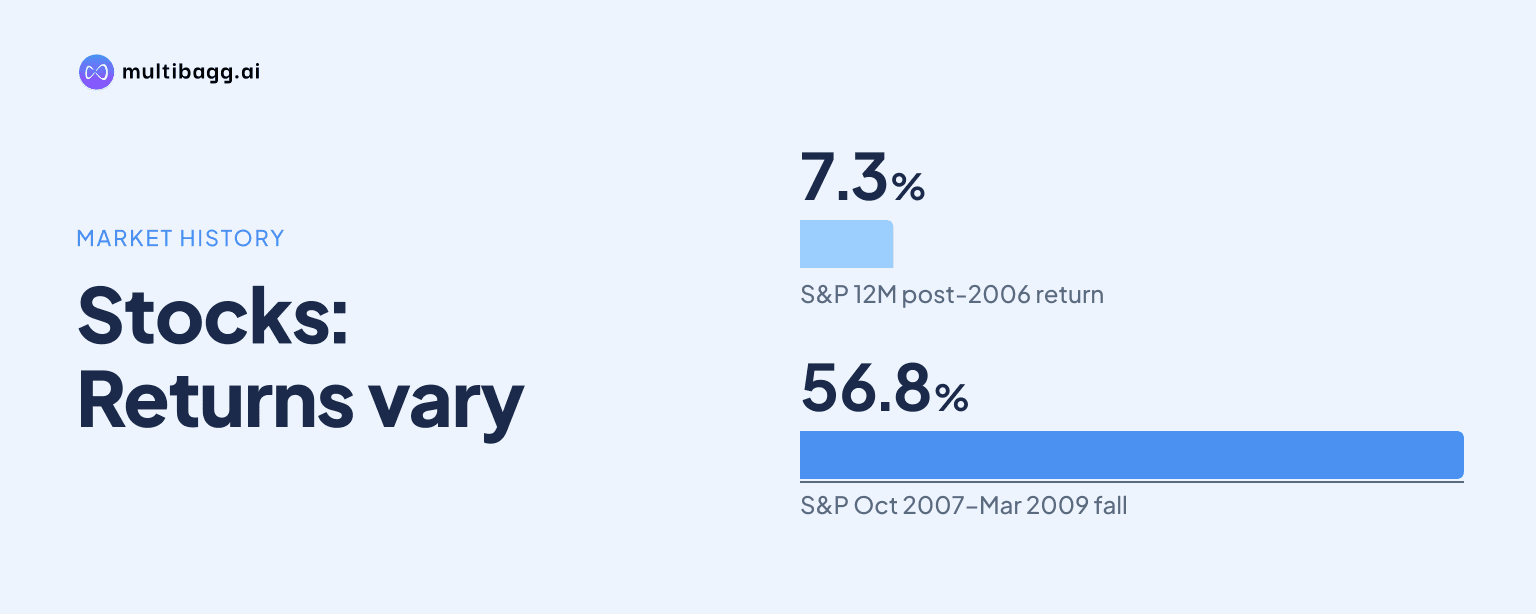
The last time Democrats took both the House and the Senate from Republicans under a Republican president was the 2006 midterms, with George W. Bush in office. The S&P 500 returned 7.3% in the next 12 months, according to Motley Fool's table of Shiller data. The Sensex gained 47.1% in calendar 2007. Both fell sharply in the 2008 crisis.
How did stocks perform after the 2006 midterms?
US stocks rose modestly after the vote, and Indian stocks rose far more. In calendar 2007 the S&P 500 returned 5.49% and the Sensex 47.1%. On election day, 7 November 2006, the S&P 500 closed at 1,382.84 and the Dow Jones Industrial Average set a new trading high, according to a Spokesman-Review report. Before the result, Prudential Securities analyst Charles Gabriel said: "Gridlock is good, Wall Street doesn't like change."
Motley Fool's table, built on Shiller's data, puts the S&P 500's total return (price plus reinvested dividends) at 7.3% over the 12 months after election day. Motley Fool's annual returns page puts 2006 at 15.79%. The index set a record close of 1,565.15 on 9 October 2007, about 13.2% above its election-day close (our calculation).
India did better. The Sensex closed 2006 at 13,786.91 and 2007 at 20,286.99, a gain of 47.1% (our calculation, matching the figure Business Standard reported). That followed a 46.7% rise in 2006, so the rally was under way before the vote. On 9 November 2006 the Sensex opened 35.27 points higher even though traders worried about Indo-US relations after the Democratic win, Oneindia reported.
What did the Democratic Congress actually change?
Its laws were limited by President Bush's veto. Democrats won a 233 to 202 House majority. In the Senate, 49 Democrats and two independents who caucused with them outnumbered 49 Republicans, according to the House historian. Nancy Pelosi became Speaker.
The headline law was the minimum wage rise. Signed on 25 May 2007 inside an Iraq war funding bill, it lifted the federal minimum from $5.15 an hour to $5.85 on 24 July 2007, $6.55 in 2008 and $7.25 in 2009.
Bush also vetoed two versions of a children's health insurance bill, and Congress overrode four of his vetoes by two-thirds votes. The Energy Independence and Security Act became law on 19 December 2007. From 2008 the agenda turned to crisis response, including the Housing and Economic Recovery Act (30 July) and the Emergency Economic Stabilization Act (3 October).
Was the 2007-08 crash caused by the Democratic Congress?
The sources reviewed point to housing and credit, not the election. Federal Reserve history essays say housing peaked in 2006, subprime lender (a lender to high-risk borrowers) New Century Financial filed for bankruptcy in April 2007, and the recession began in December 2007. Lehman Brothers filed for bankruptcy in September 2008. The Fed cut its benchmark interest rate from 4.5% at the end of 2007 to 2% by early September 2008, then to 0 to 0.25% by the end of 2008.
The S&P 500 closed at 676.53 on 9 March 2009, down 56.8% from its October 2007 record close, according to CNBC. From the election-day close of 1,382.84, the fall was about 51.1% (our calculation). The Fed says US GDP fell 4.3% peak to trough and unemployment rose from under 5% to about 10%. The Sensex hit an intraday high of 21,206.77 on 10 January 2008, then touched an intraday low of 7,697.39 on 27 October 2008, a fall of about 63.7% (our calculation). It ended 2008 at 9,647.31, down 52.45% for the year.
One case cannot separate the election from the housing bust. It shows only that a Democratic win and a crash can fall in the same stretch of years without one proving the other.
Got a follow-up? Ask IRIS
Is 2006 the only comparable case?
No. House historian records show only one other case since the Civil War: the 1954 midterms under President Dwight Eisenhower, when Democrats gained 19 House seats and also took the Senate. Motley Fool's table shows an S&P 500 total return of 39.9% over the next 12 months. Two cases, at 7.3% and 39.9%, are too few to call a pattern.
Near misses do not match. In 1874, 1882, 1890, 1910 and 1930, Democrats won the House under a Republican president but not the Senate. In 1878 under Rutherford Hayes and 1986 under Ronald Reagan, they won the Senate while already holding the House.
How is 2026 different?
In 2026 the result is only projected, rates are lower and tech stocks were already falling before the vote. Democrats are projected, according to NBC News, to win both chambers, and counting continues. Donald Trump keeps his veto, and the new Congress takes office only in January 2027.
The Fed held at 5.25% in October 2006. In 2026 it raised its range to 3.75% to 4% on 16 September and held on 28 October by 10 to 2, with two policymakers, Lisa Cook and Beth Hammack, preferring a hike.
The market reaction also differs. In early trading on 4 November, S&P 500 futures were down 0.6% at 11:12 am IST, Reuters reported, on fears that tighter tech and AI regulation could disrupt the data-center buildout. Before the vote, the Nasdaq-100 closed on 30 October 9.1% below its 6 October record, and the Philadelphia semiconductor index lost 15.4% in October, according to 24/7 Wall St.
Conclusion
The 2006 case shows a modest US gain, a much larger Indian gain, laws limited by a presidential veto, and a crash that Federal Reserve histories trace to housing and credit. With only two comparable cases, it is a reference for how divided government works, not a forecast for 2026, when rates and the market theme differ.
Watch the final seat counts, since counting continues, and the lame-duck session (the outgoing Congress's final weeks) before the new Congress starts in January 2027. The stopgap funding law (H.R. 6500) runs to 11 December 2026. The Fed meets on 8 and 9 December.