










Can a Democratic Congress Roll Back Trump's Tariffs?
Key highlights
- A veto override needs 290 of 435 House members and 67 of 100 senators with full attendance.
- The Supreme Court ruled 6 to 3 on 20 February 2026 that IEEPA does not authorise tariffs.
- Section 301 tariffs of 10% or 12.5% took effect on 24 July 2026 on 60 economies.
- India faces an additional 10% under Section 301, against 12.5% for China, Vietnam and Thailand.
powered by IRIS
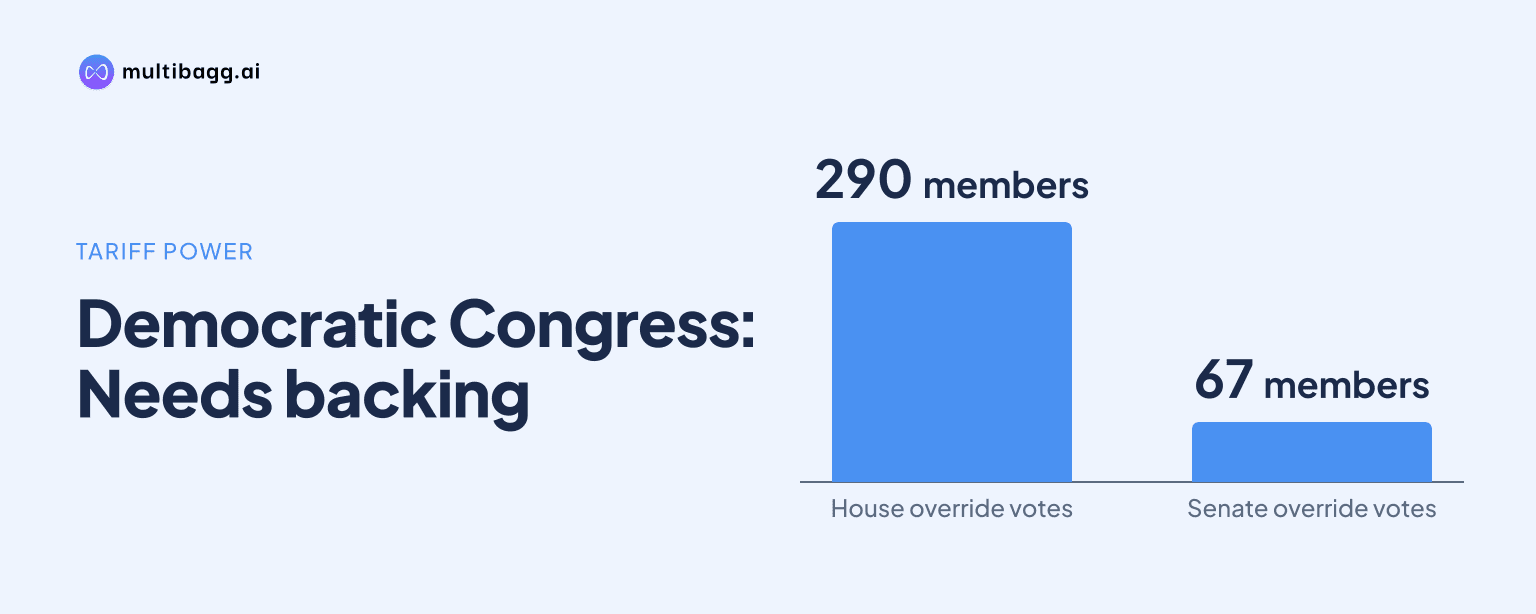
A Democratic Congress, projected to take office in January 2027, is unlikely to roll back President Donald Trump's tariffs on its own. Overriding a veto needs 290 of 435 House members and 67 of 100 senators. The 10% to 12.5% Section 301 tariffs on 60 economies also rest on a trade law the administration can apply without a new vote.
Who controls tariff powers, Congress or the president?
The Supreme Court has said the power to tariff is an exercise of Congress's taxing authority, but Congress has written parts of it into laws that the president and trade officials can use. Section 122 of the Trade Act of 1974 lets a president impose a temporary global tariff for up to 150 days unless Congress votes to extend it. Section 301 lets the US Trade Representative (USTR) act on findings from its own investigations.
Democrats argue that Trump imposed tariffs without following legally required procedures and bypassed Congress, according to a commentary by William Alan Reinsch of the Center for Strategic and International Studies (CSIS). It adds that the party is split between trade sceptics and centrists, and that some tariffs are acceptable to Democrats.
What did the Supreme Court rule, and what replaced those tariffs?
On 20 February 2026 the Supreme Court ruled 6 to 3 that IEEPA (the International Emergency Economic Powers Act) does not let the president impose tariffs, according to law firm Hogan Lovells. A temporary 10% global tariff under Section 122 replaced those duties until it expired on 24 July. That day, Section 301 tariffs of 10% or 12.5% took effect on 60 economies that USTR said had failed to ban imports made with forced labour, according to EY and USTR. A coalition of 25 US states has challenged them at the Court of International Trade (the US court for trade disputes), calling them a workaround for the Supreme Court ruling, according to Construction Dive.
Refunds of the struck-down tariffs are under way. As of 2 October, US Customs had sent about $126 billion to the Treasury for disbursement, according to Supply Chain Dive. The Justice Department is appealing the trade court's order that refunds go to all importers, not only those who sued.
What can a Democratic Congress do about tariffs in practice?
It can investigate and vote, but it cannot change a tariff without the president's signature or a veto override. According to CSIS, Congress can hold hearings, amend bills in committee, control funding and subpoena documents. The commentary names Canada tariffs as the most obvious target, and says Democrats may seek ways to pass refunds to consumers and examine whether exemptions were tied to campaign contributions.
Votes on trade bills are likely to be symbolic, Reuters reported on 1 November. Senator Chuck Schumer's End Trump's Tariff Tax Act, with 28 co-sponsors, would repeal Section 122 of the Trade Act of 1974 and Section 338 of the Tariff Act of 1930, the law behind the current tariffs on Canada, and refund duties collected under them. CSIS's William Reinsch told Reuters that neither party will have a "veto-proof majority in any scenario". In February the House passed a Democratic resolution rejecting Trump's tariffs on Canada by 219 to 211, with six Republicans joining, according to Rep. Richard Neal's office. That vote came before the Supreme Court ruling. CSIS calls the Democratic measures reactive rather than a trade policy.
Got a follow-up? Ask IRIS
Can Congress override a Trump veto on tariffs?
Only if two-thirds of each chamber vote for it, which is 290 of 435 House members and 67 of 100 senators with full attendance. In late October Trump said he would "veto everything" if Democrats won Congress and then make a deal, according to CQ-Roll Call.
Projections point to Democratic control of both chambers, not two-thirds majorities, and counting continues. CSIS wrote on 20 October that nothing that passes is likely to get a presidential signature. The more realistic near-term changes may come from courts, as the February ruling showed, or from the administration itself.
What does this mean for trading partners, including India?
Little changes soon, because trading partners negotiate with the USTR and the White House, not with Congress. India and the US had not signed a trade deal by early October, when Finance Minister Nirmala Sitharaman said both sides had reached "a plateau", according to CNBC. On 1 November Reuters named India among trade deal holdouts, alongside Vietnam and Canada.
Under the Section 301 action, the EU and Taiwan face a 10% rate that includes normal duties, and Japan, South Korea and Switzerland face 12.5%, according to RVIA. An additional 10% applies on top of existing duties for 17 countries including India, and an additional 12.5% for 38 economies including China, Vietnam and Thailand. India's additional rate is therefore below the rate on China, Vietnam and Thailand.
Reuters also reported a forthcoming investigation into excess industrial capacity in 16 major trading partners, so new tariffs remain possible even if Congress objects. For Indian exporters and the stocks tied to them, USTR notices and court rulings are likelier to move tariffs than congressional votes.
Conclusion
Congress holds the formal tariff power, but it has delegated much of it, and a projected Democratic majority does not change the veto arithmetic. The Supreme Court closed the emergency-law route in February, the administration moved to Section 301 within months, and Democrats' tools are hearings, resolutions and bills that a veto can stop. The likelier result is pressure and investigation rather than repeal.
Several dates frame the next steps. Final seat counts are still being confirmed, and the current Republican-led Congress sits in a lame-duck session until the new Congress takes office in January 2027. The stopgap funding law runs to 11 December, and the Federal Reserve meets on 8 and 9 December. Beyond that, watch for court action on the Section 301 tariffs, the government's refund appeal, and any new USTR notices.