










What the Democratic Win Means for H-1B Visas and Indian IT
Key highlights
- Courts have blocked collection of the $100,000 H-1B fee since 24 July 2026, and an 18 September 2026 proclamation extended it to 21 September 2027.
- Infosys cut its FY27 constant-currency revenue growth guidance to 1% to 2% from 1.5% to 3% on 23 October 2026.
- The HIRE Act proposes a 25% excise tax on outsourcing payments but had no Senate cosponsors and no committee vote as of October 2026.
- DHS proposed a separate $103,265 fee on H-1B petitions that go through the annual lottery on 25 August 2026, estimating about $8.8 billion a year.
powered by IRIS
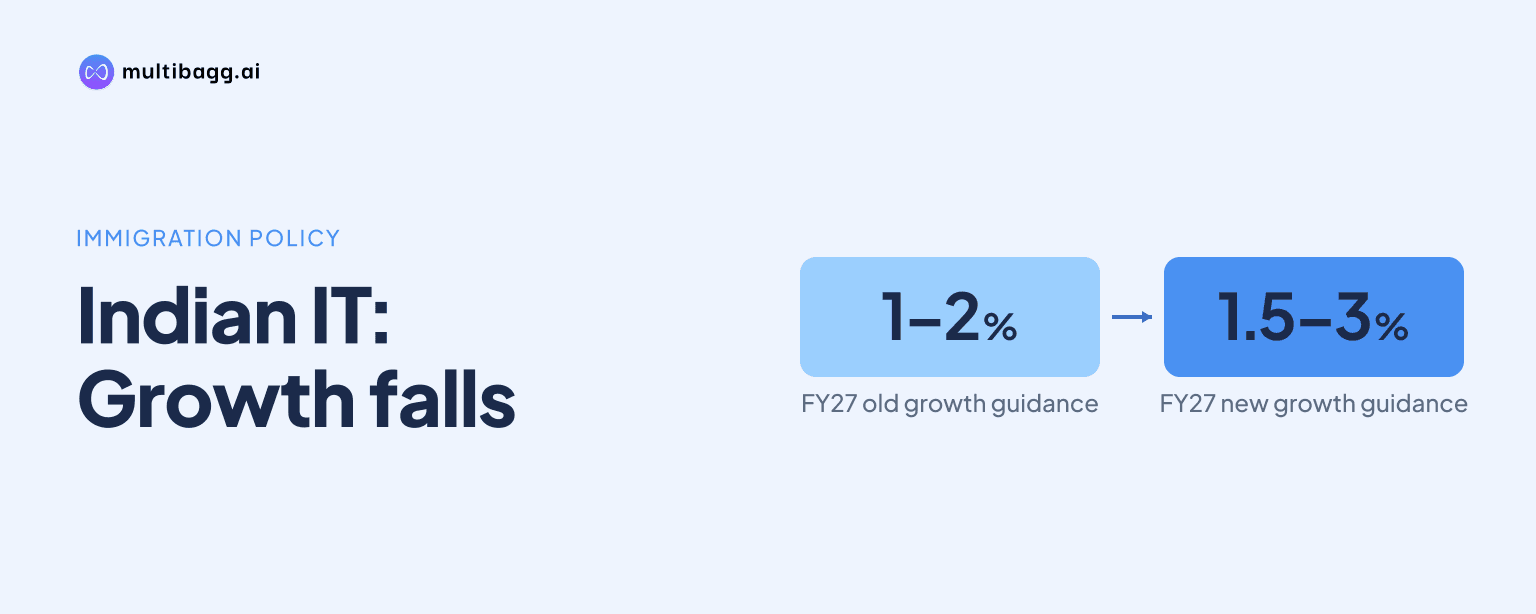
The projected Democratic win does not change the $100,000 H-1B fee on its own. The fee is a presidential proclamation, courts have blocked its collection since 24 July 2026, and a Democratic Congress takes office only in January 2027. For Indian IT, US tech spending matters more: Infosys cut its FY27 growth guidance to 1% to 2% on 23 October.
Does the Democratic win change the $100,000 H-1B fee?
Not directly. CBS News projects that Democrats won both the House and the Senate, but counting continues and the result is not certified. The fee is not a law. It comes from Proclamation 10973, signed by President Trump on 19 September 2025, and a second proclamation signed on 18 September 2026 extends it to 21 September 2027.
The fee covers new H-1B petitions for workers outside the US. Workers who already hold valid H-1B visas are exempt. Until January the current Republican-led Congress sits, and even afterwards Trump can veto any bill that limits the fee or writes it into law.
Where does the fee stand in court?
It is blocked, and the courts matter more than the election. The key dates are below.
In Massachusetts, Judge Leo Sorokin ruled in a case brought by 20 states that the fee is in substance a tax, which only Congress can impose. The government's main appeal is still pending. In a separate case, a California judge on 30 September temporarily barred officials from enforcing the fee, including the 18 September extension, according to the plaintiffs' lawyers. Because a court in Washington, D.C. upheld the fee, the case could reach the Supreme Court, but no filing there has been reported.
A separate route is open to the executive. On 25 August 2026 DHS (the Department of Homeland Security) proposed a $103,265 fee on every H-1B petition that goes through the annual lottery. DHS estimates about $8.8 billion a year from roughly 85,000 petitions. The proposal is not in effect and must first go through public comment and a final rule.
Is the HIRE Act outsourcing tax any closer to law?
No. The HIRE Act (S. 2976), a bill from Republican Senator Bernie Moreno, would put a 25% excise tax on payments from US firms to foreign persons for services that benefit US consumers, and would deny the income tax deduction for those payments. As of October 2026, according to BillTrack50, it had no Senate cosponsors and no committee vote. A House companion, H.R. 7559, was introduced on 12 February 2026 and sits in the Ways and Means Committee.
Neither chamber has voted on it. Nasscom, India's IT industry body, appears in US lobbying filings on the bill, which do not show whether it supports or opposes it. From January the majority party would set committee agendas, so the bill's path would depend on Democratic leaders. Democratic leaders have not publicly stated a position on it.
Got a follow-up? Ask IRIS
What can a Democratic Congress do on H-1B?
It can pass laws, hold hearings and attach conditions to spending bills, but every bill still needs Trump's signature or a two-thirds vote in each chamber to override a veto. No Democratic H-1B bill or plan on the fee has been reported. The scope for change in 2027 therefore looks narrow.
The Massachusetts reasoning gives Congress a role, though. If higher courts agree that the fee is a tax, the administration would need Congress to authorise such a charge. How Democratic leaders would respond to that request is unknown.
Does US tech spending matter more than visas for Indian IT?
On the numbers so far, yes. The fee is not being collected, yet revenue growth is already slowing. On 23 October Infosys cut its FY27 revenue growth guidance in constant currency (growth with exchange-rate effects removed) to 1% to 2% from 1.5% to 3%. Revenue for the July to September quarter was Rs 49,244 crore and net profit Rs 7,823 crore, up 6.2% from a year earlier.
Spending data is split. Gartner's July forecast put 2026 global IT spending at $6.37 trillion, up 14.2%. Spending on data center systems was forecast to grow 62.5%, but IT services only 5.3%. Those are mostly hardware budgets, so that growth does not automatically reach services firms such as Infosys and TCS.
In a Reuters report timed 11:12 am IST on 4 November, Nasdaq futures had fallen more than 2% at one point and were then down 0.8%, as investors feared tighter scrutiny of AI and a disrupted data center buildout. The Week reported at 10:56 am IST that Indian IT stocks were wobbly on AI disruption fears, with TCS among the laggards, while Sensex was up 0.62% and Nifty 50 up 0.56% at their highs.
Conclusion
Together, the findings put the H-1B fee in the courts, not in the ballot count. A Democratic Congress cannot remove or impose it alone, the HIRE Act has no Senate cosponsors, and the DHS proposal still has to clear rulemaking. The larger swing factor for Indian IT revenue is how much US clients spend on services as AI budgets shift, and the Infosys guidance cut points to weak demand already.
Watch the final seat counts first. Then come the 11 December funding deadline, when the stopgap law expires, and the Fed meeting on 8 and 9 December. On visas, watch the First Circuit's final ruling, any Supreme Court filing, and whether DHS finalises its proposed fee.