










Why Treasury Yields and the Dollar Fell After the Midterms
Key highlights
- The 10-year Treasury yield fell 6 basis points to 4.906% in early trading on 4 November, according to Reuters.
- The dollar index fell 0.37% to 101.34 in early trading on 4 November, while the yen rose 0.7% to 157.55 per dollar.
- CME FedWatch showed a 77% chance of a December quarter-point Fed hike on 3 November, according to HousingWire.
- FPIs net sold Rs 48,056 crore of Indian equities in October up to 25 October, according to depository data reported by News On AIR.
powered by IRIS
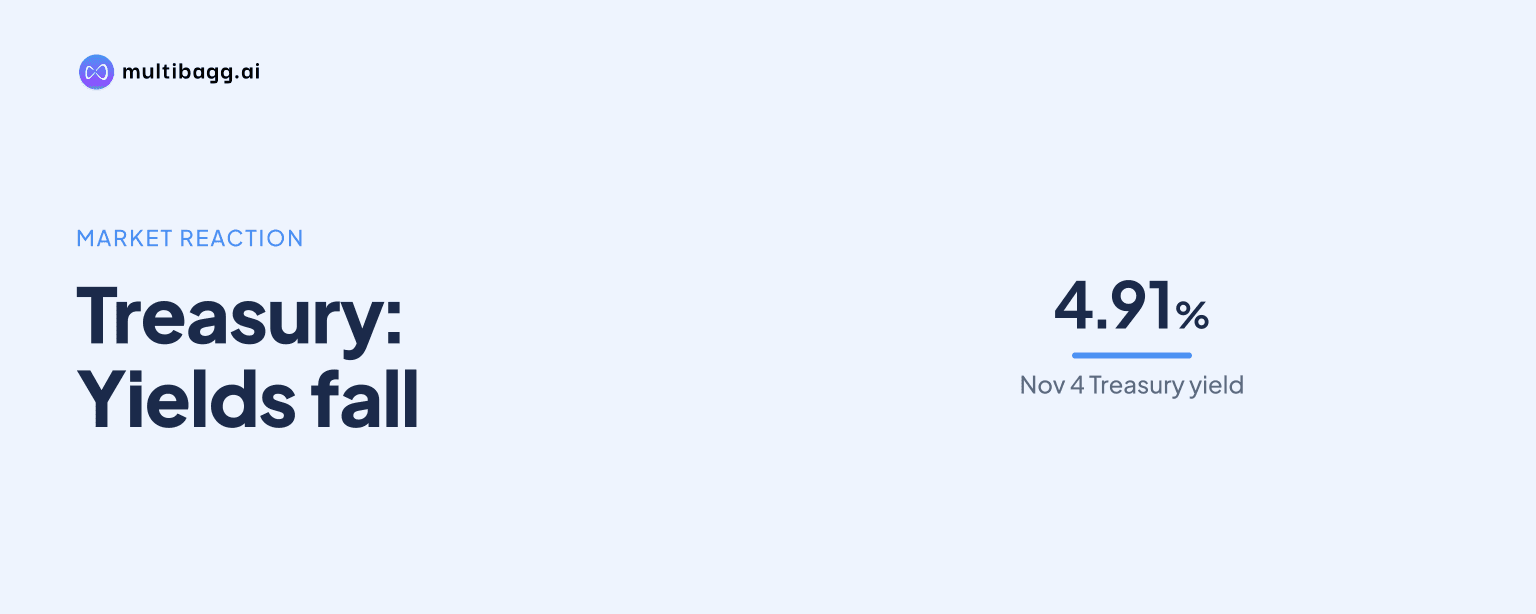
Treasury yields and the dollar fell on 4 November as investors bought bonds for safety and bet that a divided Washington would slow government spending, after a projected Democratic win of Congress. According to Reuters, the 10-year yield fell 6 basis points (0.06 percentage point) to 4.906% in early trading.
Why did Treasury yields fall after the midterm result?
Yields fell as investors bought government bonds for safety and expected gridlock to slow government spending, while US stock futures (bets on where indices will open) dropped. Bond prices and yields move in opposite directions, so heavy buying lowers the yield. NBC News projects Democrats will win both chambers, with about 255 House seats against the 218 needed, though the count could shift.
CNBC reported at 8:54 am IST on 4 November (late on 3 November in New York) that the 10-year yield fell nearly 5 basis points to 4.902%. At that point S&P 500 futures were down 1.1% and Nasdaq-100 futures down 2%. In early trading on 4 November, Reuters put the 10-year at 4.906%, down 6 basis points, and the dollar index (the dollar against six major currencies) at 101.34, down 0.37%. Reuters quoted TD Securities' Prashant Newnaha: "Bonds are coming out as the clear winner... embrace the higher possibility that further tax cuts are put on ice and government spending slows."
The table lists early moves reported between 8:54 am and 11:12 am IST on 4 November, before US markets opened.
Why did the dollar fall at the same time?
The dollar fell with yields. Reuters reported that the dollar slid broadly against major peers as the 10-year yield fell. Lower US yields make dollar assets pay less. The euro rose 0.5% to $1.1249 and sterling firmed 0.37% to $1.3464.
The dollar did not act as the main haven. Reuters said the yen and the Swiss franc, both safe havens (assets investors buy in turmoil), made the biggest gains in the session: the yen rose 0.7% to 157.55 per dollar and the franc almost 0.8% to 0.8144. Saxo's Charu Chanana said markets were pricing a stronger-than-expected Democratic showing, which helps explain a softer dollar. Monex Group's Jesper Koll took the opposite view, saying that "at the margin" the result is "going to be dollar positive" as markets see the Fed as more independent.
Do lower fiscal stimulus expectations explain the move?
Partly, according to Reuters, which said Treasuries rallied as investors expected gridlock to cut government spending. Chanana said a Democratic showing could reduce expectations for "further fiscal stimulus". J.P. Morgan Asset Management's Tai Hui expects divided government to keep deficits "controlled or limited".
The timing matters. The new Congress takes office in January 2027, so the current Republican-led Congress sits until then. The US stopgap funding law runs to 11 December. Spending decisions before then rest with the current Congress.
Direction is not guaranteed. Brown Brothers Harriman, according to FXStreet, argues the dollar falls if yields rise on fiscal doubts, which is the reverse of the 4 November pattern.
Got a follow-up? Ask IRIS
What does the result mean for the Fed's December meeting?
Nothing has formally changed, and the Fed meets on 8 and 9 December. It raised its range by 0.25 point to 3.75% to 4% on 16 September and held it on 28 October by 10 votes to 2, with Lisa Cook and Beth Hammack preferring a hike. The statement said inflation remains high.
Data keeps the pressure on. September CPI (consumer price inflation) was 3.7%, according to FXStreet. CNBC reported September PCE (a price gauge the Fed watches) up 3.6% from a year earlier and third-quarter GDP growth of 3.4% annualised. CNBC, citing CME FedWatch (a tool that turns futures prices into rate odds), reported a more than 77% chance of a December quarter-point hike on 29 October, and HousingWire cited 77% on 3 November. No post-result figure was available at the time of writing.
Reuters said investors expect AI regulation could slow growth and reduce the need for rate hikes. The October jobs report on 6 November and October CPI on 10 November come before the meeting, according to FXStreet.
Why do US yields and the dollar matter for Indian investors?
They matter because FPIs (foreign portfolio investors) weigh US returns against Indian ones. FPIs had net sold Rs 48,056 crore of Indian equities in October up to 25 October, according to depository data reported by News On AIR, down from Rs 52,100 crore on 18 October as reported by Swarajya. Swarajya put 2026 outflows at Rs 3.12 lakh crore as of 18 October, against Rs 1.66 lakh crore in 2025, and cited high US bond yields, a strengthening dollar and rising crude prices. A softer dollar and lower US yields ease one pressure, but a 6 basis point move leaves the 10-year near 4.9%.
Conclusion
Together the findings show a bond rally driven by safety buying and bets on slower US government spending, with the dollar slipping alongside it and analysts split on what comes next. The result does not change the Fed's inflation problem, and fiscal changes await a Congress that is not seated until January 2027. The early moves on 4 November may reverse once US cash markets trade.
Next on the calendar are final seat counts, the October jobs report on 6 November, October CPI on 10 November, the Fed meeting on 8 and 9 December and the 11 December funding deadline. The 10-year yield and the dollar index will show whether the early moves hold.