










What the Midterms Mean for European Defence Stocks
Key highlights
- Figures from NATO, reported by German news agency dpa on 8 July 2026, project European allies and Canada spending $634 billion on defence in 2026, up nearly 11%.
- Core defence spending of European allies and Canada is projected at 2.53% of GDP in 2026, against a 3.5% core target for 2035.
- Rheinmetall cut its 2026 sales guidance on 6 August 2026 to €13.7 billion to €14.2 billion from €14.0 billion to €14.5 billion.
- The US stopgap funding law runs to 11 December 2026.
powered by IRIS
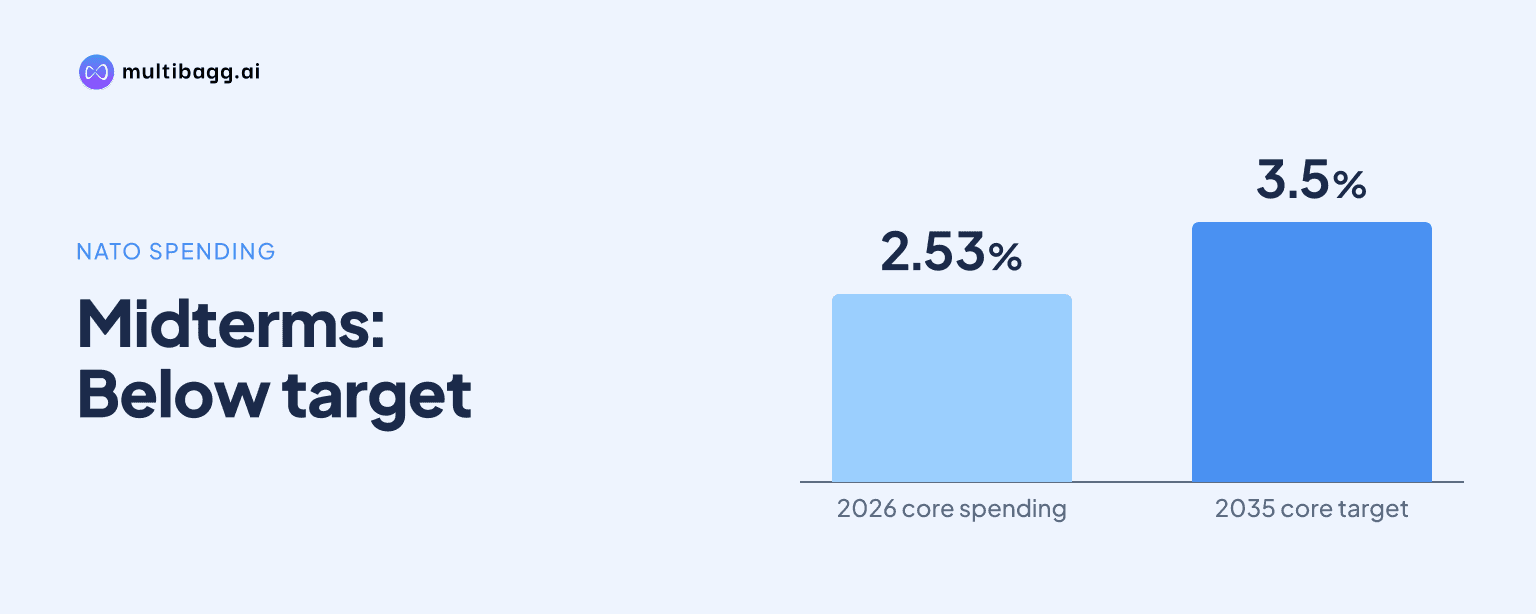
European defence stocks track European budgets, not US elections. Figures from NATO (the North Atlantic Treaty Organization, the military alliance of the US, Canada and most of Europe), reported by German news agency dpa on 8 July 2026, project $634 billion in 2026 defence spending by European allies and Canada, up nearly 11%. Midterms may sway Ukraine aid, not budgets.
Why do the midterms matter for European defence stocks?
They matter mostly through US policy on Ukraine and on NATO. Defence stocks are shares in companies that make weapons and military equipment. The best-known European names are Rheinmetall (Germany), BAE Systems (United Kingdom), Thales (France), Leonardo (Italy) and Saab (Sweden). Most of their orders come from governments, so US politics reaches them indirectly, through how fast Washington backs Ukraine and how hard it presses Europe to spend. As of 3 November 2026 the results are not known, and nothing below assumes an outcome.
How much is Europe spending on defence?
Europe is spending more but is still below NATO's 2035 target. At The Hague on 25 June 2025, NATO allies committed to invest 5% of GDP (gross domestic product, the value of a country's yearly output) annually by 2035. That means at least 3.5% on core defence and up to 1.5% on related spending such as protecting infrastructure and civil preparedness. Allies must also submit annual plans showing a credible path to 3.5%, and the trajectory will be reviewed in 2029.
According to dpa's report of NATO's Ankara summit figures on 8 July 2026, European allies and Canada are projected to reach these levels in 2026.
|:--|--:|--:| | Share of GDP | 2026 estimate | 2035 target | | Core defence | 2.53% | At least 3.5% | | Related spending | 1.4% | Up to 1.5% | | Total | 3.93% | 5% |
The same report puts core spending at 1.62% of GDP in 2021, the year before Russia invaded Ukraine. Germany's core spending is projected to rise from 2.22% of GDP in 2025 to about 2.69% in 2026. These are NATO estimates, not final accounts.
Could Democratic gains change US aid to Ukraine?
Some Democrats say yes, but the timing is uncertain. Rep. Jim Himes, a Connecticut Democrat, said at the Warsaw Security Forum on 13 October 2026 that aid packages would move in weeks rather than months if Democrats win. He cited polling and prediction markets for his expectation of a likely switch in the House. He added that, with control of both chambers and the budget, Democrats could force President Trump to negotiate and would demand a more consistent policy supporting Ukraine, Breaking Defense reported. This is a forecast by one party's lawmaker, not an outcome.
Breaking Defense's editor-in-chief, Aaron Mehta, said in a video on 15 October that turning the promise into action could take longer than Democrats hope, because of a divided Congress and unfinished spending business. A US stopgap funding law, signed on 2 September 2026, runs only to 11 December 2026. CNBC reported on 2 November that a Democratic Congress could challenge some Iran and Israel related spending while pushing for more Ukraine aid.
Got a follow-up? Ask IRIS
How have European defence shares moved since 2025?
They rallied strongly in 2025 and have been uneven in 2026. On 25 June 2025, CNBC reported that the Stoxx aerospace and defence index, a basket of European defence and aerospace shares, was close to 50% higher for the year to date. On 24 November 2025, after reports of progress on a US-Ukraine peace plan, the index closed 2.2% lower on a preliminary basis, with Saab down 5.5% and Rheinmetall down more than 4%, CNBC reported.
In 2026 the big moves followed company news. On 24 June 2026, after reports that Germany would scrap its planned F126 frigates (warships), Rheinmetall had its largest one-day drop since April 2025, broker XTB reported. XTB's morning market note showed Renk down 4.0%, Leonardo 3.5%, Saab 2.6% and BAE Systems 1.6% at that point in the session. XTB said investors were questioning how much announced spending becomes company revenue, and some were pricing in easing conflicts.
On 6 August 2026, Rheinmetall cut its 2026 sales guidance to €13.7 billion to €14.2 billion from €14.0 billion to €14.5 billion, tying the cut to a €300 million hit to its naval division. Its shares fell as much as 4% early that day, Defense News reported. The sources used here give no sector-wide 2026 return.
What could a change in Congress alter, and what could it not?
A new Congress could change US funding and oversight, but it cannot set European budgets. Congress can pass or delay aid and spending bills, which is the lever Himes pointed to, and CNBC noted that presidential veto power would limit Democrats' reach. Allies set the 5% target themselves in 2025, and each European government sets its own budget, so a US vote does not rewrite either.
NATO's PURL scheme (Prioritised Ukraine Requirements List), in which allies fund purchases of US-sourced weapons for Ukraine, depends on Washington making those weapons available. Breaking Defense noted the administration could still limit European-funded aid by restricting access to US equipment. Company events also move shares without any US vote, as the frigate cancellation showed.
Conclusion
Taken together, the data show a European build-up that rests on NATO commitments and national budgets, with core spending at 2.53% of GDP in 2026 against a 3.5% target. The midterms bear mainly on Ukraine aid, where one Democratic lawmaker forecasts faster action and Breaking Defense warns it could be slower. In 2026, reported share moves followed a cancelled warship programme and expectations of easing conflicts. This is information, not a recommendation.
Watch the vote count first, then the stopgap funding deadline of 11 December 2026, which sets the next test for any Ukraine aid. NATO's review of its spending plan is scheduled for 2029.