










Great Eastern Shipping Company puts NAV reset at Rs 250
Key highlights
- GE Shipping said valuing all vessels at January 2026 prices would reduce NAV by about Rs 250 per share.
- Management said crude tankers recorded the sharpest asset-value increase during the preceding three to six months.
- GE Shipping had not seen crude-tanker sale transactions in the two weeks before its November 11, 2026 call.
- The crude-tanker order book was 28% of fleet capacity, but only 7.5% was due for delivery by end-2027.
powered by IRIS
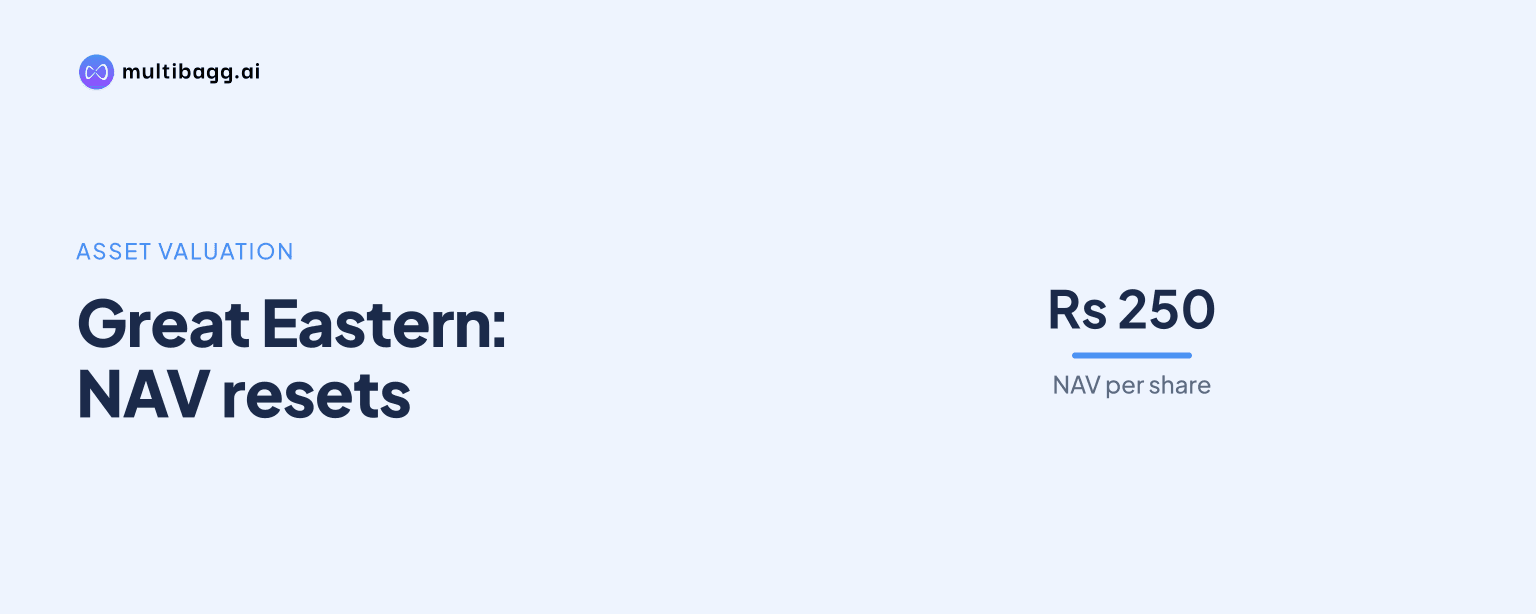
Great Eastern Shipping Company said on November 11, 2026 that resetting every vessel to its January 2026 price would reduce net asset value, or NAV, by about Rs 250 a share, with crude tankers driving the sensitivity after their values rose most sharply over the previous three to six months.
Know Great Eastern Shipping Company inside out
Results, valuation, peers and who's buying, in one view.
How much could GE Shipping’s NAV fall at January values?
GE Shipping said NAV would probably be about Rs 250 per share lower if all its ships were valued at the prices prevailing in January 2026. The estimate was management’s response to an investor seeking a pre-Iran-war reference point, rather than formal NAV guidance, a target or a forecast of where vessel prices will trade.
The sensitivity is concentrated in crude tankers rather than being evenly distributed across GE Shipping’s fleet. Management said an example of a Suezmax crude tanker selling at about USD 80 million versus a possible USD 40 million fair value referred specifically to crude tankers. Other vessel categories had not experienced the same degree of appreciation during the preceding three-to-six-month period.
January 2026 was not a low point for ship values, according to management. When an investor suggested that subtracting Rs 250 from current NAV could establish a floor, management accepted the calculation but said January vessel prices had already been “really high.” The stress test therefore measures a return to an earlier elevated valuation level, not a return to a cyclical trough.
Why can GE Shipping’s vessel values rise while freight earnings decline?
GE Shipping said voyage accounting creates a normal timing lag between changes in spot freight rates and the earnings reported in a quarter. Crude-tanker voyages usually last 45 to 60 days, so July-to-September earnings largely reflected rates fixed up to around August 15, even though the market strengthened further during September.
Management said crude-tanker freight began strengthening significantly in early to mid-August 2026. A vessel fixed on August 1 could remain on voyage until September, delaying revenue recognition. Ship buyers, however, can respond to prevailing spot rates immediately, meaning vessel values may incorporate September freight conditions before those higher rates appear in the next quarter’s profit and loss account.
The lag can also work in the other direction when freight rates retreat. GE Shipping said it had not seen any crude-tanker sale transactions in the two weeks before the November 11 call, despite a fall in freight rates. Management therefore could not say whether vessel prices had fallen or quantify the potential decline, though it said fleet values could decrease significantly.
GE Shipping also cited the experience of the 2004-to-2008 tanker upcycle, when freight rates fell quickly after the global financial crisis but ship prices took longer to reach cheap levels. Management said asset prices retain hope after earnings weaken, while noting that crude-tanker freight rates in November 2026 remained materially above the levels of a year earlier.
Got a follow-up? Ask IRIS
What could offset lower vessel values in GE Shipping’s NAV?
GE Shipping said operating cash flow could offset part or all of a decline in vessel values, although management did not quantify either side of that equation. Its explanation was that fleet values translate into cash flows over time, so NAV accretion is produced by operating earnings as well as changes in the assessed value of ships.
The outcome depends on the relative movement in asset prices and cash generation. Management agreed that the arithmetic of reducing NAV by Rs 250 and adding future earnings was logical, but said it was impossible to know whether any fall in ship values would be greater or smaller than operating cash flow. That uncertainty is particularly relevant because more than 70% of capacity, and close to 80%, is exposed to the spot market.
Freight rates still provide a potentially material operating contribution. Management said Suezmax vessels earned about USD 70,000 to USD 80,000 a day in early February 2026, before the conflict intensified, compared with spot-market rates of about USD 130,000 to USD 150,000 a day after a significant two-week fall before the call. GE Shipping did not forecast future rates or earnings.
The rupee-dollar exchange rate is another NAV variable. Management said the exchange rate was Rs 95.5 at the end of September 2026 and below Rs 94 by November 11. Because vessel values and much of shipping cash flow are dollar-linked, changes in the exchange rate can alter the rupee value of NAV separately from movements in vessel transaction prices.
Which market developments could change GE Shipping’s NAV next?
GE Shipping said the most immediate risk to elevated tanker freight is a return to efficient supply-chain operations if hostilities ease. Current disruption around the Strait of Hormuz has created shuttle movements, waiting time and ship-to-ship transfers, increasing the amount of tanker capacity needed to move the same cargoes.
Management said a return to January or February 2026 conditions would reduce these inefficiencies, but described the pre-conflict Suezmax market as already strong at USD 70,000 to USD 80,000 a day. It added that importing countries had drawn down oil inventories for about three months and would need to replenish stocks, potentially supporting crude-oil movements even after trade routes normalise.
The terms of any Iran-related agreement could also affect supply. Management said that, if Iranian sanctions were removed, Iranian cargoes could return to the mainstream tanker market and become accessible to conventional ships. This could shrink sanctioned trade and lead older shadow-fleet vessels, including ships around 25 years old, to leave service or be scrapped.
Newbuilding supply is a longer-dated consideration. GE Shipping said the crude-tanker order book had risen from less than 10% of the fleet in 2024 to 28%, but only 7.5% of that order book was due for delivery by the end of calendar 2027. Most deliveries were expected in 2028, 2029 and increasingly 2030, so management regarded supply-chain normalisation as the nearer-term issue.
GE Shipping said it was not currently investing in tankers because second-hand ship prices were above its preferred purchase levels. Management said it was ready to buy when suitable vessels became available at its required price, while noting that a newbuild order would generally deliver only three to four years later. Its disclosed blended fleet break-even was about USD 13,000 a day.
Conclusion
The Rs 250-per-share January valuation reset is a defined NAV sensitivity, not a management forecast of a decline. It shows that recent fleet-value gains were particularly exposed to crude-tanker prices, while the impact on NAV can be moderated or amplified by spot-market operating cash flow and the shift from Rs 95.5 per dollar at September-end to below Rs 94 in November.
Investors should watch for actual crude-tanker sale transactions after the two-week gap cited on November 11, 2026, as these could establish a clearer market value for the fleet. Management also identified the eventual normalisation of Strait of Hormuz operations, the 7.5% of the crude-tanker order book due by end-2027, and future oil-inventory rebuilding as variables that could affect freight and asset values.