










Great Eastern Shipping outlines 15 vessels operating in India
Key highlights
- Great Eastern Shipping said 15 vessels were operating in India during its September 2026-quarter call.
- Management said four vessels were outside India, implying 19 vessels were covered by the deployment update.
- The CFO cited a rumoured one-year Indian contract at $100,000 per day, without confirming it as a company contract.
- Great Eastern Shipping reported consolidated net profit of INR 581 crore in Q2 FY26, according to the supplied historical call record.
powered by IRIS
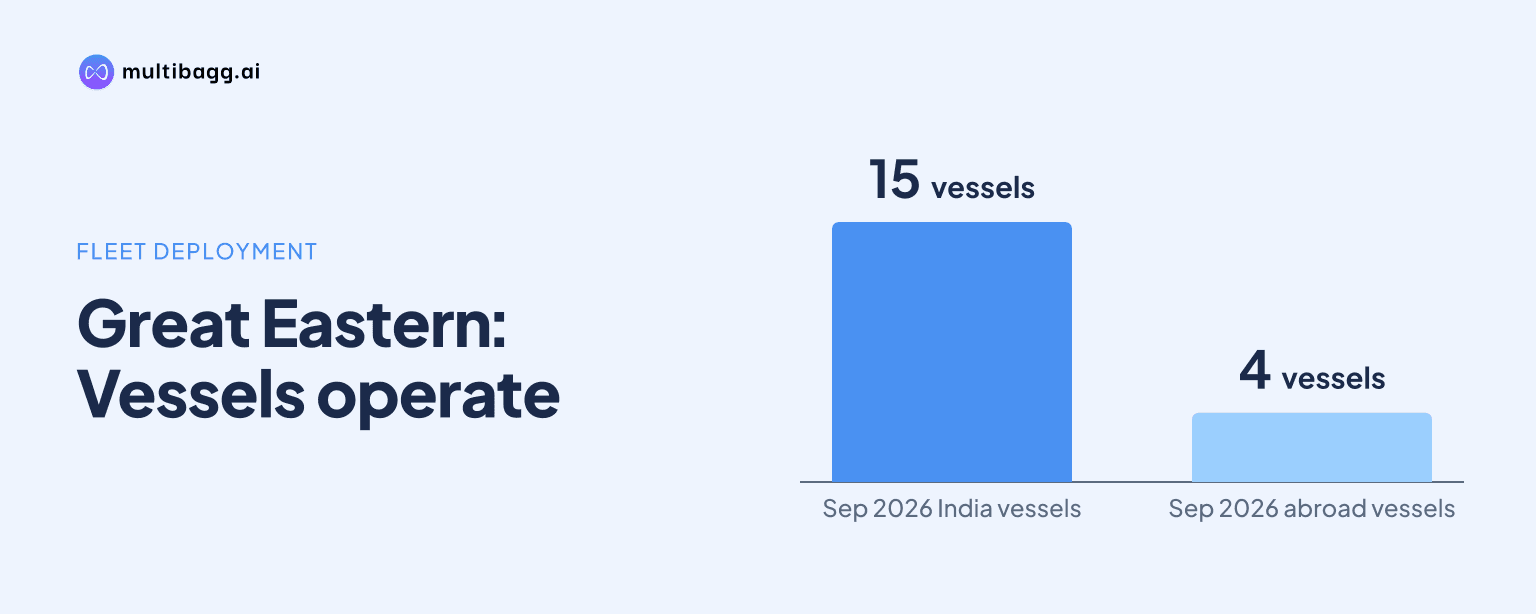
The Great Eastern Shipping Company Limited said 15 of its 19 offshore vessels were operating in India and four were outside the country during its earnings call for the quarter ended September 30, 2026. The deployment update provides a direct view of the company’s offshore operating footprint, although the supplied call extract does not provide quarterly revenue or a revenue beat figure.
Know Great Eastern Shipping Company inside out
Results, valuation, peers and who's buying, in one view.
What did Great Eastern Shipping disclose about vessel deployment?
Great Eastern Shipping disclosed that four boats were outside India, while the remaining 15 were in India. This indicates that 19 vessels were covered by the management comment on the call. The statement was made by Shivakumar, Executive Director and Chief Financial Officer, during the company’s results call for the September 2026 quarter.
The supplied transcript extract does not identify the vessel types, individual locations within India, customer names, contract tenures, or utilisation levels. It also does not state whether the four overseas vessels were working under contracts, between assignments, or positioned for new work. These details are therefore not available from the material provided.
The call moderator described the event as an earnings call held following the declaration of results for the quarter ended September 30, 2026. However, the supplied source material does not include the revenue, operating profit, net profit, dividend, fleet-value or balance-sheet figures for that quarter. As a result, a claim that the company reported a revenue beat cannot be verified from the transcript excerpt.
What was said about offshore contract rates?
Great Eastern Shipping’s CFO referred to market talk about a one-year contract in India at a rate of $100,000 a day. He characterised the information as a rumour, rather than a company-confirmed contract award or a forecast of Great Eastern Shipping’s own charter income.
The statement offers a limited indication of the rate environment being discussed in India’s offshore market. But it cannot be treated as realised revenue, contracted revenue, or guidance for the company. The extract does not say whether Great Eastern Shipping bid for, won, or participated in the reported contract.
For investors, the distinction is important because offshore vessel earnings depend on several factors beyond a headline daily rate. These include vessel specifications, contract duration, downtime, mobilisation terms, operating expenses and the number of vessels that are actually employed. None of these operating details were disclosed in the supplied segment of the call.
Got a follow-up? Ask IRIS
How does the September 2026 call compare with earlier disclosures?
Earlier call records in the supplied material show that Great Eastern Shipping had reported consolidated net profit of INR 581 crore for Q2 FY26, in a call held on November 10, 2025. The accompanying summary stated that the company sold two tankers, acquired a bulk carrier and declared an interim dividend.
For Q3 FY26, management reported consolidated net profit of INR 813 crore and standalone net profit of INR 650 crore in its January 30, 2026 earnings call. These figures establish that the company had remained profitable in the prior financial year, but they should not be used to infer September 2026-quarter earnings because the current extract contains no comparable financial results.
The provided historical material also notes consolidated net profit of INR 594 crore in Q3 FY25 and a third interim dividend, marking 12 consecutive quarters of quarterly dividends at that time. Separately, Great Eastern Shipping said it recorded its highest reported consolidated net profit of INR 2,614 crore in the year-ended March 2024. Those records provide context on the company’s past financial performance, not a measure of the quarter under discussion.
Why does the domestic fleet presence matter to investors?
Great Eastern Shipping’s disclosure that 15 vessels were in India is relevant because it shows that most of the fleet addressed in the comment was deployed in its home market. A domestic operating base can influence vessel scheduling, client servicing and exposure to Indian offshore activity, although the transcript does not specify the commercial contribution of these vessels.
The four vessels outside India show that the company also maintained an international operating presence. Yet the available material does not disclose whether overseas work generated higher or lower charter rates than domestic activity. It also does not give the revenue split between Indian and overseas assignments.
The reported $100,000-a-day market rumour may draw investor attention to offshore rate conditions, but management did not present it as an executed company contract. The more meaningful evidence in the supplied record is the actual fleet-location disclosure: 15 vessels in India and four abroad. Investors seeking to assess earnings impact would need confirmed results, vessel utilisation data, contract coverage and fleet-specific rate information.
Conclusion
Great Eastern Shipping’s September 2026-quarter call extract provides a clear operational data point: 15 vessels were in India and four were outside the country. It also records management’s reference to an unconfirmed one-year Indian contract rumoured at $100,000 a day, but contains no basis for describing that market talk as company revenue or a revenue beat.
The company said the recording and transcript would be posted shortly. The next material items to watch are the complete results presentation and transcript, particularly any disclosed revenue, consolidated profit, vessel utilisation, contract details, fleet changes and management commentary on offshore market conditions.