










Great Eastern Shipping says Hormuz shuttles cut capacity 20%
Key highlights
- Great Eastern Shipping said Hormuz shuttle transfers added eight to nine days to a normal 45-46-day VLCC voyage.
- Great Eastern Shipping said the extra voyage time reduced tanker efficiency by 18% to 20%.
- Great Eastern Shipping said Suezmax spot rates fell to USD130,000-USD150,000 a day from a USD350,000-USD400,000 peak excluding high-risk premiums.
- Great Eastern Shipping said only 7.5% of the 28% crude-tanker order book is due by the end of 2027.
powered by IRIS
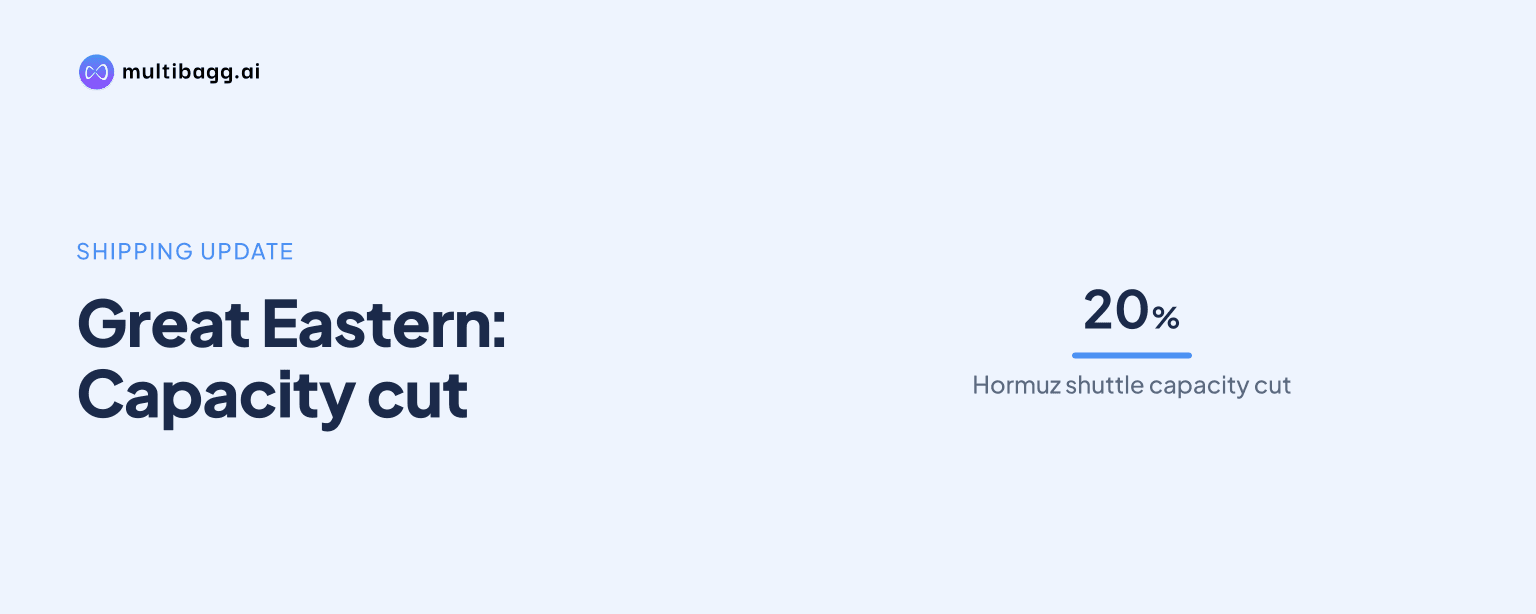
The Great Eastern Shipping Company Limited said on November 11, 2026, that Strait of Hormuz shuttle transfers added eight to nine days to a normal 45-46-day very large crude carrier voyage, reducing effective tanker capacity by 18% to 20% and contributing to exceptional freight rates during August, September and early October.
Know Great Eastern Shipping Company inside out
Results, valuation, peers and who's buying, in one view.
Why did Strait of Hormuz shuttle trade raise tanker rates?
Great Eastern Shipping said the shuttle process raised rates by making each crude cargo movement take longer and reducing the effective availability of ships. A vessel loaded oil inside the Strait of Hormuz, sailed outside it and discharged into another vessel, which then carried the cargo to its final destination. That process required two loading and two discharge operations rather than one of each.
Great Eastern Shipping said a normal Middle East-to-Far East voyage on a very large crude carrier, or VLCC, takes about 45 to 46 days. The shuttle arrangement added an average eight to nine days, equating to an 18% to 20% reduction in efficiency. Management said this operational loss tightened the tanker market through early October, helping push up freight rates without a corresponding increase in cargo demand.
How far have crude-tanker freight rates fallen?
Great Eastern Shipping said Suezmax spot earnings had declined to about USD130,000-USD150,000 a day by the November 11 call, after reaching about USD350,000-USD400,000 a day in late September or early October. Management attributed the sharp decline over the preceding 10 to 12 days to renewed vessel traffic through the Strait of Hormuz.
The company said headline Suezmax earnings of USD600,000-USD700,000 a day included substantial risk premiums on routes it does not serve. Those routes included loading inside the Strait of Hormuz and at Novorossiysk in the Black Sea, where management cited attacks on vessels. Excluding those premiums, management estimated the market peak at USD350,000-USD400,000 a day.
Great Eastern Shipping said product tankers had not experienced the same correction as crude carriers. Medium-range, or MR, product tanker spot rates were about USD50,000-USD60,000 a day at the call, compared with Suezmax spot rates of USD130,000-USD150,000 a day. Management linked product-tanker resilience to diesel shortages and higher diesel crack spreads.
What did the rate move mean for Great Eastern Shipping's earnings?
Great Eastern Shipping said freight-market gains flow into reported earnings with a 45-to-60-day voyage lag. Rates fixed in September are recognised while a voyage is performed, so management said a significant part of the September freight spike should be reflected in the October-to-December quarter rather than in the quarter ended September 30, 2026.
The company’s average time-charter equivalent, or TCY, for crude carriers fell to about USD73,000 a day in the second quarter from about USD93,000 a day in the first quarter. Aframax TCY declined from nearly USD85,000 to about USD50,000 a day, while product-tanker TCY fell from USD45,000 to USD32,000 a day. Great Eastern Shipping said the decline in crude and product tanker yields drove the quarter-on-quarter reduction in shipping profitability.
Great Eastern Shipping said about 60% of operating days for crude, product and dry-bulk vessels were covered for the December quarter when it presented its slides, and that booked tanker rates were significantly higher than the previous quarter’s averages. Management did not disclose the precise TCY for that coverage. It also fixed two of the four Suezmax vessels it operates, one owned and one chartered in, on one-year charters beginning in August and September.
Got a follow-up? Ask IRIS
Why did Great Eastern Shipping not lock in more peak rates?
Great Eastern Shipping said longer-term charter offers were far below spot rates during the spike. When Suezmax spot rates were about USD300,000 a day, management said a two-year charter could secure only about USD60,000-USD70,000 a day. That was a 60% to 70% discount to spot, rather than the 20% to 25% discount suggested by an investor.
Management also said older vessels can be difficult to fix on time charter without substantial price concessions. It cited MR tankers aged 18 or 19 years as an example and said the company could not broadly lock in its average crude-carrier TCY of about USD75,000 a day. The company said its Suezmax chartering decisions reflected available rates rather than an ability to preserve wartime spot earnings for two years.
Great Eastern Shipping said it does not participate in the two high-risk routes that inflated headline Suezmax rates, citing crew safety rather than insurance. Management also said it has avoided Russian trade since February 2022, despite some cargoes being legal at particular price levels. This means its realised freight exposure differs from market indices containing high-risk voyage premiums.
What could happen if Strait of Hormuz traffic normalises?
Great Eastern Shipping said a cessation of hostilities would immediately remove shuttle-related inefficiencies and return the market closer to conditions before the disruption. Management said Suezmax vessels earned about USD70,000-USD80,000 a day in early February 2026, before the conflict, compared with USD130,000-USD150,000 a day at the November 11 call after the recent correction.
Management said countries had drawn on oil inventories while Strait of Hormuz flows were disrupted for at least three months. Replenishing those inventories could create further demand for Middle East crude-tanker voyages after normal traffic resumes. That outcome is management’s assessment, not a forecast of the scale or duration of inventory rebuilding.
Great Eastern Shipping said the terms of any US-Iran agreement would also matter. If Iran were removed from sanctions, Iranian oil could enter the mainstream tanker market and be carried by vessels such as Great Eastern Shipping’s. Management said some sanctioned vessels are about 25 years old and could face scrapping if their dedicated trade contracts and they cannot return to regular international operations.
Is the crude-tanker order book an immediate risk to rates?
Great Eastern Shipping put the crude-tanker order book at 28% of the existing fleet, but said it was weighted to later delivery years. Management said only 7.5% of that order book was scheduled to arrive between the November 2026 call and the end of 2027, with most deliveries due in 2028, 2029 and increasingly 2030.
Management therefore identified supply-chain normalisation as a more immediate variable than newbuilding deliveries. It said more than 20% of the crude-tanker fleet had previously been older than 20 years, an age at which vessels would normally leave international trading in a weaker market. The pace of removals remains uncertain because it depends on freight rates and whether older sanctioned vessels can continue trading.
Conclusion
Great Eastern Shipping’s explanation indicates that the exceptional tanker market reflected a temporary reduction in usable vessel capacity as much as cargo demand. The added eight to nine days on a 45-46-day VLCC voyage cut efficiency by up to 20%, while the resumption of Hormuz traffic coincided with Suezmax spot rates falling from a USD350,000-USD400,000 peak to USD130,000-USD150,000 a day.
Next, investors can watch whether Hormuz operations fully normalise, whether oil-importing countries rebuild inventories and whether any US-Iran agreement changes sanctions access for Iranian cargoes. Great Eastern Shipping has also committed to a newbuilding Suezmax due in a little over two years and said four vessels had been bid into Indian tenders, with awards still pending.