










Hindustan Zinc targets sub-$1,000 costs as volumes grow
Key highlights
- Hindustan Zinc guides for COP below $1,000 per tonne as mining capacity rises from 18 million tonnes to 35 million tonnes.
- Fixed costs account for 35% of Hindustan Zinc’s total cost, according to management.
- The Rs 80,000 crore programme is broadly split 45% for mining and 55% for smelting.
- Silver capacity is planned at 1,500 tonnes a year, supported by slag-recovery fumers.
powered by IRIS
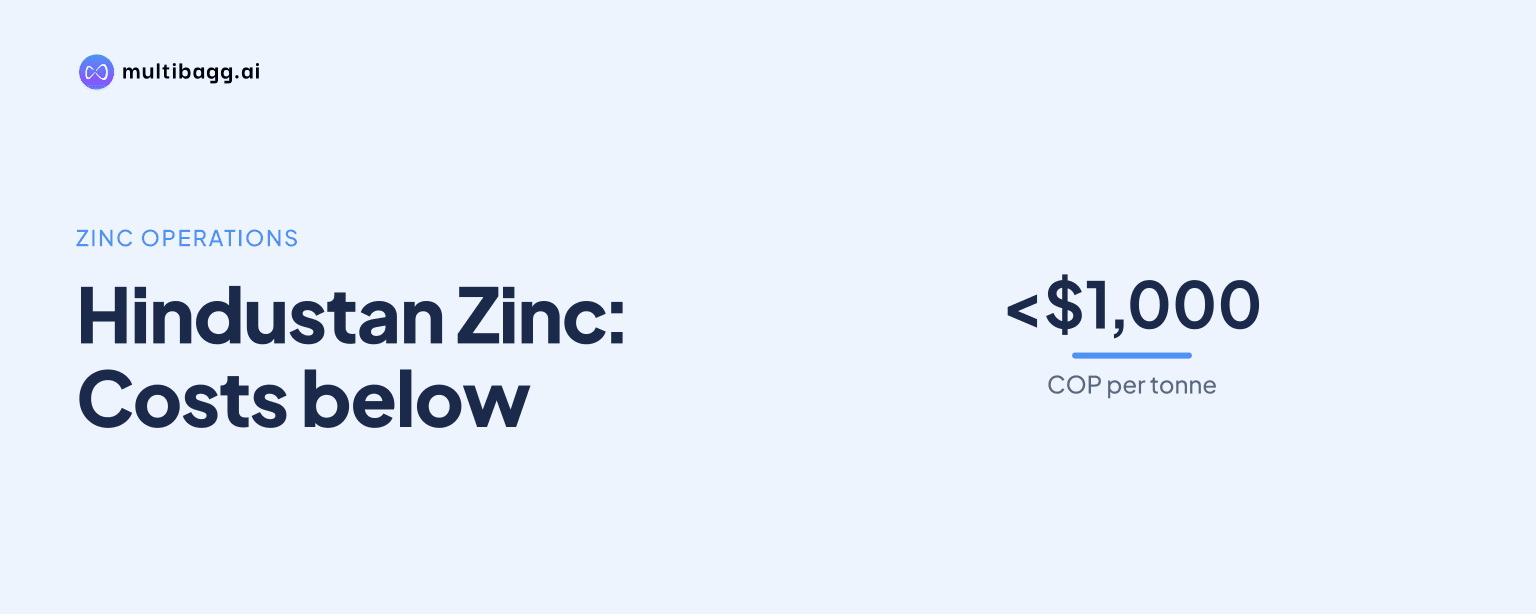
Hindustan Zinc Limited expects to maintain cost of production below $1,000 per tonne while increasing mining capacity from 18 million tonnes to 35 million tonnes, because management expects higher volumes to absorb fixed costs despite deeper mines and lower ore grades. The plan also uses slag-recovery equipment to support 1,500 tonnes of annual silver capacity.
Know Hindustan Zinc inside out
Results, valuation, peers and who's buying, in one view.
How will Hindustan Zinc keep costs below $1,000 per tonne?
Hindustan Zinc’s cost-of-production, or COP, guidance remains below $1,000 per tonne after the proposed expansion from 18 million tonnes to 35 million tonnes of mining capacity. Management acknowledged that deeper mining will increase costs, but said scale savings and fixed-cost optimisation at the same locations should offset that pressure.
The company’s case rests on expanding output without a matching increase in manpower and other fixed costs. Management said fixed costs currently represent 35% of total cost and used a hypothetical example in which no fixed costs rose: spreading that base over the higher volume would result in savings of about 15% to 17%.
The 15% to 17% illustration was not a forecast that fixed costs will stay unchanged. Rather, management used it to explain how operating leverage could compensate for the cost effects of lower ore grades and some additional mine depth while retaining COP in the current below-$1,000-per-tonne range.
What does lower ore grade mean for Hindustan Zinc’s costs?
Hindustan Zinc expects some grade dilution as Rampura Agucha becomes a smaller share of total production and RD and Zawar provide most of the new capacity. Management said the forward mining-grade assumption is about 7%, implying consumption of about 14 to 14.5 tonnes of ore for one tonne of refined metal.
An analyst compared this assumption with FY26 levels of roughly 14 to 15 tonnes of ore per tonne of mined metal and suggested that the future requirement could reach 19 to 21 tonnes. Management did not adopt that range, instead citing its 7% grade assumption and the 14-to-14.5-tonne requirement for refined metal.
Mine geometry is another cost consideration. Management said some locations will need deeper development, while most expansions are expected to move wider into additional ore lenses. It cited about 1,300 metres relative level as a worst-case depth observed across the mines, without allocating a mine-specific cost to that depth.
Rampura Agucha, Dariba and the Zawar group are due for lease renewals in 2030. Management said mining plans are submitted for five-year periods and it sees no conflict between expansion approvals and renewal or rebidding, since mines are intended to be transferred as operating assets.
Got a follow-up? Ask IRIS
How much capital spending supports Hindustan Zinc’s scale strategy?
Hindustan Zinc’s Rs 80,000 crore investment programme covers the move from 18 million tonnes to 35 million tonnes of mine operations, two shafts, associated smelting capacity, power, water, land and other project requirements. Management broadly allocated 45% of the programme to mining and 55% to smelting.
The smelting element includes zinc smelting, a 200,000-tonne-a-year lead smelter and a silver refinery designed for 1,500 tonnes a year. Management said the Rs 80,000 crore estimate was based on the project’s conceptual design and includes amounts approved earlier.
Earlier approvals totalled about Rs 14,000 crore, consisting of Rs 12,000 crore for the original project and Rs 2,000 crore for exploration and other facilities. Management therefore put the additional approval implied by the revised programme at about Rs 65,000 crore to Rs 66,000 crore, with around Rs 30,000 crore of that increase directed to the enlarged mining operation.
Management has not issued a year-by-year schedule beyond FY27 guidance. It said guidance for the following year would be provided with fourth-quarter results, after work progresses through basic and detailed engineering. The timing of spending and commissioning therefore remains an unresolved part of the cost-absorption plan.
How will Hindustan Zinc support silver recovery as mine mix changes?
Hindustan Zinc expects limited silver dilution even as RD and SK become major additions to capacity, according to management. It said silver output depends on both the silver contained in ore, measured in parts per million, and the amount recovered from slag and other by-products after processing.
The project includes fumers across refinery operations to recycle slag and by-products for silver recovery. Management presented this recovery route as one contributor to the planned 1,500-tonne annual silver capacity, alongside silver mined from the expanded resource base.
Management said existing fumer circuits had not reached 100% capacity because of certain design features. It said the units had been debottlenecked over the past year and that developments in the latest two to three months increased its confidence in the technology and operating regime.
Hindustan Zinc now expects both the existing and new fumers to operate at capacity, although it gave no recovery percentage or separate silver-output target for the equipment. That means the eventual contribution of slag recovery to the 1,500-tonne capacity plan remains dependent on operational delivery rather than a disclosed quantified recovery rate.
Conclusion
Hindustan Zinc’s below-$1,000-per-tonne COP target depends on a larger production base absorbing a substantial fixed-cost component, rather than on deeper and lower-grade mining having no cost impact. The planned increase from 18 million tonnes to 35 million tonnes is paired with smelting investment and fumer-based recycling intended to increase recovered silver from processed material.
The next disclosures to watch are the annual capital-spending schedule after basic and detailed engineering, including the guidance management said it would provide with fourth-quarter results. Progress towards capacity operation at the fumers and the 2030 renewals for Rampura Agucha, Dariba and the Zawar group will also affect the expansion pathway.