










HZL says Rs 80,000 crore plan adds up to Rs 66,000 crore
Key highlights
- HZL's Rs 80,000 crore programme adds Rs 65,000-66,000 crore to earlier approvals of about Rs 14,000 crore.
- HZL plans to raise mine throughput from 18 million tonnes to 35 million tonnes, including two new shafts.
- Management allocated about 45% of the Rs 80,000 crore plan to mining and 55% to smelting.
- The plan targets 2 million tonnes per annum of refined metal capacity and 1,500 tonnes per annum of silver refining capacity.
powered by IRIS
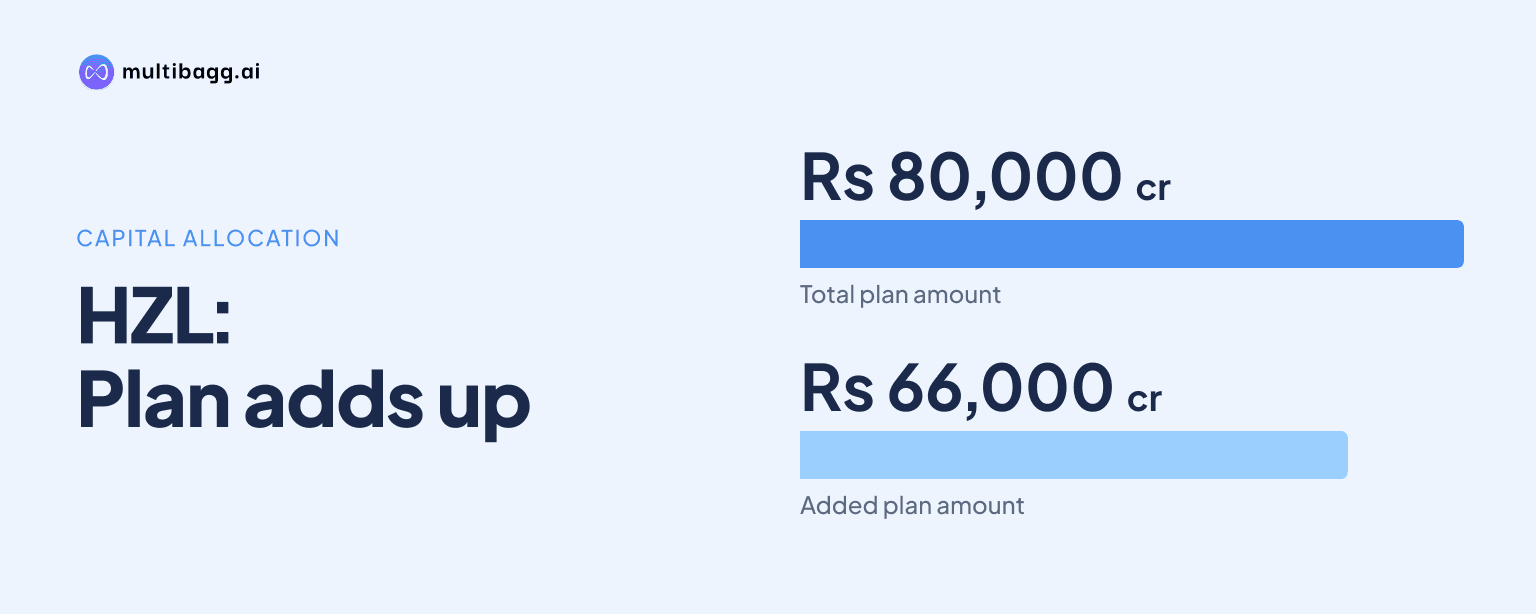
Hindustan Zinc Limited said on November 16, 2026 that its Rs 80,000 crore integrated expansion plan requires Rs 65,000-66,000 crore of additional approvals because mining throughput must increase from 18 million tonnes to 35 million tonnes, requiring two shafts, related infrastructure and expanded zinc, lead and silver facilities. HZL targets 2 million tonnes per annum of refined metal capacity.
Know Hindustan Zinc inside out
Results, valuation, peers and who's buying, in one view.
Why did HZL's expansion cost rise to Rs 80,000 crore?
HZL said the Rs 80,000 crore outlay covers a wider integrated project than earlier approvals, chiefly because mine operations must expand from 18 million tonnes to 35 million tonnes of throughput. Chief Financial Officer Amit Gupta said the revised conceptual design includes two shafts not anticipated originally, plus power, water, land and other mine-development requirements.
The earlier approval was Rs 12,000 crore for the zinc smelter, while Board approvals for exploration and other facilities added Rs 2,000 crore. The earlier total was therefore about Rs 14,000 crore, making the Rs 65,000-66,000 crore amount an additional approval within the Rs 80,000 crore integrated plan.
The original phase did not cover the full lead and silver additions now proposed. HZL plans a 200,000-tonnes-per-annum lead smelter and intends to lift silver refining capacity from 800 tonnes per annum to 1,500 tonnes per annum, while the revised scope also requires matching mining and concentration capacity.
How will HZL allocate the Rs 80,000 crore capex?
HZL said roughly 45% of the Rs 80,000 crore programme will be allocated to mining and 55% to smelting. That proportion equates to about Rs 36,000 crore for mining and Rs 44,000 crore for smelting, while Chief Executive Officer Amarendu Prakash separately said nearly Rs 30,000 crore of the roughly Rs 66,000 crore additional approval relates to mine expansion.
Management divided the project into three buckets: increased mine capacity, corresponding smelting capacity near mine locations, and zinc, lead and silver smelting and refining facilities. Gupta did not provide a detailed split for captive power or smelting technologies, saying HZL would give a fuller breakdown after basic and detailed engineering.
The programme includes a 765,000-tonnes-per-annum zinc smelter, a 200,000-tonnes-per-annum lead smelter and 700 tonnes per annum of additional silver refining capacity. These projects would take integrated zinc capacity to 1.6 million tonnes per annum, integrated lead capacity to 0.4 million tonnes per annum and total refined metal capacity from 1.1 million tonnes per annum to 2 million tonnes per annum.
HZL said it had previously planned to meet an additional 250,000-tonne mining requirement within the available mine layout. The move to 35 million tonnes requires a larger mine build-out, including shafts and auxiliary infrastructure; the company has land at existing sites and is privately acquiring land for certain auxiliary requirements.
When will HZL spend the expansion capex?
HZL expects to commission the integrated project in three to five years and to phase the Rs 80,000 crore spending over almost five years. Prakash said that, broadly, 60% of construction-project capital expenditure is incurred during construction, with the remaining spend extending over the following two years.
HZL has not provided an annual capex schedule beyond existing FY27 guidance. Gupta said guidance for the next year would come with fourth-quarter results, while the company completes basic and detailed engineering; the stated three-to-five-year horizon is therefore not a committed year-by-year spending plan.
HZL said it can fund the Rs 80,000 crore programme through debt, internal accruals or a combination of both. Management said it would assess market interest rates and available free cash flow before deciding the funding mix, and did not disclose a debt amount, leverage target or internal-accrual allocation.
Management said the brownfield programme across existing locations is designed to keep zinc cost of production, excluding royalty, below $1,000 per tonne after expansion. HZL attributed that expectation to economies of scale, digitalisation and automation, rather than presenting it as a guaranteed project outcome.
Got a follow-up? Ask IRIS
What approvals and lease matters could affect HZL's plan?
HZL requires environmental clearance, Consent to Establish and Consent to Operate for its projects, and said these approvals are in process. The 35-million-tonne mine-capacity plan also requires fresh mine plans and environmental clearance, with management saying some approval work started during conceptual planning.
The 2030 renewal cycle covers Rampura Agucha, Dariba and the Zawar group of mines. HZL said about 35% of its mining assets continue beyond 2030, leaving roughly two-thirds facing lease renewals that year; management said it has a legal first right of refusal and is confident of continuing the integrated operations.
Management said mine plans are submitted for five years and that operating mines are meant to be transferred as running mines in a renewal or re-auction process. HZL also said its project model assumes continuing operations and uses conservative assumptions for costs and London Metal Exchange prices, but did not disclose those price assumptions.
Gupta said the conceptual project model indicates returns in the mid-teens under management's conservative assumptions. HZL acknowledged that deeper mining can increase costs, while Prakash said fixed costs currently account for 35% of total costs and used a hypothetical zero rise in fixed costs to illustrate 15%-17% savings from higher volumes.
How will HZL address ore grades and silver recovery?
HZL said the expanded plan assumes an average mining grade of about 7%, requiring approximately 14 to 14.5 tonnes of ore for one tonne of refined metal. Management said Rampura Agucha will represent a smaller share of output, while Rajpura Dariba and Zawar will contribute much of the new capacity, resulting in some grade dilution.
HZL said the capacity increase should spread fixed costs over larger volumes, partly offsetting deeper or lower-grade ore. Management cited about 1,300 metres relative level as a worst-case mine depth, while saying some expansions require going deeper and most involve widening horizontally into additional mineral lenses.
For silver, HZL said Rajpura Dariba and Sindesar Khurd are major sources of incremental capacity. The plan adds fumer circuits to refinery operations to recover silver from slag and by-products; management said existing fumers had faced design constraints but had been debottlenecked over the past year, with improved performance in the latest two to three months.
Conclusion
HZL has linked the rise from roughly Rs 14,000 crore of earlier approvals to a Rs 80,000 crore integrated programme mainly to the mine-throughput increase from 18 million tonnes to 35 million tonnes. The revised scope combines mine development, two shafts, power and water infrastructure with 765,000 tonnes per annum of zinc smelting, 200,000 tonnes per annum of lead smelting and higher silver refining capacity.
The next disclosures to watch are the annual capex plan expected with fourth-quarter results and the cost split expected after basic and detailed engineering. Progress on environmental, Consent to Establish and Consent to Operate approvals, alongside the 2030 lease-renewal process for Rampura Agucha, Dariba and Zawar, remains material to management's assumption of continuing mining operations.